


The other day at church, a fellow parishioner asked me, “Lars, my friend just bought a house, but the property taxes are really high, and the assessed value is higher than what they just paid for the house. How could the assessor1 have made such a mistake?”
“Simple,” I replied. “The appraisal district has no idea what your friend paid. There’s about a dozen ‘real estate non-disclosure’ states in the US, and Texas is one of the six strictest. In Texas neither the appraisal district nor the public knows what any given house last sold for unless someone volunteers that information.”
My friend was dumbfounded. “So the assessors just don’t know? Do they just guess? How do they even do their job?”
I nodded. “They do the best job they can, but they’re doing it blindfolded. They probably have some sales from that neighborhood that were voluntarily disclosed. However, I bet in your friend’s case the sales were older, and might not reflect recent trends, namely that the housing market over there has recently cooled off a bit.”
“I see,” he said. “So they’re still anchored by those old higher sales. How can my friend protest, since property tax protest season is already over this year?”
“They don’t have to wait,” I said. “Whenever a home sells, the central appraisal district (CAD) sends the new owner a voluntary sales disclosure form. Most people throw it away, thinking the CAD is their enemy and that hiding information from them will lower their taxes. But that’s the exact opposite of what you should do, especially when prices are coming down. Your friend should make sure to fill out that form and send it in. And next year, if their valuation doesn’t come down, go on the local appraisal district’s website and schedule an informal hearing. Go to that meeting, and bring two things: the sale records for their new home, and printouts of three or four nearby comparable sales records—if you can find them, given they’re not public. The CAD will probably even thank them for it.”
The Secret Tax
The costs imposed by real estate non-disclosure amount to a perverse and unintended “secret tax.” The chief beneficiaries are millionaires, large commercial properties, and private data brokers. The chief losers are everybody else, including middle class homeowners.
Real estate non-disclosure selectively makes high end luxury homes and downtown commercial properties especially difficult to value, because there are fewer properties to compare them to. By contrast, single family residential homes are both homogeneous and abundant. Even if you don’t voluntarily disclose your home’s sale price, somebody else in your neighborhood probably will. This means that for a typical house, the assessor will eventually get close to its true value over time. By contrast, super valuable properties tend to get valued at a fraction of their true, unknown value.
Here’s just such an example from a report by Nathan Morey in St. Mary’s Law Journal:
In 2008, the City of Dallas negotiated for the purchase of an 8.34-acre tract of downtown real estate, which at the time was being used as a parking lot. The city agreed to a purchase price of $42 million; however, that same property was valued at only $7.3 million by the Dallas Central Appraisal District for tax purposes.
The author notes that after the sale price became public, Dallas CAD re-valued the lot at $36.5 million, which “would not have taken place had the above transaction been between two private parties.”
But so what? Who cares if some rich guys are getting a tax break on their property valuations? How could that possibly affect you?
The most important thing to understand about property taxes is that under-valuations don’t reduce the budget, which is shared across the entire property tax base no matter what. If one party gets a reduced valuation, the lost tax revenue mechanically comes out of somebody else’s pocket, just like squeezing on one part of a balloon causes it to bulge out the other side.

How big a deal is this? A 2015 study asserted that 85% of commercial sales were hidden from Travis CAD, suggesting an undervaluation of as much as 47%2. In 2018, Michael Amezquita, chief appraiser of Bexar CAD, testified before the Texas School Finance Commission that top-end commercial properties routinely end up on the tax roll at half of their selling price, thanks not only to non-disclosure but also to Texas’s ‘equity appeal’ loophole, which allows owners to appeal their taxes without offering any sales evidence at all:
This oftentimes leads to the best commercial property in a particular category being placed on the appraisal roll for 50% or less of its sale price…This has increased our litigation load and subsequent legal costs significantly over the past several years as well.
It’s especially strange to find a supposedly free-market state like Texas hiding price information at the same time state leaders are trying to pass housing affordability bills. The magic sauce that makes competitive capitalism so unreasonably effective, as famously described in Leonard Read’s essay “I, Pencil”, not to mention Milton Friedman’s short film, is price signals. Obscuring prices leads to less efficient markets and more expensive housing.
Non-disclosure makes protests harder
Not only does real estate non disclosure push more of the tax burden onto middle class Texans, it also makes it harder for them to protest their property taxes. To understand why, let me first explain how the property tax protest system works.
Every year your local CAD (Central Appraisal District) will send you a notice of value. This is not a bill, because the appraisal district doesn’t set the tax rate, just your valuation3. If you think your valuation is too high, you can file a protest.
Usually this starts with an informal hearing, and if you bring sufficient evidence that shows the market value of your home is lower than what the appraiser set, you have a good shot at getting your value lowered.
How to protest your property taxes
The gold standard of evidence is a “comp grid”, where “comp” means comparable sale. Those are nearby, physically similar properties (same style, same age, same size, same bedroom/bathroom count, etc.) that have recently sold. Here’s a simple example4:
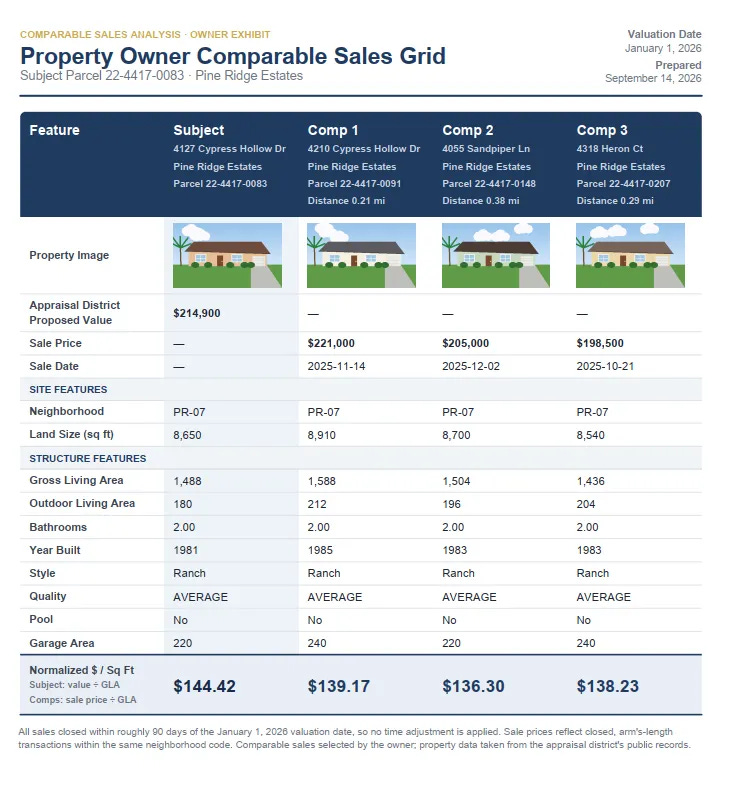
Find three to five sales of very similar properties, note each of their characteristics, especially the sale price, sale date, and size of the buildings and land. Then, divide the sale price by the building size to get the price per square foot. Do this for your house as well, dividing the assessor’s proposed value by the building’s size. Show those figures lined up along the bottom row.
Your evidence is strong if you can show two things: 1) that the properties are truly similar and 2) that your valuation per square foot is significantly higher than the sale price per square foot of the comparable properties. In this (made up) example, the assessor’s value is just shy of $7 per square foot higher than the rate the comparable sales support.
If you can prove the comps are genuinely similar, and that the appraised full market value is higher than the average value supported by the comps, that’s essentially the whole game. This is the same fundamental approach the CAD will use to defend its valuations, by the way.
The problem is that this whole system only works if people can actually see the sale prices. No problem, can’t I just go on Zillow or Redfin and look up sale prices? Nope, not in Texas, all you’ll see are listings, which aren’t the same as what the property actually sold for; they don’t include information about closing costs, concessions, or the terms of sale, which are crucial for sales validation. More importantly, they don’t legally have the same evidentiary weight as an actual confirmed sale.
Ironically, property tax protests are one of the key ways that CADs get price information, besides just asking nicely. Think about how crazy this is and how much taxpayer time and money it wastes—instead of just giving the CADs the sale prices they need to do their jobs, we withhold them, wait for them to make a mistake, then throw the sale prices back in their face, when we could have just shared them in the first place.
This increases the cost of property tax administration, eats up the appraisal district’s valuable time and attention, and makes everybody upset, all for no good reason. Both the CAD and the appellant would prefer to sort out all such obvious reductions before protest season comes around. Meanwhile, the next parking lot that sells privately for tens of millions, appraised for a fraction of that, isn’t saying a thing.
Where on earth does this nonsensical policy come from?
The Non-Defenses of Non-Disclosure
The chief defenders of real estate non-disclosure are the Texas Realtors, who offer four arguments in support of the policy:
Protecting people’s privacy
Preventing a real estate transfer tax
There’s no valuation problem
True sales data will confuse CADs
These arguments are wrong. Real estate non-disclosure does not protect privacy, any proposed real estate transfer tax would be a constitutional dead letter, and there is abundant evidence of a valuation problem. The final assertion that more sales data will lead to less accurate valuations is not only nonsensical, it is in direct conflict with the professional standards of appraisal the law upholds.
1. Non-Disclosure Does Not Protect Privacy
Real estate non-disclosure does not protect your privacy. For one, it does not hide the fact that you purchased a property, just what you paid for it. Anyone who wants to know where you live, at what address you receive mail, what property you own, when you bought it and from whom, can easily look that up on a multitude of public information websites. For instance, my homeowner’s association uses the local CAD records to confirm membership in the neighborhood, which unlocks access to amenities like the community pool. All real estate non-disclosure does is hide the price from taxpayers and the appraisal district.
However, anyone with a little money to spend and a financial interest in knowing what you paid for your house doesn’t have to work super hard to figure it out. Let’s start by counting the number of distinct parties who have eyes on any given real estate transaction:
The buyer
The seller
The buyer’s agent
The seller’s agent
The buyer’s lender
The bank’s fee appraiser
The settlement/escrow/closing company
The title insurance company
As the saying goes, “three can keep a secret if two are dead,” and I’m counting eight here, without even considering lawyers, home owner/condo associations, private mortgage insurers, loan purchasers/aggregators, mortgage brokers, and so on.
But at least we hid the price from the big, bad, government, right? Well, which “the government” are we talking about? Just because your local appraisal district is in the dark doesn’t mean the IRS is, because the selling price of your home is part of the seller’s taxable income, disclosed on Form 1099-S.
Given so many pairs of eyes on your transaction, of course at least one of them will sell it on to a data brokers, who will happily sell it to just about anyone else.
Additionally, the Realtors know what you paid, which is published for all other Realtors in the state to see. Every Texas listing broker is required to share price information with their local Multiple Listing Service, or MLS, a proprietary database only agents have access to. Regular people can access MLS only through a Realtor.
To be clear, I’m not trying to bash Realtors here. I think the organization thinks they’re protecting taxpayers, but are misguided and don’t realize the unintended consequences. I should also mention they aren’t a uniform bloc, it’s not hard to find affiliated voices who question non disclosure. Here’s one from realtor.com!
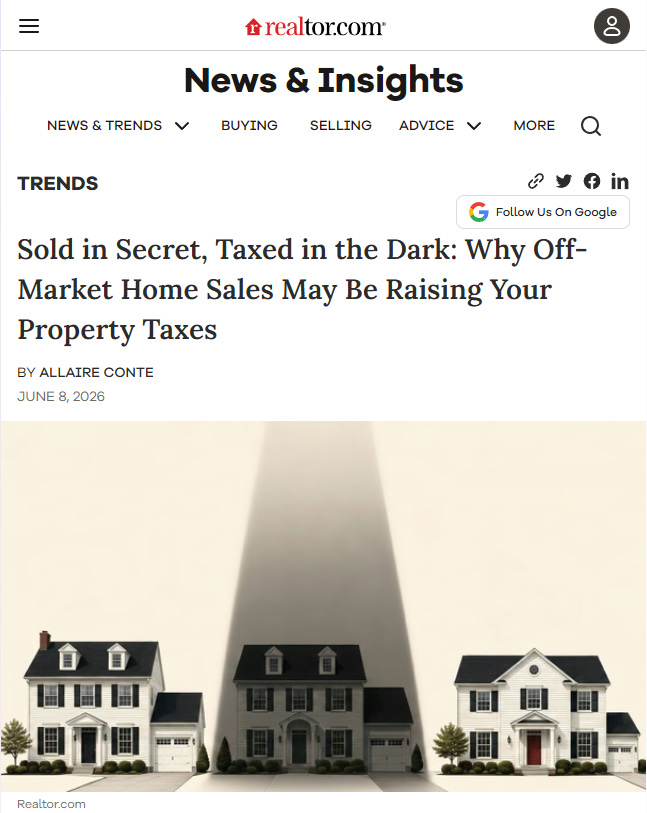
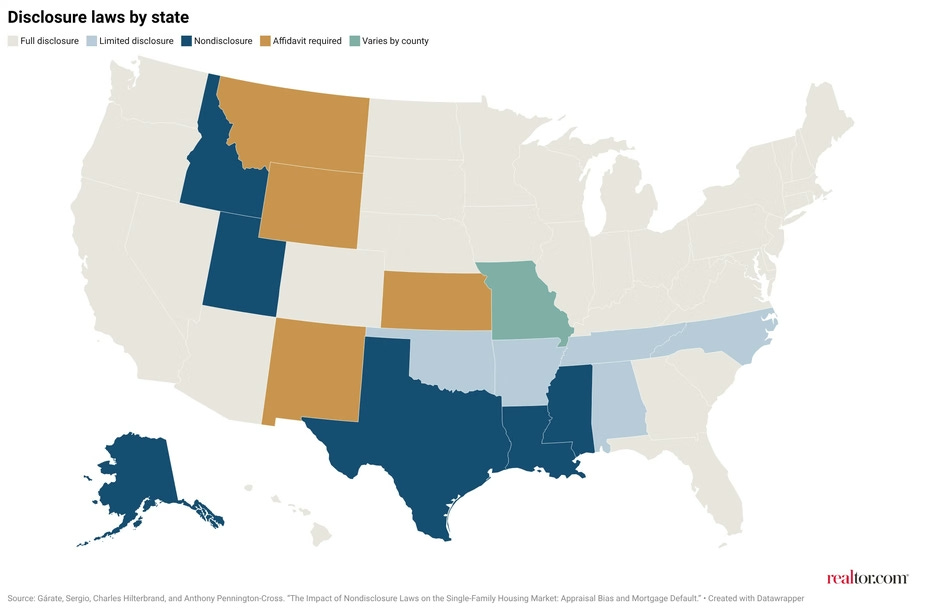
The article includes a chart which shows that Texas’s particularly strong version of real estate non-disclosure is a genuine outlier, a policy shared with only a handful of other states. The fact that Realtors have been humming along elsewhere without the policy shows that ending non-disclosure will not cause the sky to fall.
In the rare cases that CADs do wind up with MLS access, local Realtor associations often issue legal threats, as they did in 2019 when a third party vendor attempted to sell MLS data to Travis CAD. That said, Realtors will sometimes voluntarily sell MLS data to local governments, CADs included, but on an inconsistent basis and always on their terms, not the public’s.
Here’s more from the testimony of Michael Amezquita:
The Bexar Appraisal District has not had an agreement with the local Multiple Listing Service (MLS) for more than 10 years. I have polled many districts and determined there are several north Texas districts that do have access to MLS albeit may be through a licensed Realtor in their office. In many cases, the district is not a party to the contract with MLS or the local board of realtors. I also have discovered the following counties do not have access to MLS data - Travis, Williamson, Cameron, Atascosa, Bastrop, Mills, Hardeman, Mitchell, San Saba, McCulloch, Sutton, Schleicher, Shackelford, Presidio, or Brewster. Harris County doesn't have direct MLS access but they get their sales data from a third party vendor. There is a misconception that appraisal districts already have all of the sales that take place in the county and therefore sales disclosure is unnecessary.
Real estate non-disclosure does not protect your privacy. It just hides sale data from the appraisal district, who thereby becomes more prone to mistakes, and it hides sales data from you, the taxpayer. It does nothing for privacy and if anything simply turns your data into a monetizable asset.
2. Transfer Tax is not happening
Real estate transfer tax, known across the pond as “stamp duty,” is a sort of real estate sales tax, where one or both parties to the transaction must pay a tax equal to a percentage of the property’s value whenever it changes hands.
The Realtors are absolutely right in hating real estate transfer tax—it’s really bad, and nearly every tax expert and economist agrees. They’re wrong, however, that non disclosure would lead to a real estate transfer tax.
That’s because real estate transfer tax is already prohibited by the Texas Constitution (Article VIII, section 29), which was amended by Proposition 1 in November 2015.
While non-disclosure can be removed by simply passing a normal law, instituting a transfer tax would require a constitutional amendment, which must pass both houses by a two-thirds majority, as well as win a public referendum.
3. There is a valuation problem
Critics allege that the comptroller’s property value study (PVS) routinely finds that CADs are assessing at about 99% of true market value, so we have nothing to worry about with regards to undervaluation. Per the position paper:
The Texas Comptroller of Public Accounts, in the most recent report on appraisal districts and appraisals, stated that all real property in Texas is being valued at 99% of market value. Based on this official report, it can hardly be determined that real property appraisals in Texas are inaccurate.
For context, the comptroller performs the PVS every two years to check on the performance of the individual CADs. Because the state is responsible for supplementing poorer school district funds, the comptroller’s office needs to ensure that CADs aren’t selectively undervaluing their districts so they can give their citizens an unfair tax break while mooching off the rest of the state. It’s a decent oversight system, but it has limits.
The property value study is a ratio study, which compares each CAD’s valuations to sale prices and independent appraisals that the comptroller gathers on its own (for more on ratio studies, see Mass Appraisal for the Masses). The problem is that the “99%” figure is a value-weighted aggregate summary statistic of the whole state, which hides dispersion. Linebarger, a law firm that represents school districts, found 220 districts with invalid findings in 2019 and 113 districts in 2024. In 2023, when the Comptroller first ran their Targeted Appraisal Review Program, no less than 30 CADs had at least one school district which had failed three years running.
I’m not trying to harp on the CADs here. How are they expected to do their jobs when we require them to appraise at full market value, test them against full market value, but then intentionally withhold the very data they need to do their jobs from them?
Finally, let’s just imagine that the PVS came back with a perfect score for every single CAD. That would still prove nothing because the comptroller is also affected by real estate non disclosure and has to beg, borrow, and steal sales data just like everybody else. A perfect PVS score could still hide significant undervaluation, and nobody would know except the high-end property owner enjoying a massive tax break at everybody else’s expense.
4. Sales data will confuse CADs
The Realtors’ position paper on sales price disclosure asserts:
There are numerous problems with basing value, especially taxable value, on the sales prices of a real property.
That’s one opinion. Meanwhile, here’s the law:
“Market value” means the price at which a property would transfer for cash or its equivalent under prevailing market conditions if: (A) exposed for sale in the open market with a reasonable time for the seller to find a purchaser; (B) both the seller and the purchaser know of all the uses and purposes to which the property is adapted and for which it is capable of being used and of the enforceable restrictions on its use; and (C) both the seller and purchaser seek to maximize their gains and neither is in a position to take advantage of the exigencies of the other.
— Texas State Code §1.04(7)
If the Realtors are arguing against the practice of “sales chasing,” as in setting the valuation to exactly whatever the observed sale price was, then I whole-heartedly agree that such practice is bad. The good news is that appraisal districts know this already, the IAAO (the international standards body for local government assessors) explicitly warns against it, and industry standards are designed to catch it. Sales chasing isn’t the issue, lack of sales is.
The position paper further elaborates all the complicated things that could happen if appraisal districts (and taxpayers) were allowed to actually look directly at sales:
Special considerations, such as seller concessions are not articulated in final sales prices, nor are the nuances of irregularly-shaped lots or custom-built homes.
Farm and ranch property transactions may include improvements like trade fixtures and livestock in the sales price.
Additional difficulties arise with commercial properties, which may include a business and/or trade fixtures, value of long-term leases, and properties where mineral rights are included or excluded from the sale.
Each of these circumstances can lead to artificially high tax-appraisal values in the purchase year and beyond.
All of these complications and considerations are taught in publications, standards, literature, and courses from sources like the IAAO, the Appraisal Institute, and USPAP. They’re also exactly the kind of complications and considerations that would be easier to account for with more data, not less. Also, the law already requires that CADs consider such things:
(a) If the chief appraiser uses the market data comparison method of appraisal to determine the market value of real property, the chief appraiser shall use comparable sales data and shall adjust the comparable sales to the subject property.
(b) A sale is not considered to be a comparable sale unless the sale occurred within 24 months of the date as of which the market value of the subject property is to be determined, except that a sale that did not occur during that period may be considered to be a comparable sale if enough comparable properties were not sold during that period to constitute a representative sample.
(c) A sale of a comparable property must be appropriately adjusted for any change in the market value of the comparable property during the period between the date of the sale of the comparable property and the date as of which the market value of the subject property is to be determined.
(d) Whether a property is comparable to the subject property shall be determined based on similarities with regard to location, square footage of the lot and improvements, property age, property condition, property access, amenities, views, income, operating expenses, occupancy, and the existence of easements, deed restrictions, or other legal burdens affecting marketability.
— Texas State Code §23.013
Non-Disclosure is a Non-Starter
The critics are not only wrong in their defense of non disclosure, they fail to account for the obvious harms it creates.
Non disclosure makes it harder for the average citizen to protest their property taxes.
Non disclosure does not protect privacy—countless parties already have access to and sell the information out the back door; the only people consistently in the dark are CADs and taxpayers.
Non disclosure is not the norm, most states don’t have it, and most that do have weaker forms than Texas does. Other states have rolled it back: Indiana repealed full non disclosure in 1993, New Mexico went from full non-disclosure to partial in 2004, and North Dakota repealed even partial non-disclosure in 2013. All the while, Realtors have long been operating successfully in the states that have full disclosure.
Non disclosure makes CADs more prone to making mistakes, which disproportionately benefit high-end luxury buildings and commercial properties, at the direct expense of regular taxpayers. It also raises costs and wastes time for local governments and taxpayers alike.
The non-disclosure “secret tax” costs the taxpayer money, time, and frustration, all to no end. It’s bad policy supported by bad arguments, and we’d be better off without it.
“Assessor” is the colloquial term regular people use, but any appraisal district employee will tell you they go by the term “appraiser” here in Texas.
Travis CAD disputed the report’s methodology but agreed that sales non-disclosure was harming their results.
Honestly, this is a pretty smart separation of powers—the CAD is simply a neutral fact-finding body with no power to tax, and the taxing entities, who have an interest in raising revenue—can only set the tax rate, they can’t touch the value of anyone’s homes.
This is about the level an appellant should be able to produce with Excel (or ChatGPT/Claude), provided they can get access to sale prices. The CAD office will likely respond with a more sophisticated version that additionally time-adjusts the sale price and individually prices every difference between any individual comp and the subject, so make sure your comparable properties are as close as possible to the subject. Don’t use a comp from the next neighborhood over, one which sold two years ago, or which has more bedrooms or bathrooms.
Can states like Texas give voucher or cash for helping to pay for there house? Or is that best left for the federal government?
The comps that the appraisal boards use are Calvinball. It's like doing a price comparison of a hammer, a saw, and a screwdriver.