

Land stands out as an economic asset because, among other reasons, it is necessary for production, obtains value from its surroundings, and is fixed in supply.
“Necessary for production” means you can’t opt out of needing land. You cannot eat, sleep, work, or even poop without access to some location somewhere on Earth to do that thing. Worse, if you do that thing on someone else’s land you don’t have permission to access, bad things can happen to you, up to and including being arrested or killed. Simply existing at all requires access to land.
“Obtains value from its surroundings” is a restatement of the Realtors’ famous mantra about the three most important rules of real estate: location, location, location. Land obtains its value because of what it grants access to: a good job, desirable amenities, a highly rated school, a nice neighborhood, proximity to interesting people, etc.
“Fixed in supply” is the chief thing we want to talk about today. When we say something is fixed in supply, we mean that nothing we do can affect how much of it there is in the world, nor can we make any more of it. This particular claim attracts some degree of controversy from critics, who point out at least three different ways in which land supply seems variable rather than fixed:
What about the Netherlands and land reclamation? They made new land!
Land in existence may be fixed, but land offered to the market is variable.
The relevant measure is not acres of land, but land potential, which varies all the time due to economic factors and legal restrictions like zoning.
Today, we’re kicking off a three-week, three-part series on the question of land supply, answering each critique in turn. Today’s article concerns the first, the question of land reclamation.
What do we mean by “fixed?”
When we say something is “fixed in supply” we mean nobody makes it. People make pencils. People make popsicles. People make patios, plastic, plates, and posters. People even make PowerPoint presentations. But nobody makes land. In this sense land is a “non produced” asset.
However, land isn’t the only “non produced” asset. Genuine historical artifacts are another example: convincing forgeries aside, we can’t create new dinosaur fossils or ancient Egyptian mummies, we can only discover additional ones that already existed. However, “non produced” isn’t the same as “fixed in supply” because we can certainly destroy some of the fossils and mummies we already have. “Non produced” just means the supply can’t increase.
However, land on planet Earth seems well and truly fixed in supply. Land can’t be created or destroyed, and this special attribute makes it behave differently from other assets. The amount of land does not change in response to price or tax changes, and it is on this basis that Land Value Tax (LVT) supporters assert that a holding tax on land generates no deadweight loss, that is, lost economic activity that would have otherwise happened if not for the tax.
That’s the story, at least. What happens when we “make new land?”
Land Reclamation
If the “supply of land is fixed,” isn’t that contradicted by land reclamation in the Netherlands? They’ve been “making new land” for centuries, after all.
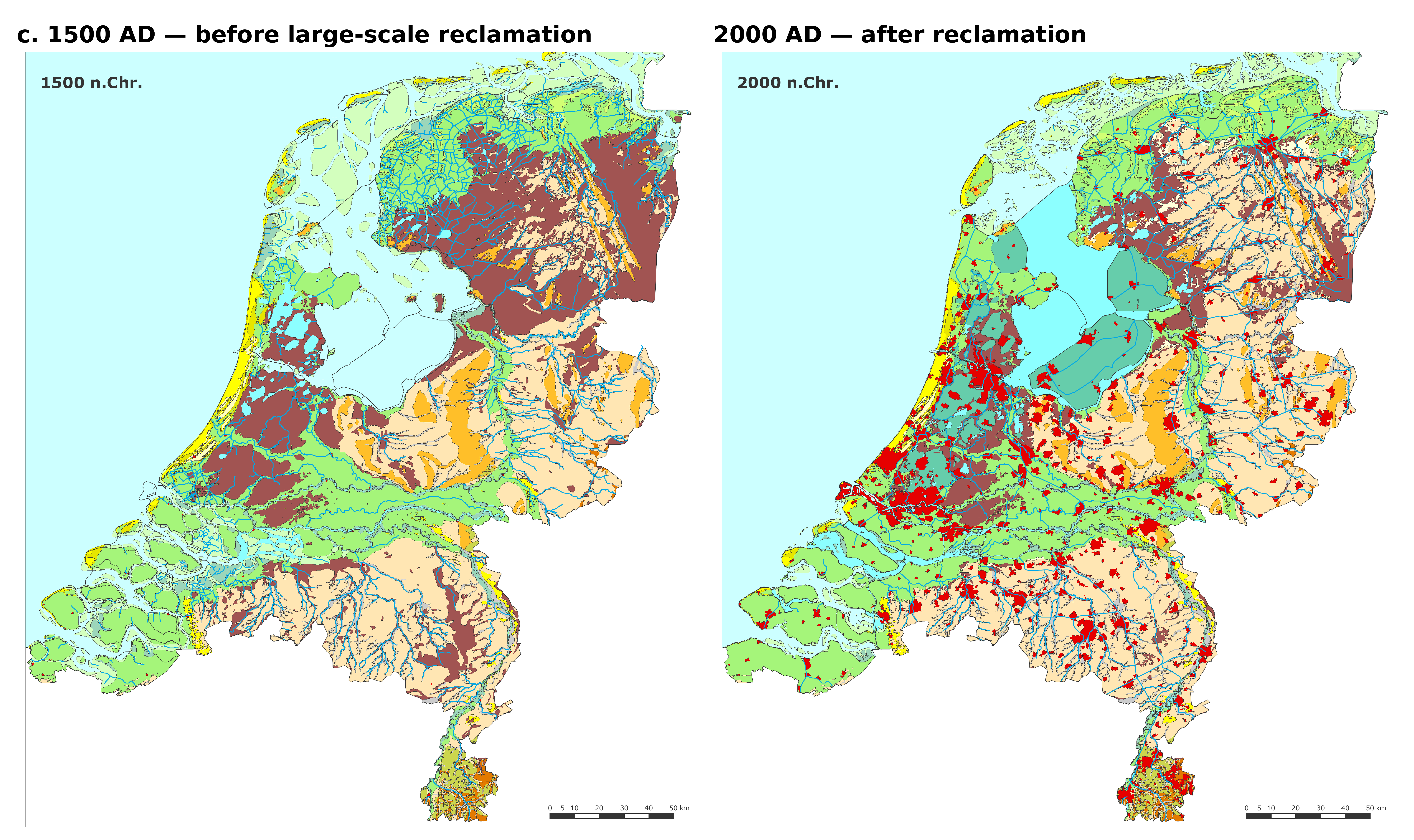
Land reclamation is the process by which additional surface land is produced by draining, damming, and/or dumping of landfill into the seabed. On the surface this seems to directly increase the supply of usable land, and seemingly contradicts the assertion that land is “not produced.”
The most common response from LVT supporters is that the classical definition of “land” means something more like “location” than simply a patch of physical dirt. If we use this definition, it’s clear that we can’t make more locations, on Earth, even if we can make more solid patches of dirt to walk around on.
That’s one way of looking at it, but it’s not enough to just win the debate with a semantic move. The only reason we care about whether land can or can’t be created, is because of the policy implications that follow from that. As it turns out, equating “land” with “location” not only lends clarity to the debate, it suggests a straightforward and logical policy recommendation that dissolves the critique.
Let’s start with the basic pitch for why LVT is supposed to be good: conventional property tax levies a tax on the total value of a parcel, which includes the value of both the land and the building. Since buildings are a “produced good,” the effort and material that goes into producing them is sensitive to taxes. The more we tax buildings, the less buildings we get. However, when we tax land, we don’t get any less land, because nothing affects the amount of land. Therefore, it is better to tax land rather than buildings. Going further, LVT advocates recommend removing as many other taxes as possible, dollar-for-dollar, in exchange for an increased tax on land, because just about every other tax causes deadweight loss and penalizes production.
What does this mean for reclaimed land? The critic would point out that if we can “make new land,” then taxing the act of holding that land ought to discourage its future production (through land reclamation) in exactly the same way that taxing the holding of buildings does. So to the extent it’s good to reclaim land, won’t we get less land reclamation the more we tax landholding?
Reclamation is an improvement
The critics are actually right about this, such a tax would discourage land reclamation. Now let’s show how taking “land” to primarily mean “location” resolves this debate: a location on Earth that is currently filled with water is still “land” in the sense of a location. It’s just not particularly useful land. There’s even a real estate term of art for such pieces of submerged land, they’re known as “water parcels.” Land reclamation fills them in and makes them much more useful, in effect improving the already-existing land. The labor and capital that converts the water parcel into a land parcel should therefore be classified as “improvement,” not as “land.”
So far, so semantic—so what? Well, LVT advocates insist that improvements should be exempt from property taxation. Therefore, a straightforward application of LVT principles to the practice of land reclamation implies that water parcels turned into surface land parcels through land reclamation, should enjoy some kind of exemption from property tax.
In actual practice, most land reclamation projects are the purview of sovereign states. If public funds are paying to reclaim land, it stands to reason the public should retain ownership of the parcel. Reclaimed land should simply be retained perpetually by the state and leased on ground rent, which achieves the same economic effects as an LVT. For more on this, see Jeff Fong’s excellent essay on this blog concerning the case of Battery Park City in New York:

Reclamation tax exemptions
For privately financed land reclamation, we’ve determined that reclamation itself should be classified as an improvement and exempted from taxation. But when does that exemption kick in, at what rate, and how long does it last?
For one, reclaimed land can stick around for a long time. It makes sense to exempt the value of the “improvements” of reclamation in order to properly incentivize that activity in the present, but making such an exemption perpetual seems unwise. Two hundred years from now reclaimed land will be a permanent feature of the landscape, and whoever owns it will have no connection to the original investment decision. Levying a land value tax on land that was reclaimed centuries ago will not cause some Dutchman to travel back in time to destroy the dikes.
The challenge is that there’s an edge case where improvements, over time, become indistinguishable from the site itself. In the short term we want to exempt the effort and investment, and in the long term we want to avoid land speculation, same as we would for any other parcel. This suggests that the tax exemption for reclaimed land should be temporary, but how temporary?
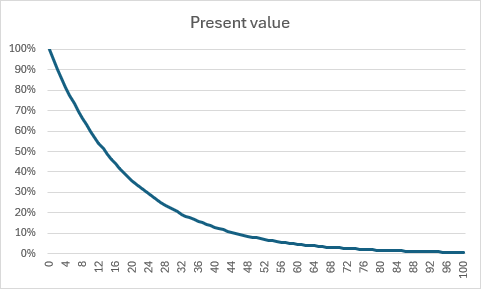
One hint is that investors have time horizons. Put simply, investors care way more about money they will earn today rather than money they will earn in the future, and they quantify this preference with a “discount rate,” such as 5%, for example. This means getting a dollar next year is valued the same as getting 95 cents today, and getting a dollar 14 years from now is only worth as much as earning about 50 cents today. The further a future dollar is pushed into the future, the less it’s “present value” is to an investor. This means that most of the present value of the tax exemption is front-loaded, and when the expiration date is sufficiently far in the future, it has little to no effect on an investor’s decisions today.
Incidentally, Jonathon Moses & Anne Margrethe Brigham detailed in their book The Natural Dividend a similar case where Norwegian policy makers in the early 20th century, directly inspired by Georgist principles, solved a similar puzzle with Norwegian hydropower resources: they needed to attract and reward investment, but didn’t want private (and largely foreign) owners to gain perpetual title to Norway’s waterfalls.
Land, in the context of land reclamation, means location, and water parcels are land in the same sense that surface parcels are, it’s just that the ones that are underwater are a lot less useful. Reclaiming them simply means improving them. We want to encourage and reward people for making these improvements now, but we don’t want to hand over perpetual title to the resulting land stretching centuries into the future.
This gives us a clear and coherent policy package for land reclamation.
When privately developed:
Issue a temporary tax exemption on the reclaimed site, which expires sometime past the typical investment horizon, when the net present value of the future expiration no longer affects current day investment decisions.
When publicly developed:
The public paid for the “improvements” to the reclaimed site, so simply treat it as any other land that happens to be publicly owned. It should ideally be kept in public hands and let out under a ground lease, but if it is sold privately, there should not be any tax exemption on it, it should be taxed just like any other land.
The critics have a real point here, but all it takes to resolve the issue is to apply the correct frame and follow through on the core principles behind LVT, landing on a practical and efficient solution.
Join us next week where we’ll discuss land supply being fixed in the context of all the land that exists versus the amount of land offered to the market at any given time!
Land created by reclamation must be continuously protected or the sea will take it back again. The cost of upkeep of the protective dykes and sea walls should be met by the owners of the protected land, preferably by a land value tax. If the value is less than the cost of the protection then the case for continued protected needs to be questioned. It could be more than the land is worth.