

Welcome to part two of our three part series, “Is Land supply fixed?” Last week we explored the case of land reclamation, where “new land” is seemingly created by filling in the seabed, and its implications for land value tax (LVT) policy. In that article we emphasized that when LVT advocates say “land,” we really mean “location,” and that reclaimed land should really be seen as an improvement (akin to a building) applied to previously useless submerged land.
Reclaimed land aside, hopefully we’re now all on the same page that the amount of locations on Earth is fixed, and that neither changes in land prices nor changes in land taxes can change that amount.
But is amount the same thing as supply?
Some critics of LVT contend that when LVT advocates point to the “supply” of land being fixed, they are confusing two different concepts: the amount of a thing that exists, and the amount of a thing offered to the market.
These critics assert that the relevant “amount of land” is not how much land exists, but how much land is offered for sale or which actually transacts. These critics often employ Econ 101 treatments of sales taxes, and their effects on the supply of taxed goods, to drive this point home.
Let’s meet this Econ 101 critique head on by reference to two things close to the heart of twentieth century America’s favorite Econ 101 explainer, Milton Friedman: pencils and land value tax.
Pencils vs. Parcels
Consider two assets, pencils and land. Pencils are produced, and land is non-produced. Let’s apply two different taxes to each one: a sales tax, and a holding tax. What differences do we expect to see between these four scenarios, and why?
Sales tax on pencils
Yesterday there was no tax on pencils. Today the government passes a special sales tax on them, 10% of the pre-tax selling price. What happens?
The first effect is that the price the buyer pays and the amount the seller receives are no longer the same. If the buyer pays $1.10, and the seller only receives $1.00, there is a 10-cent difference, called a wedge. Each party is forced to transact at a mis-matched pair of prices. Compared to the untaxed price, the buyer’s price is elevated to a level at which she would want to buy slightly fewer units, and the seller’s price is depressed to one where he would want to sell slightly fewer units. This wedge creates what is known as “deadweight loss,” lost economic activity that would have happened without the tax.
How does this go on to affect the overall supply of pencils? It depends on which pencils we’re talking about.
Pencils in my desk drawer aren’t affected, except to discourage me from selling them on the used market, as I’ll lose a bit of each sale to the tax.
As for existing pencils in stores, the profit margins are thin, which means at least some of them will be sold at a loss after the tax. However, the production cost for these pencils is already sunk, and throwing them away would be an even bigger loss. Therefore, pencils in stores probably still sell through, but perhaps more slowly.
The real bite comes from future production: only the most efficient pencil producers are still profitable after the tax, so the others shut down, and the total number of pencils in existence declines over time, compared to a world that didn’t enact a sales tax on pencils.
Sales taxes create deadweight loss and destroy value in two ways: by introducing a wedge between buyers and sellers, and by discouraging the marginal production of now-unprofitable pencils.
Holding tax on pencils
Whereas a sales tax only bites when pencils change hands, a holding tax is a recurring annual tax on the market value of every pencil that exists, regardless of where it is, who owns it, or what’s done with it. Assuming pencils are as easy to observe and as difficult to hide as land (which is completely implausible, but let’s assume it for the sake of argument), what effect does a holding tax on pencils have?
One key difference is that a holding tax on pencils does not produce a wedge the way a sales tax does. Under a holding tax but not a sales tax, buyer and seller transact at the same price.
That said, the selling price changes. The holding tax is a perpetual liability, so buyers will only be willing to pay a reduced price to offset the ongoing cost of that liability, lowering the selling price by a certain amount. This reduction is a one-time effect, and the loss of that value is experienced by whoever was holding the pencil at the time the tax was enacted. From then on, buyer and seller transact at the new reduced price, with no wedge between what one pays and the other receives.
What does this do to incentives, and how does it affect the number of pencils in the world and the number of pencils for sale?
If the holding tax is high enough, I have an incentive to only keep pencils I really need. Otherwise, I empty every drawer in my house and sell the rest immediately. Pencils I can’t sell, and have no use for, I may even throw away or destroy. Meanwhile, anyone thinking about buying a pencil knows they’re going to have to pay an ongoing cost as long as they hold onto it.
The immediate effect of a holding tax on pencils is to increase the number of pencils offered for sale. Pencils remain just as useful as they were before, but their market value is now offset by the ongoing tax liability, which decreases their selling price. Additionally, the glut of used pencils flooding the market reduces selling prices even further. Finally, reducing the selling price of this already low-margin item chases out all the least efficient producers, meaning fewer future pencils, and in the long run, fewer pencils in existence.
Here’s a handy summary:
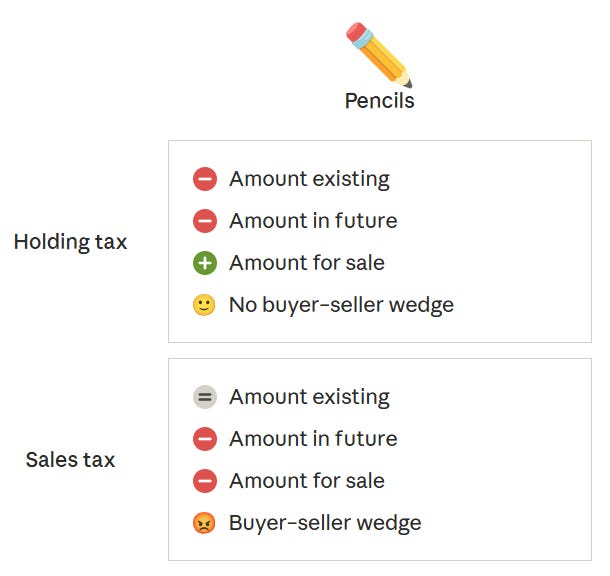
Pencils are a produced asset. A holding tax on a produced asset produces no wedge between the price a buyer pays and a seller receives, and thus no additional deadweight loss, but a sales tax does. Both taxes introduce deadweight loss through the loss of future production, but have different effects on the existing stock: a holding tax reduces it while a sales tax has no effect. Finally, a sales tax discourages offering existing assets for sale, while a holding tax encourages doing so.
For pencils, which we can make as much of as we want, which nobody fundamentally needs simply in order to exist, and which don’t passively obtain value from the labor and investment of neighbors, there’s no need for a targeted holding or sales tax. We can just let the market sort it out and we’ll be awash in a natural abundance of pencils.
Land is different. Let’s now see what happens when we apply the same two taxes to parcels, not pencils.
Sales tax on land
A sales tax on land has essentially all the same effects as a sales tax on pencils, with one big difference: nobody can produce any more or less land in the future, so the amount of land in existence never changes.
However, the amount of land offered for sale does change in response to a sales tax on land just as it does for pencils—we get less. Similarly, a wedge opens up between buyer and seller when one receives a different price than the other pays. Both of these effects introduce significant deadweight loss, even though land is non-produced and its supply is “fixed.”
However, these effects are only in the case of a sales tax on land, which LVT supporters oppose. A sales tax on land is a kind of real estate transfer tax, commonly known as “stamp duty” in commonwealth countries, and the effects of these taxes are both well known and highly destructive. They produce a strong disincentive to sell property, which means people who would otherwise want to buy, can’t, and those who would otherwise want to sell and move, don’t. An empirical analysis of real estate transfer taxes in Germany quantified this deadweight loss and found it to be enormous: 67 Euro cents for every 100 raised in revenue.
Holding taxes on land
Just as with pencils, there’s no wedge between the price paid by buyer and seller, because holding taxes don’t introduce such a thing, regardless of whether the asset is produced or non-produced. Similarly, a holding tax on land increases the amount of land offered to the market, because there’s an ongoing, unavoidable financial liability which bites no matter what is done with the land or who owns it.
Although the land holding tax is the same for every potential owner of any particular parcel, idle holders of valuable land speculating on future potential gains face a particular incentive to sell as they gain little income from the site. This is why LVT encourages land to flow to those who actually intend to put it to productive use.
A key difference, however, is that no one can simply throw the land away or destroy it, all they can do is sell it or give it away to someone else, who then takes up the holding tax. Who holds land changes, but not whether it’s held. Because there’s no wedge, this reallocation is neutral in the worst case, but beneficial whenever it causes land to move from idle speculators to people who actually have a better use for the land.
As for the price of land, the financial liability of the tax bites at the time the tax is first announced, “capitalizing” into a reduced selling price, just as it does for pencils. This is a one-time loss in value that is realized by whoever happens to be holding onto the land at the time.
NOTE: while taxing land tends to lower the selling price of land, un-taxing buildings tends to raise the selling price of land. Therefore, raising land holding taxes at the same time as lowering building holding taxes—the “LVT shift” we advocate for—may tend to offset one another in certain cases. The exact effects are beyond the scope of this article.
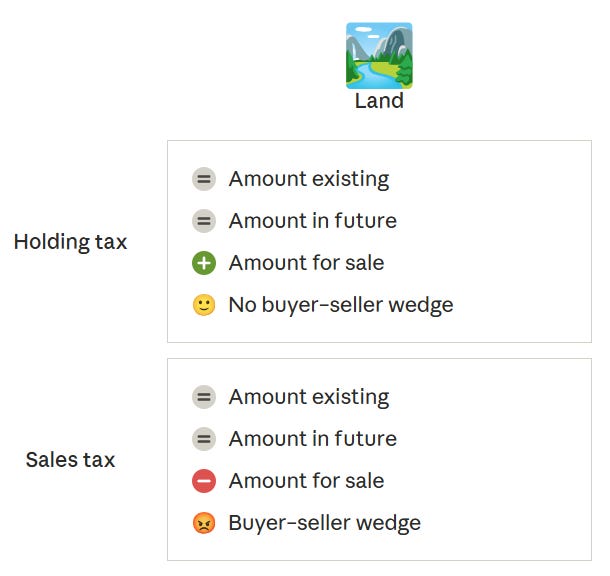
For non-produced, non-destroyable assets, neither the existing amount nor the future amount changes in response to either sales tax or holding tax, because neither amount ever changes. Otherwise the results are the same as for a produced asset: a sales tax opens a wedge while a holding tax doesn’t, and a sales tax discourages offering assets for sale while a holding tax encourages it.
The supply of land is fixed
When we say the “supply” of land is fixed, we mean that the amount of land in existence does not change at all, and certainly not in response to changes in prices and taxes. Critics are right to point out that the Econ 101 textbook supply curve refers to the amount offered for sale, which changes in response to prices offered (my land is not for sale for $1, but certainly would be for $1 billion). However, conceding this obvious fact changes nothing about the case for LVT, because land value tax is not a sales tax, but a holding tax.
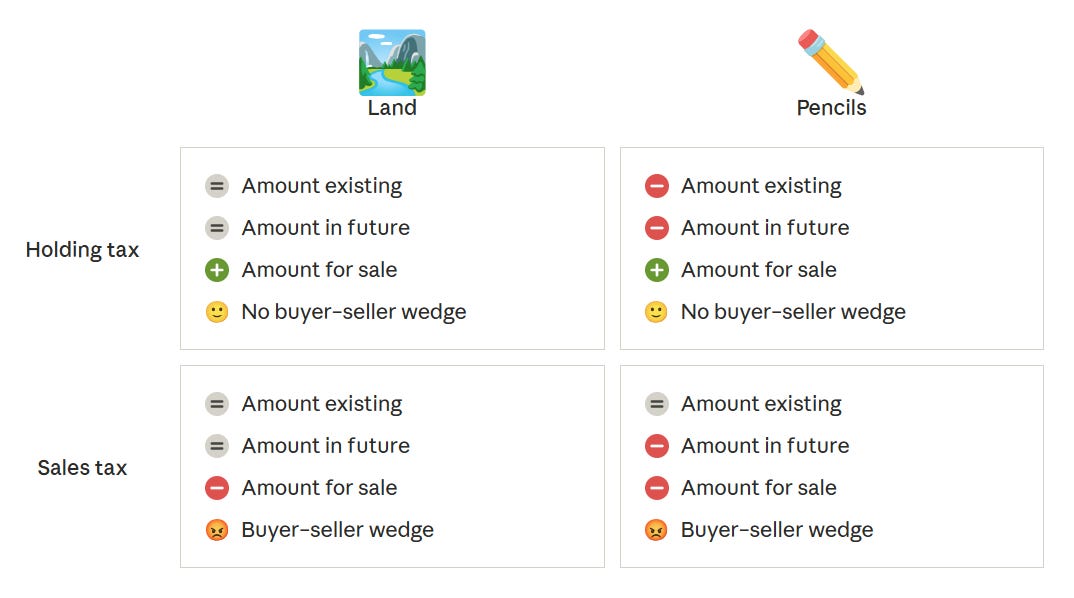
Holding taxes are not magical in and of themselves, and applying them to a produced asset can still be destructive by discouraging future production. Land value tax, however, is a holding tax on a non-produced asset. Furthermore, land is not just any non-produced asset; it is a rival asset where one person’s ownership means another’s exclusion, a necessary asset that everyone must access simply to exist, and a locational asset which passively obtains value from the labor and investment of its neighbors. It is for these reasons, among others, that LVT advocates support land value tax.
With this and last week’s article, we have now covered two of the three ways critics assert that land supply is not truly fixed. One last dispute remains: that the value of land is what really matters, which everyone, LVT supporters included, agrees is not fixed. Does a holding tax on land encourage owners to become NIMBYs, to dump toxic waste, in order to reduce their land’s value and thus their tax burden? And what about extending land into the third dimension by building multi story units? What about search costs and the work of entitling the land?
For answers to all these questions and more, come back next week for the third and final article in our series!