

A new academic study adds evidence to what we already know: low property taxes create a privileged landowning class at the expense of those vying for homeownership.
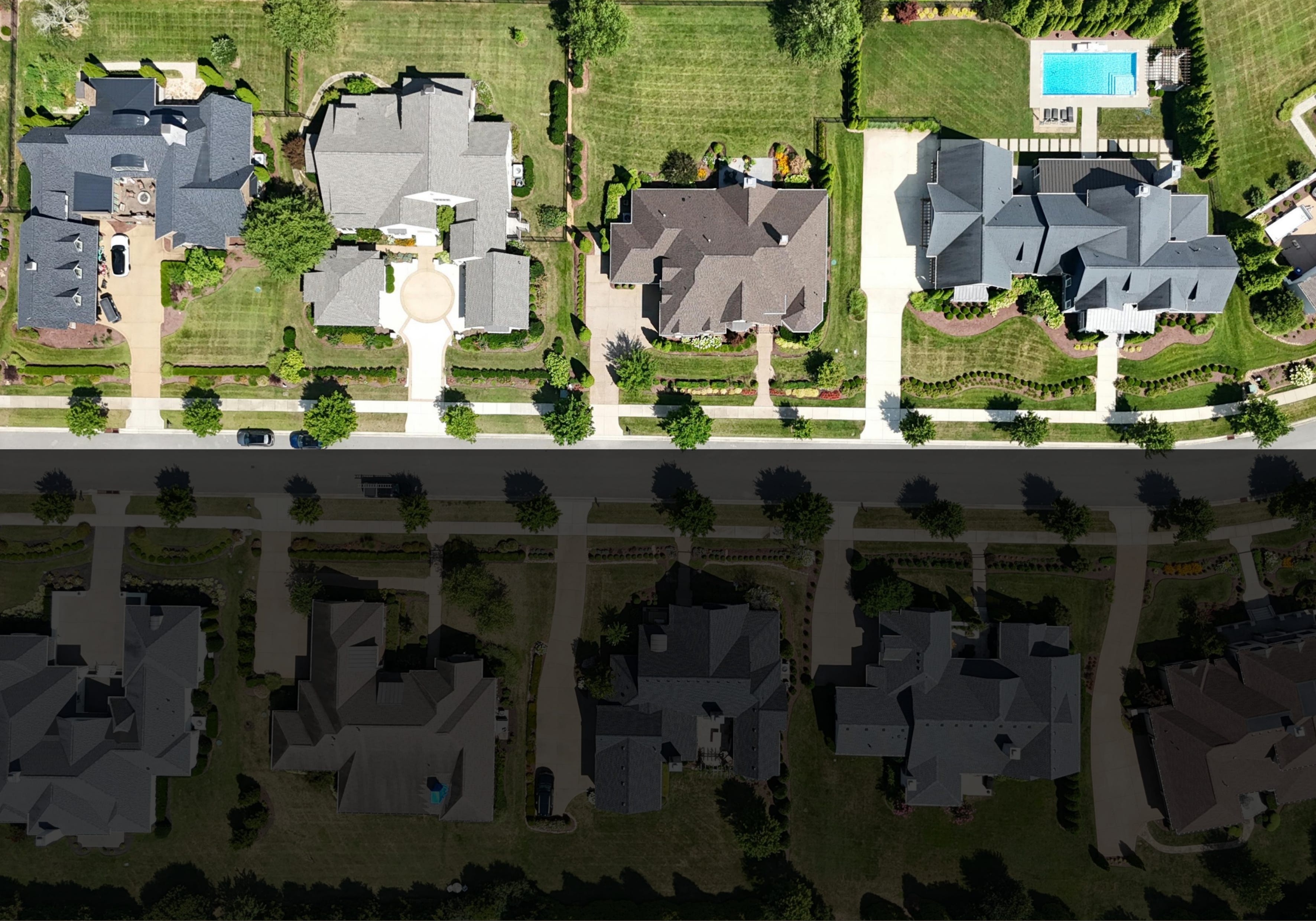
Published this month by a group of CUNY and NYU academics, the working paper (pdf) finds: “property taxes reallocate homeownership towards the young from the elderly.” The authors identify two main levers:
Low property taxes raise the selling price of housing.
Example: If I was considering buying one of two identical gold bars, both of equal weight and purity, but one which came with an annual tax of 1% of its value every year, and the other a tax of only 0.5%, I would gladly pay more for the one with the lower holding cost. This is called the capitalization effect–lower property taxes “capitalize” into higher selling prices. The opposite is also true, reducing property taxes raises selling prices. Since being able to afford a down payment or qualifying for a loan are greater barriers to housing for young families than monthly holding costs, young families prefer lower upfront selling prices, even if the monthly tax burden is a little higher.
Low property taxes decrease the cost of holding on to housing.
When property taxes are lower, there is less cost in holding on to a house bigger than the current occupant actually needs, rather than downsizing after children move out. This decreases the supply of housing available for young people seeking to start families.
This paper is released at the same time that Florida governor Ron DeSantis moves full steam ahead trying to abolish property taxes in his state, starting with a $250k homeowner exemption on the ballot next year. The capitalization effect of this policy would immediately lower property taxes and pump wealth into the values of boomers’ home values. However, that value comes at the direct expense of young Florida families. Meanwhile, the long-term effect of the policy will cause the housing market to stagnate, as generous tax breaks encourage boomers to sit on big houses, while young people are increasingly priced out.
The broader story is about the decades in which boomers have wielded power across the government and economy. They have been a frequent beneficiary of government assistant programs for decades, from homeownership subsidies to social security, with property tax breaks now being added on top. This is not necessarily nefarious; boomers have demographic power, and vote to address the problems most visible to them. However, the societal result is bad policy that does not consider the negative tradeoffs, and which favors one generation over the rest.
Yet none of this is really about boomers. Instead, it is about creating a new social contract, in which all generations prosper instead of fighting. Someday I will be old, and I hope that I will then be able to maintain an open mind, capable of understanding that a strong society must be open to change. A dynamic country would make space for the young while still caring for the elderly. Ensuring security for the elderly shouldn’t mean freezing younger generations out.
Boomers own a lot of land
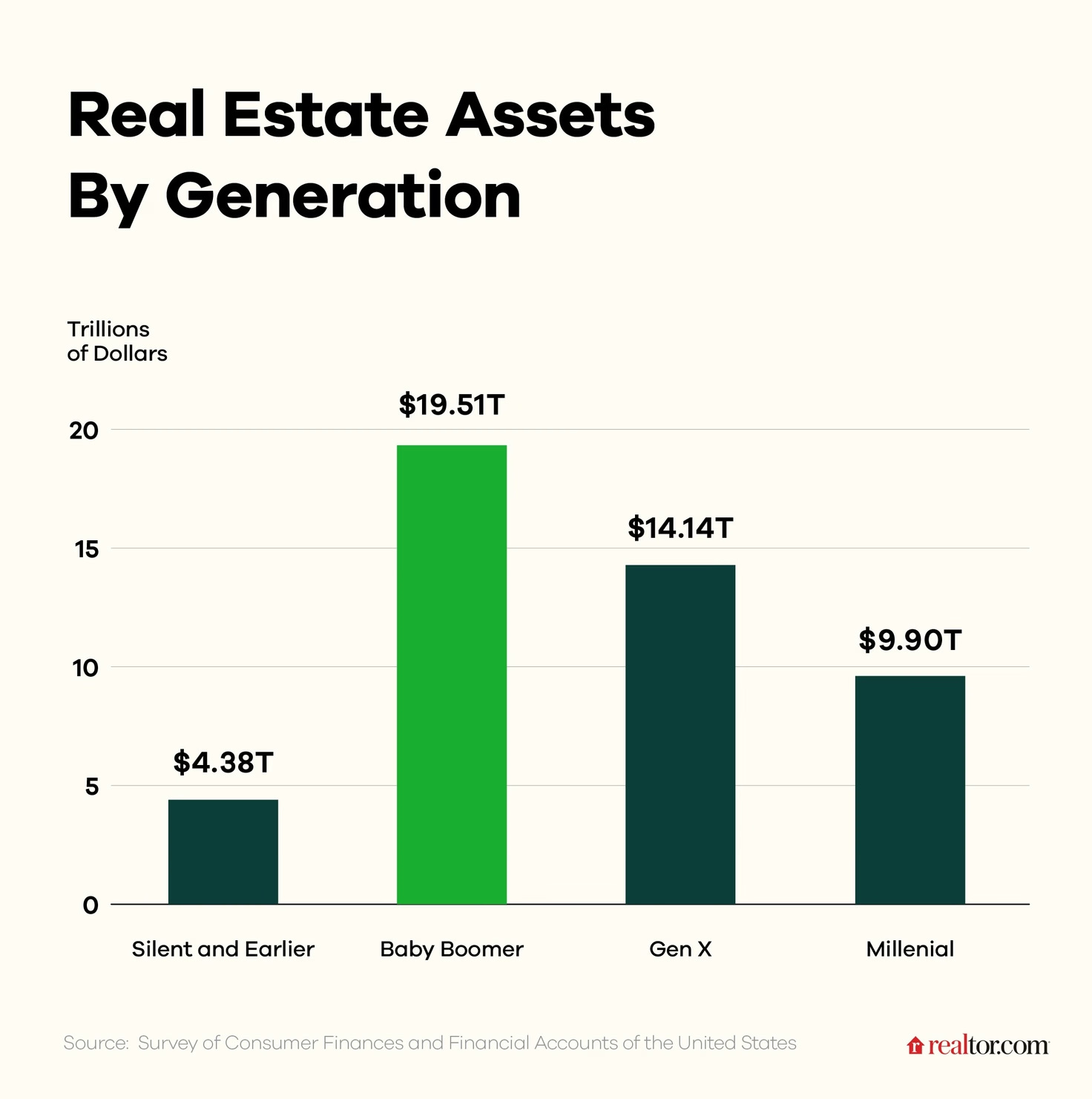
Boomers control the largest amount of real estate assets today, according to Realtor.com. They own just under $20 trillion in assets, a little less than half of all real-estate, compared to Gen X at $14 trillion and millennials at just under $10 trillion. Isn’t this to be expected, though? Those who have lived longer have had more time to acquire more money and real estate, won’t other generations catch up? The problem is that a lot of this real estate is in job-rich locations, and land in these locations is fixed in supply. As long as boomers own this fundamentally scarce land, millennials cannot. Meanwhile, there are homes that boomers are sitting in with more bedrooms than people where young families would love to live.
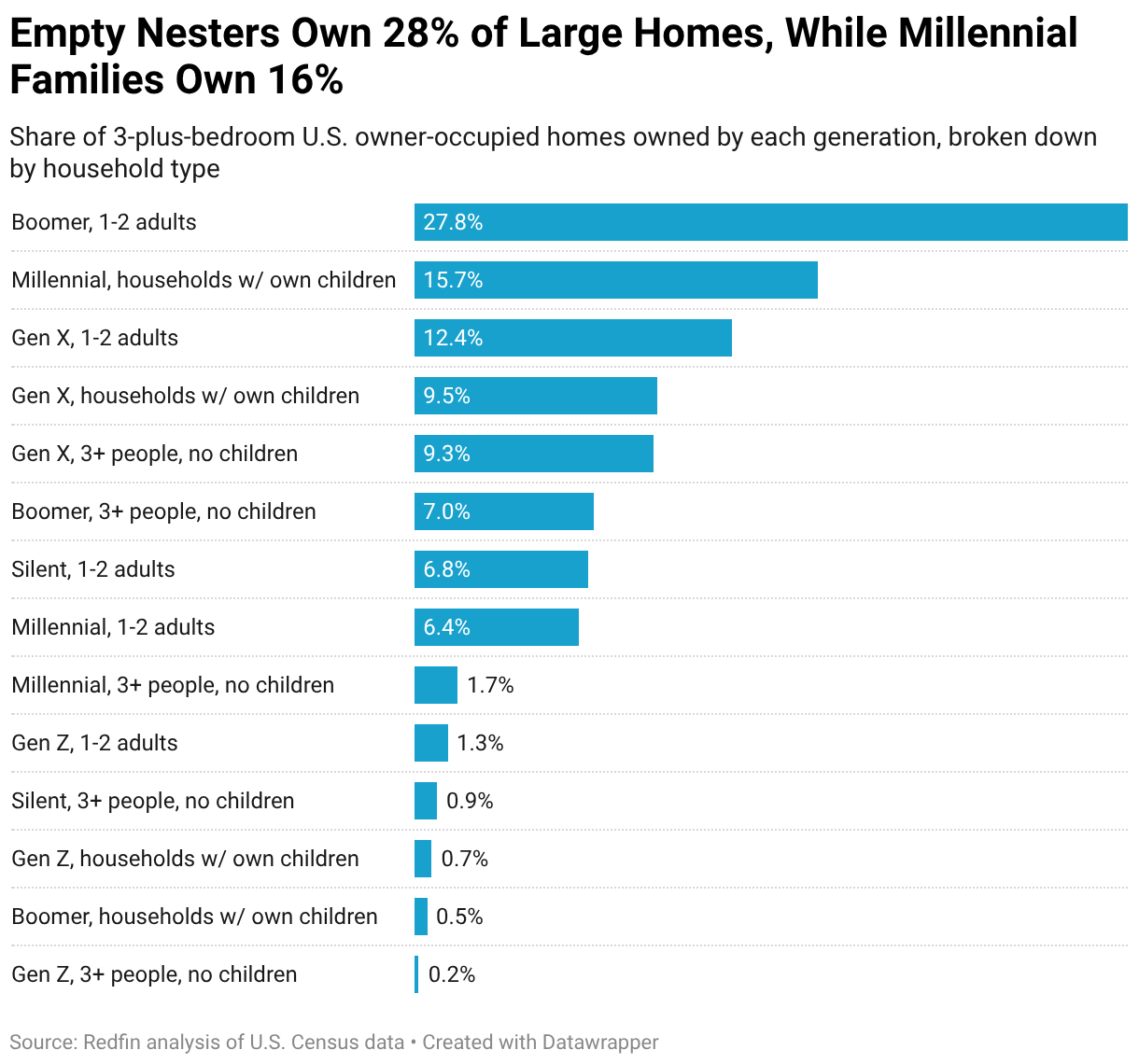
Redfin finds that boomers own over a third of all homes with 3-plus-bedrooms, and that 28% of the 3-plus-bedroom housing stock is owned by boomers with no kids. Young families with kids own only 16% of these.
The working paper identifies similar trends, and puts it like this:
“Households aged 30–50 have the highest rates of housing crowding, with the largest fraction living with more than one person per bedroom. In contrast, the 50–70 age group, which owns the largest share of bedrooms, tends to underutilize its housing space relative to younger households.”
As demand for urban and suburban housing is growing and housing prices are shooting out of reach for young families, allocation of scarce land matters more than ever. We must be able to house workers in the places they can be most productive, if we want the economy to be strong enough to support both the youth and the elderly alike. And, this is where the study enters the scene…
What can North Carolina re-assessments teach us about property taxes
The authors start by estimating the immediate capitalization of property taxes into selling price: how much does an increase in property taxes decrease the selling price of a home, and vice versa
To do this, they look to North Carolina, which requires re-assessments no less than once every eight years across the counties. Importantly, these re-assessments do not all occur in the same year; they are staggered.
When a reassessment occurs, total property values across a county tend to increase, and over eight years, that increase can be quite significant. In North Carolina, local jurisdictions first decide how much money they need for their budget, then they look at the total value of all assessed property and work out the tax rate from that. This means that even if the total assessed property value of a county increases, taxes don’t necessarily increase. As a simple example, if every property in a county doubled in assessment, but the county budget stayed fixed, the tax rate would drop by half. That said, in North Carolina, a UNC School of Government report found that roughly two thirds of reassessments also resulted in overall increases in property tax collections.
The authors used both variability in the years that assessments were conducted and the changes in total amount of property tax across counties to understand the impact of property taxes on selling prices. They did this by comparing, by year, counties that went through a reassessment to those that did not, then estimated the amount of property tax. They measured how much selling prices moved in response, isolating the effect of the tax change itself from broader market trends happening at the same time.
Decreased property taxes immediately raise the wealth of homeowners
Ultimately, the authors found that a one percentage point increase in property taxes led to a 22% decrease in property value. This also implies the inverse: a decrease in property taxes leads to a significant increase in property value.
Increased property taxes leads to higher homeownership among younger families
The authors then ask another question. How much do increased property taxes change the allocation of housing by age group?
To answer this question, they looked nationally. They used Census survey data from 2016 to 2021, which tells you each person’s age and whether they own or rent. The Census only reports this statistic for areas which each contain about 100,000 people, called PUMAs (Public Use Microdata Areas). They paired this with tax records which show the actual dollars paid on each home.
For each PUMA, they measured how much the typical tax bill grew over five years, and how much the share of owners grew over those same five years. They did this for different age categories, and found correlations by comparing only places in the same state with similar home prices, so that a pricey suburb would not be matched with a rural county.
They found that doubling the amount of property tax led to an increase in homeownership in the 25-34 cohort of 4.3 percentage points. By contrast, this also led to a decrease in homeownership of 4 percentage points among the oldest cohort.
California policy locks young people out
Using the data and findings from the prior two questions, the authors then explored what the world would look like under two different policies.
First, they asked: what would the allocation of housing be if California’s effective property tax rate on housing went from its current low rate of 0.8% to Texas’ average rate of 2%?
They modeled this by pairing their North Carolina results with a set of simulated California families. In their model, each family shows up at 25 and lives to 85. Every few years each family makes a choice: buy a new home, stay in their current home, or rent. The authors assigned parameters for the households and tuned the model so that the simulated state matched the real world, with 61 percent of people owning a home. Once the model was calibrated, the authors turned the property tax rate up from 0.8 percent to 2 percent, matching Texas’ level, and ran it again.
The results? Prices fell 12% while the share of 25 to 34 year olds owning homes went up. The share of owners aged 65 to 74 fell by 5 points, and those over 75 fell by 7.6 points. Homes moved down the age ladder.
This evidence suggests that California’s low property tax, resulting from Prop 13 which caps property assessment increases to only 2% year-over-year, is a massive subsidy that keeps boomers in homes long after their kids have moved out, since their tax bill stays frozen near what it was decades ago regardless of what the home is now worth.
Yet, property tax lock-in policies are not constrained to the state level. There is a national level lock-in that not enough people are talking about, an obscure tax provision called “the step-up basis.”
Solving the step up basis is a housing problem.
The step-up basis allows capital gains tax to be avoided when heirs inherit a property after a death. Imagine you bought stocks for $200k, worth $900k today. If you sell them while you’re still alive, you will owe tax on the full $700k gain. But when you pass away, the clock resets, and your kids will inherit the stocks with the “cost basis” now reset to $900k—that’s the “step-up basis.” If they later sell those stocks at $1.2M, they will only pay taxes on a gain of $300K, not $1M. The step-up basis is a massive gain in value that’s never taxed.
The problem is, this same step-up basis applies not just to stocks, but also to housing.1 Combined with existing capital gains taxes, this produces a perverse incentive for incumbent homeowners of valuable homes to never sell, even if they would otherwise want to. If an elderly family sells their property today, they pay a tax on decades of land value gains their property has experienced; if they hold until they die, those gains never get taxed when their heirs inherit the property.
The authors ask: what would the housing allocation impacts be if the step-up basis for capital gains tax did not exist?
They estimate a similar model to the California one above, but turn off the gains from the step-up basis. Nearly a fifth (18%) of owners over 75 would drop out of homeownership. That effect is bigger than the one from simply doubling the property tax. This tells us that a good share of old age ownership is being propped up by a huge federal tax break on what gets passed down. This does not mean these folks lose housing, they just move into rental housing which will better fit their lifestyle at their age. Meanwhile, there would be more homeowners under 45.
There are 13 million units owned by individuals over 75 in the United States, if the predicted effects of eliminating the step-up basis hold, it could free up over 2 million of housing units, and that is only considering properties owned by people aged above 75. This would be a massive unlock of housing supply.
Prior to this paper, Andrew Justus at Niskanen Center published a piece where he took the idea of the step-up basis reform as a housing policy seriously. He proposes a carry–over basis to replace it, in which heirs are allowed to inherit property without owing capital gains taxes, but also without resetting the cost basis.
There may be an upcoming opportunity to make the step-up basis part of the conversation. Congress just passed a large housing package, the ROAD to Housing Act, which is rightly being celebrated, and with it, there are murmurs of Congress working on another large housing package, “ROAD 2.0”; if so, sunsetting the step-up basis must be part of the conversation.
None of this is zero-sum
Housing allocation is not a zero sum game. A four bedroom house in a job-rich area contains the same space whether it holds a single retiree or a young family of four. The authors highlight a gap. Households aged 30 to 50 face the highest rates of crowding, while the 50 to 70 group owns the largest share of bedrooms and leaves them underused. By more cleanly allocating existing housing stock, we can house more workers closer to their jobs, even without building more housing stock. This helps create an economy strong enough to care for both the youth and the elderly.
More importantly, property tax policy is about more than just allocating current homes. Land value comes from the community that helps build the value through the people, schools, transit, and jobs. A property tax—and preferably, a land value tax—is simply the price of that shared value. Slashing property taxes does not conjure wealth out of thin air. Instead, it lets incumbent land owners claim capitalized public value for themselves, while passing the bill for local services onto renters and small shops, or forcing cuts to those very services. Keeping property taxes ensures cities can fund the items needed for long term growth which will lead to more housing in job-rich areas overall.
To DeSantis: Are you listening?
The research calls your push to abolish property taxes into direct question. Your current glitzy policy push to expand homestead exemptions to $250k is an immediate wealth injection to the incumbent homeowners. Disproportionately boomers. Small businesses and renters will then be on the hook for making up the difference to pay for the schools, parks, and public services that keep boomers’ homes valuable. Meanwhile, less homes will be on the market for young families to move into.
A healthy market and economy is a dynamic one. Low property taxes threaten that. Large expansions of homestead tax credits create a permanent landed gentry, and the only ones who benefit are the elderly and the ones who will inherit their property. Added to that inheritance will be the massive subsidy you are proposing.
Younger Republicans are already sounding the alarm. They recognize that these policies are anti-family as well as economically ineffective. The choice is: should Florida become California, or should it not? And, to answer that question, you must prioritize the next generation over the boomers, especially as the boomers lose power.
The worst possible scenario is one in which older citizens vote themselves large subsidies at the direct expense of the young, enjoy a nice retirement, then die, leaving the next generation saddled with the consequences without boomers having to face the cost of their policy decisions themselves. This same pattern plays out when a lame duck governor in his last term pushes for property tax abolition with no plan for what comes next, only to leave right after.
Greg Miller is the Executive Director of the Center for Land Economics.
Primary residences do receive an exclusion of up to $250k for a single household or $500k for a married household, where the first $250/500k are excluded from capital gains tax.
I had thought that higher property taxes hurt first-time homebuyers because of the large tax impound required at closing. It can increase an FHA buyer’s minimum down payment by 50%. However, your piece changed my mind. While it may seem counterintuitive, your math adds up.
Stepped-up values have long been a pet peeve of mine. Some people oppose estate taxes as unfair because “that money was already taxed when it was earned.” Often, that is not true. Between accumulated 1031 exchanges and stepped-up values at death, many estates realize enormous capital gains and pay zero taxes. The thrifty, hardworking family pays taxes on their W-2 earnings and capital gains while an heir next door pays none because their unearned income is somehow sacrosanct. Our incentives are upside down, rewarding fortunate children while taxing people who work. If we simply required capital gains to be taxed at death as though they had been sold, we could narrow the deficit and add fairness with little economic friction.
Your article adds a material downside to stepped-up values, as keeping the elderly isolated in family-size homes to avoid tax consequences is very bad policy. Not just for young people priced out, but also for senior citizens who could live in an appropriately sized home with neighbors of similar age and, perhaps, closer to healthcare facilities.
Reduced property taxes for seniors commit the same sin, shamelessly charging more to those with less and effectively stifling mobility. We will soon have open pushback on the generational theft in policies that feather the nests of boomers while severely stretching younger people. I do not believe the approaching Social Security and Medicare cliffs will be easily resolved, as it will require another round of transferring money from the young and burdened to the wealthiest generation. We are reaching an economic and political tipping point.
The next administration should have the opportunity to pass a ROAD 2.0 and perhaps significant tax and entitlement reform as well. We can reduce economic drag while raising revenue, as there is a lot of low-hanging fruit in the misguided tax policy that we enacted over the past 45 years. As an optimist and a boomer, I have high hopes for the future, but we have a lot of work to do.
Man, I never considered the impact of the step-up loophole on housing costs. Thanks for sharing that here. Super helpful. I already supported treating capital gains same as income for taxing as part of tax reforms for UBI, but now it makes even more sense.