

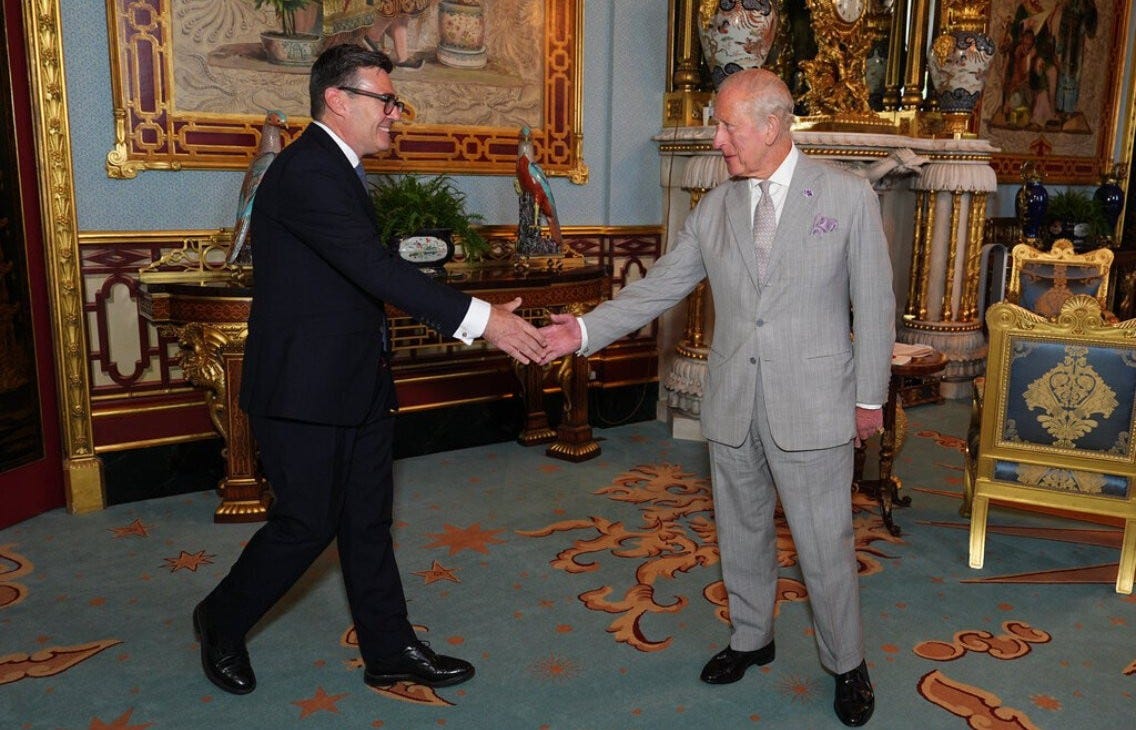
This morning, Andy Burnham became Prime Minister of the United Kingdom. He takes the reins after Keir Starmer resigned in June due to a brutal run of polling and a summer of Labour infighting. Burnham, until recently the mayor of Greater Manchester, only re-entered Parliament in May after winning a by-election–an election to fill a seat between general elections due to a vacancy. He is now the country’s seventh Prime Minister in a decade.
Burnham has been supportive of a land value tax for a long time, having said so repeatedly over fifteen years. With him in office, there are now two major world leaders who have secured office in the past year while championing taxing land. Last year, Stephen Hoskins covered South Korea’s Lee Jae-myung and asked whether South Korea had just elected a Georgist president.
What Burnham has said
Burnham first spoke of land value tax publicly during his 2010 Labour leadership bid, when he pitched an annual tax on the value of land to abolish stamp duty (and floated doing the same to inheritance tax). After that, it mostly went quiet through his years as Greater Manchester mayor, where his attention was on housing and brownfield land rather than the national tax base.
However, in a 2022 LBC interview he called an LVT “a very productive form of taxation.” In his framing, LVT pushes land into use because “if people are sitting on it and hoarding it, they get taxed.” And over the past year it has moved from an occasional aside to a headline plank. At his May 2026 campaign launch he said he had “long been persuaded of the argument for a Land Value Tax,” called council tax “highly regressive,” and criticized the status quo policy’s 1991 valuations as “not justifiable.” As Prime-Minister-in-waiting he kept the thread going, arguing simply that land in the UK is “under-taxed.”
Reasons to taper our expectations
While Burnham has championed a land value tax in the recent past, turning campaign support into legislation will prove much harder.
It’s possible that Burnham simply pivots to a more traditional property tax, aligning the UK with the precedent set by the US. Burnham has backed Fairer Share‘s proposal, which is a tax on the whole value of a property, land plus building. This would still be a massive improvement over the UK’s current system, but as we like to say, a property tax is not a land value tax. Taxing the building back in reintroduces exactly the disincentive to build that an LVT can remove.
Even with the political will, it is daunting to do a full national tax overhaul. A land value tax means putting a number on the land under every property in the country and then keeping those numbers current, which takes an assessment office to produce them and an appeals process for the inevitable disputes. Britain hasn’t revalued homes for council tax since 1991; an LVT asks the state to value land more finely, and more often, than it ever has for housing. And the transition bites: on day one some households will see their bill fall and others see it jump, and the ones facing a jump may be loud.
And, well… seventh PM in a decade. Britain has burned through Prime Ministers at roughly one every eighteen months lately, and standing all of that up is a project measured in years, not months — it needs someone still holding the keys to Number 10 when the bill finally matures. History suggests not betting the house on any one tenant.

The UK’s property taxes are a mess
With expectations set, it’s worth setting the table on why this reform matters because the system Burnham would be reforming is genuinely broken. The UK taxes homes through two main levies: council tax, an annual charge on living in a property, and stamp duty, a one-off charge on buying one (ie, a real estate transfer tax). Between them they raise close to £70 billion a year, and both are badly designed.
Council tax bands every home in England based on what it was worth in 1991 — valuations that are now thirty five years old. The top band, Band H, covers everything worth £320,000 or more in 1991 and has no ceiling above it, which means that £400,000 homes are lumped together with £4 million homes, paying nearly the same bill. All told council tax raises roughly £54 billion a year, about a quarter of what English councils spend, and all based on valuations that everyone agrees are grossly unequal and decades out of date.
Stamp duty (formally Stamp Duty Land Tax) is the tax you pay when you buy a home — a percentage of the purchase price, rising in bands as the price climbs, handed over by the buyer at the closing of the sale. The bands here work like income tax: no duty is charged on the first slice of the price, and each portion above successive thresholds is taxed at a progressively higher rate. The stamp duty is the smaller of the two taxes, but it still raises around £15 billion a year.
So why are both bad?
Council tax is, in Burnham’s own words, “highly regressive.” Because the top band has no ceiling, the more valuable a home is, the smaller its relative share of taxes, and the frozen 1991 snapshot results in a modest terrace up north paying more than a mansion in Kensington. Worse, it taxes the building you occupy rather than the land underneath it, so a boarded-up plot or a surface car park in the middle of a booming city pays almost nothing even as the land beneath it climbs in value, and when the public funds a new rail line that sends nearby land values soaring, the owners simply pocket the windfall.
Stamp duty is broken in the opposite direction: it taxes the act of moving. In one survey of economists it was ranked as the single most damaging tax on the books, because a charge on transactions freezes people in homes: the empty-nester who won’t downsize, the family that can’t upsize, the worker who turns down a job across the country because moving isn’t worth the tax bill. It clogs the housing market and the labor market in one go.
The common thread is what neither tax touches: the unearned value of well-located land. One taxes the improvements, the other taxes the move, and both leave idle and speculative landholding almost entirely alone, which is precisely the gap a land value tax is built to close.
It’s creating a lot of attention
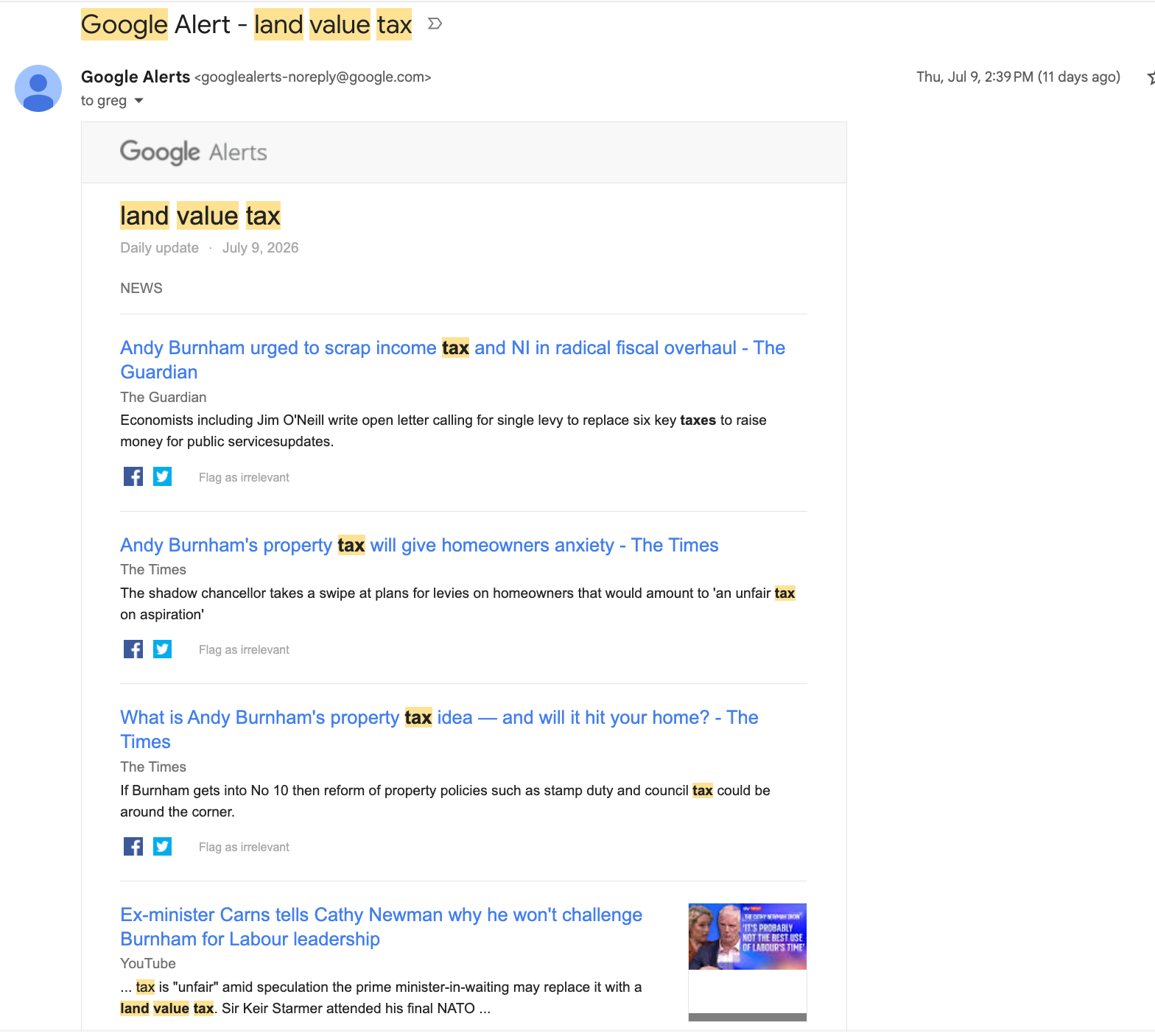
If you are like me, and have google alerts on land value tax, you have seen daily coverage of Burnham for the past month. British tabloids and tax-advisory firms are pumping out “what an LVT means for your home” constantly.
What the modeling actually shows
There are several pieces of research and analysis that look to model the land value tax impacts in the UK.
PolicyEngine ran the revenue-neutral swap from a council tax to a land value tax and found the budget-neutral rate is 0.77% of land value. At that rate, 68% of households come out ahead: the poorest tenth gains about £481 a year, only the top two income deciles pay more, and poverty ticks down.
Dan Neidle / Tax Policy Associates published their own full report and interactive model of what an LVT would actually do — who pays, who saves, and why. Big winners are places like Middlesbrough (~£1,600/year less); the big losers are prime London and the commuter belt.
And Progress and Property has modeled land value estimates for nearly all parcels in England and Wales. You can look up your own street on the Land Value Tax Calculator and see its estimated land value and what you’d pay under an LVT versus today. This site also has a research tab with interesting stories relating land value to transit proximity.
So, how likely is Burnham to follow through?
He is certainly persuaded by the argument, and in his opening speech as PM, he promised a ten year vision to bring down the cost of living for the UK. A tax overhaul will not happen overnight, and will likely require a rollout that will take great political support paired with patient and nuanced administrative considerations. While he undergoes this ten-year vision, he will also need to make sure he can hold the political support to keep his role in a volatile political environment.
None of this should take away from the broader trend: national leaders around the world are being elected to office while supporting land value taxes publicly. Combined with all the state and local leaders we’re seeing in the US, it’s now undeniable that Land Value Tax advocacy is a growing international trend.
Greg Miller is the Executive Director of the Center for Land Economics.
Interesting how the UK handles property taxes so regressively. It looks like a system biased in favor of the rich and as a way to maintain class stratifications.
One question comes to mind in terms of a land value tax. How would they fairly imposes this on farmers? Farmers barely break even most years but maintain large swaths of land and it would increase their financial burden. It seems like there should be a way to carve out special exceptions or discounts for farmers since they're so important to UK and EU food production.
The part of this that shows up on the ground for us is how much good, buildable land just sits. Owners hold a parcel as a savings account because there's basically no carrying penalty for leaving it idle, so it never comes to market at a price that pencils, and the developer who actually wants to build something ends up priced out by the guy who'd rather do nothing with it. Whether or not the politics of an LVT ever land, the diagnosis underneath it is right, that we tax the building and tax the move and leave the speculation almost completely alone, which is close to backwards if the goal is getting more housing actually built.