

In March of last year, I started the LVT Landscape series—a running series updating folks on LVT momentum. The series has tracked the rise of 13+ states now considering LVT enabling legislation, two states passing such legislation, and an international rise in coverage of LVT. For those past installments, see here. Today marks the tenth Landscape article!
In March of this year, Google searches for LVT peaked. This reflects the larger trends we are seeing and feeling: land value taxes are gaining momentum everywhere and becoming mainstream.
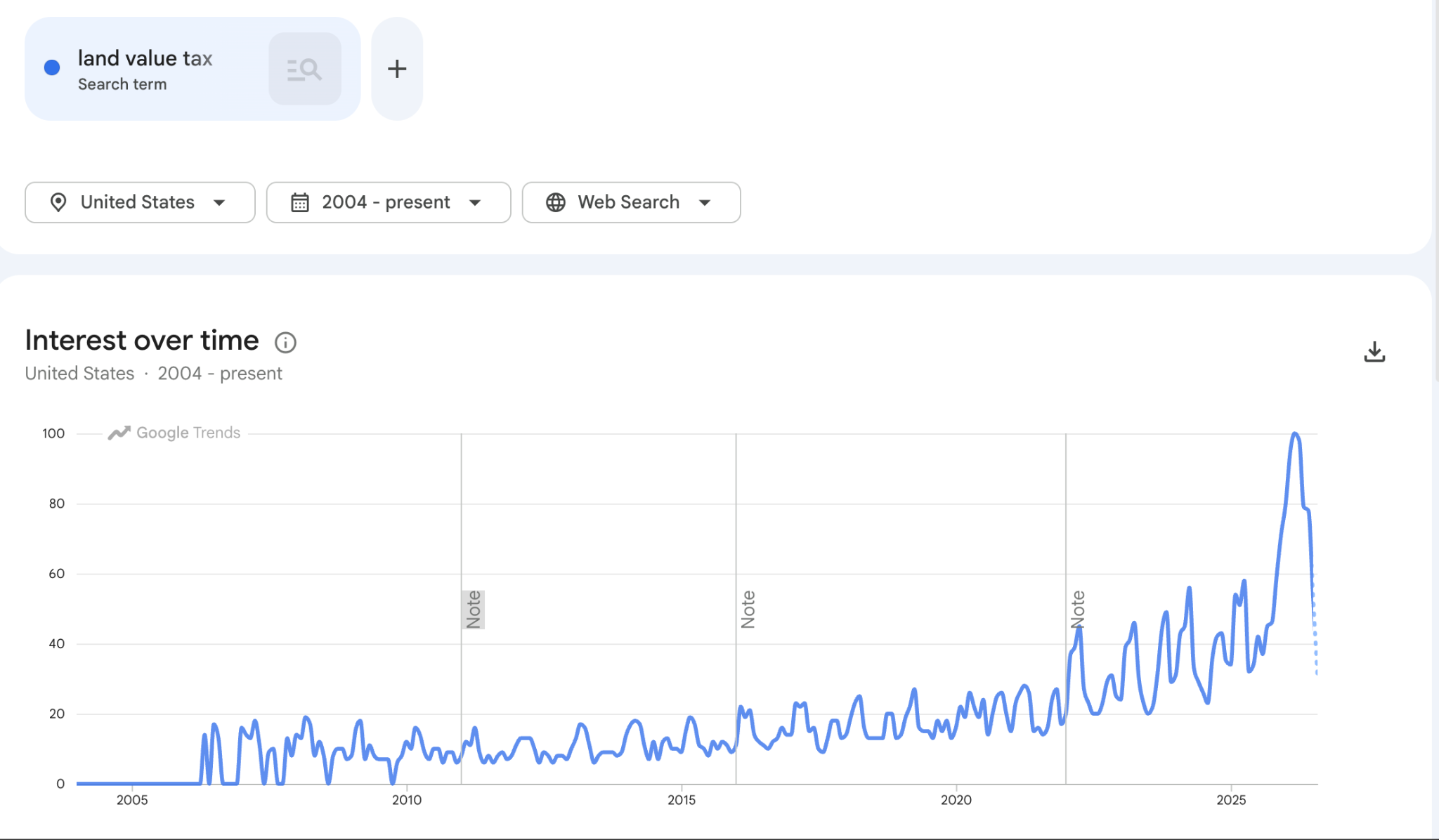
Even though most state legislatures were not in session this summer, we are still seeing progress. However, simply passing laws is not enough. Governments must support every new policy with the ability to actually administer it. Today’s Landscape focuses heavily on movement across the country which will help lay the administrative groundwork needed for LVT.
Louisville takes the first step
In this year’s past legislative session, Kentucky enabled Louisville to implement split-rate taxes. Last month, the Louisville city council took the next step, and overwhelmingly approved an ordinance that sets two categories of taxation: land and building.
For the local government to tax land and buildings at different rates, two steps must happen: first, land and buildings must be classified as separate tax bases as opposed to one combined “real property” category. Second, they must assign different rates to the categories of land and buildings. The recent ordinance, introduced by Republican Councilmember Piagentini and Democrat Councilmember Owen, and signed by Mayor Greenberg, completes the first of those two steps.
Importantly, both Kentucky’s state law and Louisville’s adopted ordinance now provide explicit definitions for “land” and “improvements”. This may sound small, but it sets the precedent for other cities and states that are considering statutes which treat land separately from improvements; this will provide a pattern for elected officials in other districts who would otherwise be nervous in blazing that trail themselves. So, what are those definitions?
(1) “Land” means the surface of the earth and its natural resources, exclusive of any human-made structures, cultivated agricultural products, or artificial improvement or alteration to the land.
(2) “Improvements” means any human made addition to or modification of land that enhances the value of the property.
Although Louisville has prepared for implementing a split-rate tax, there is still more to do. The Sheriff’s office is currently revamping their software for property tax administration, and until that process is complete, it may not have the ability to implement any split-rate tax. The reasoning relates to the way the software is set up and the bills are printed; in theory, a split-rate tax is not much different to calculate than a property tax, but it still is different and requires county software to be amenable.
Reassessments are coming to Pittsburgh
Pittsburgh has long had enabling authority to implement split-rate taxes; in fact, it was one of the most significant modern examples of a land value tax implementation until they repealed it back in 2000. Now, local activists are trying to bring back the LVT that made their city prosperous in the first place. Before they can do that, however, they must first address out of date property assessments.
In Allegheny County, property has not been re-assessed since 2012. That’s all about to change. Last week, a court ordered Allegheny County to complete a reassessment, finding the current assessments to be unfair and out of compliance with the law. This comes as the county is considering their own ordinance to mandate reassessments.
Meanwhile, Pro-Housing Pittsburgh published a report authored by Jack Billings and Connor Schwartz, which shows that reassessments would result in a more equitable property tax system. The report was developed using the Center for Land Economics’ open source library OpenAVMKit, which allowed the researchers to create a significantly better model of property values in Pittsburgh, and which out-performed the out-of-date official assessments. Pro-Housing Pittsburgh understands that reassessments are necessary for Pittsburgh to adopt a split-rate tax.
LVT in the Nation’s Capital
A new ordinance has been proposed in DC to prepare the District for a land value tax. The ordinance, introduced by Democrat Councilmember Nadeu, would set requirements for property assessments to ensure that the land valuation methodology is modern and that the land value components of property valuation accurately reflect the land’s true value. This effort is being explicitly advertised as an effort to prepare DC for land value taxes and may be the first of its kind legislation that helps create standards around land-specific valuations. Realtor.com covered this push.
There have been murmurs of a land value tax in DC for a while, and this action is the first real step toward that goal in the nation’s capital.
Washington State
In King County, Rob Foxcurran, who has publicly supported land value taxes as a method to encourage more development, is the presumptive winner of the election for assessor after a strong showing in the nonpartisan primary. Assessors in multiple states have proven to be holdups on the path toward LVT implementation, oftentimes concerned about the administrative building it would place on their office, so having an assessor who understands the need for LVT is a welcome development.
Last Landscape, I reported on a study I released on the impact a land value tax (achieved through a universal building exemption) would have for Spokane. All of this effort is gaining momentum at the state level where enabling legislation would need to pass. Spokane Councilmember Kitty Klitzke and I appeared on David Robert’s Volts podcast to discuss the momentum in Washington State and nationwide.
Meanwhile, in Seattle, Nilu Jenks won her primary for Seattle City Council while openly supporting land value taxes on her platform.
Maryland
In Maryland, the State Department of Assessment and Taxation released an update on its vacant land re-valuation: 11,539 Baltimore vacant properties revalued to fair market value, adding roughly $159M in assessed value. In sum, we anticipate this effort will add >$360M in vacant land value over the three-year reassessment period. This update came in response to local groups calling for vacant land to be assessed correctly, paired with our Baltimore report showing chronic vacant land undervaluation.
Baltimore is about to implement its vacant property tax and this re-assessment of vacant land will make that policy much stronger.
Meanwhile, the state is undertaking a $150,000 study to explore land value taxation in transit-oriented development corridors. This comes as the city of Baltimore increases its interest in pursuing a split-rate land value tax shift to spur development. Councilmember Zac Blanchard has been a key advocate for this shift and recently spoke with the Baltimore Sun on the possibilities this would unlock for Baltimore to address its chronic vacancy.
NYC IBX
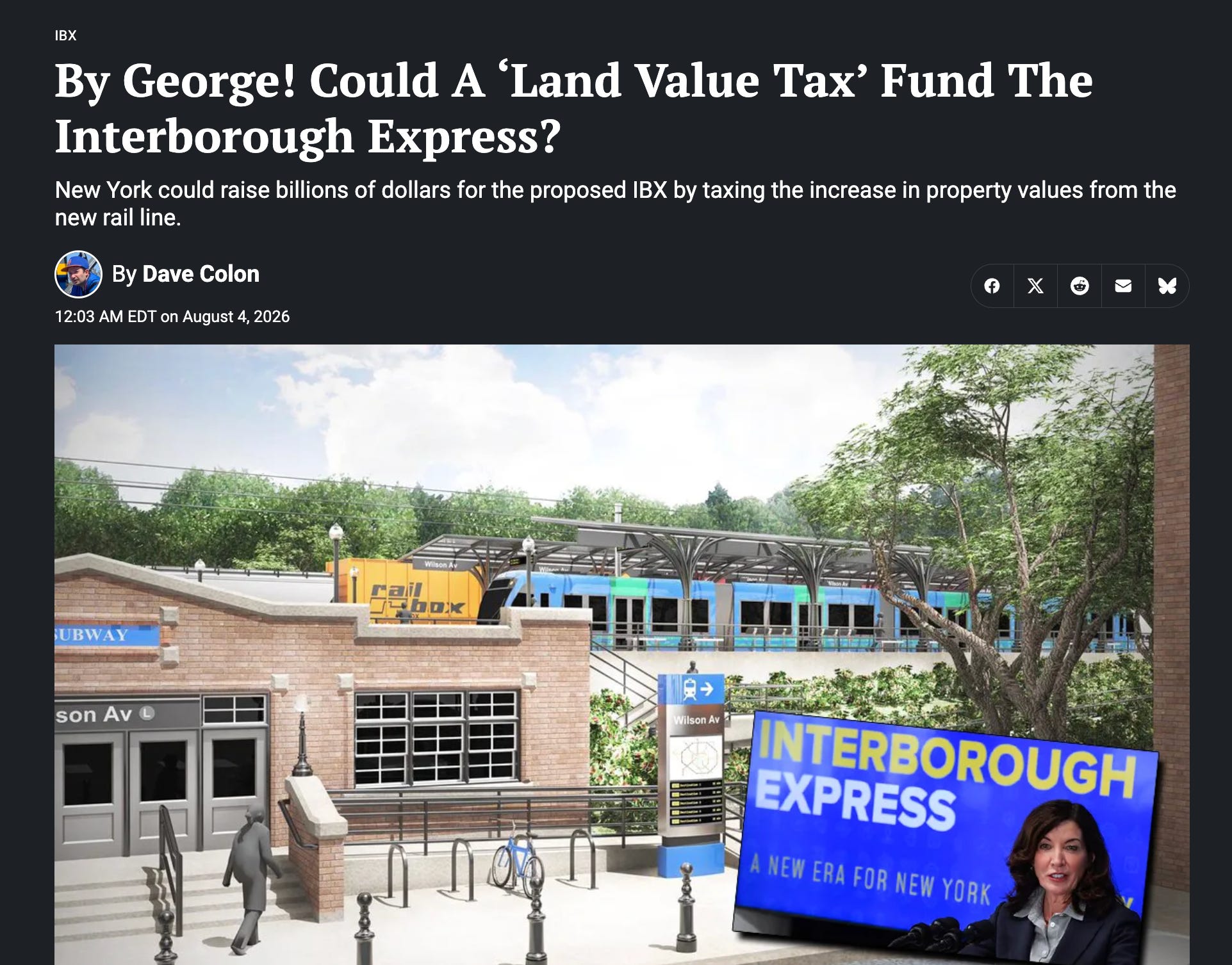
In New York, where Governor Hochul extended authority for cities to fund new transit lines using value capture, movement continues to build to fund the Inter-Borough Express (IBX) using land value taxes. Last month, the Center for Land Economics paired up with the Center for Public Enterprise and Institute for Progress to host a packed-out event at the Community Service Society of New York to discuss how to turn this idea into a real policy.
After the event, Streetsblog–a well-regarded urbanist news outlet in New York–covered the proposal following the event: “By George! Could A ‘Land Value Tax’ Fund The Interborough Express?”. The idea of using LVT to fund IBX was also covered in Vital City by Anthony Flint and Enrique Silva of Lincoln Land Institute.
CivicMapper open source
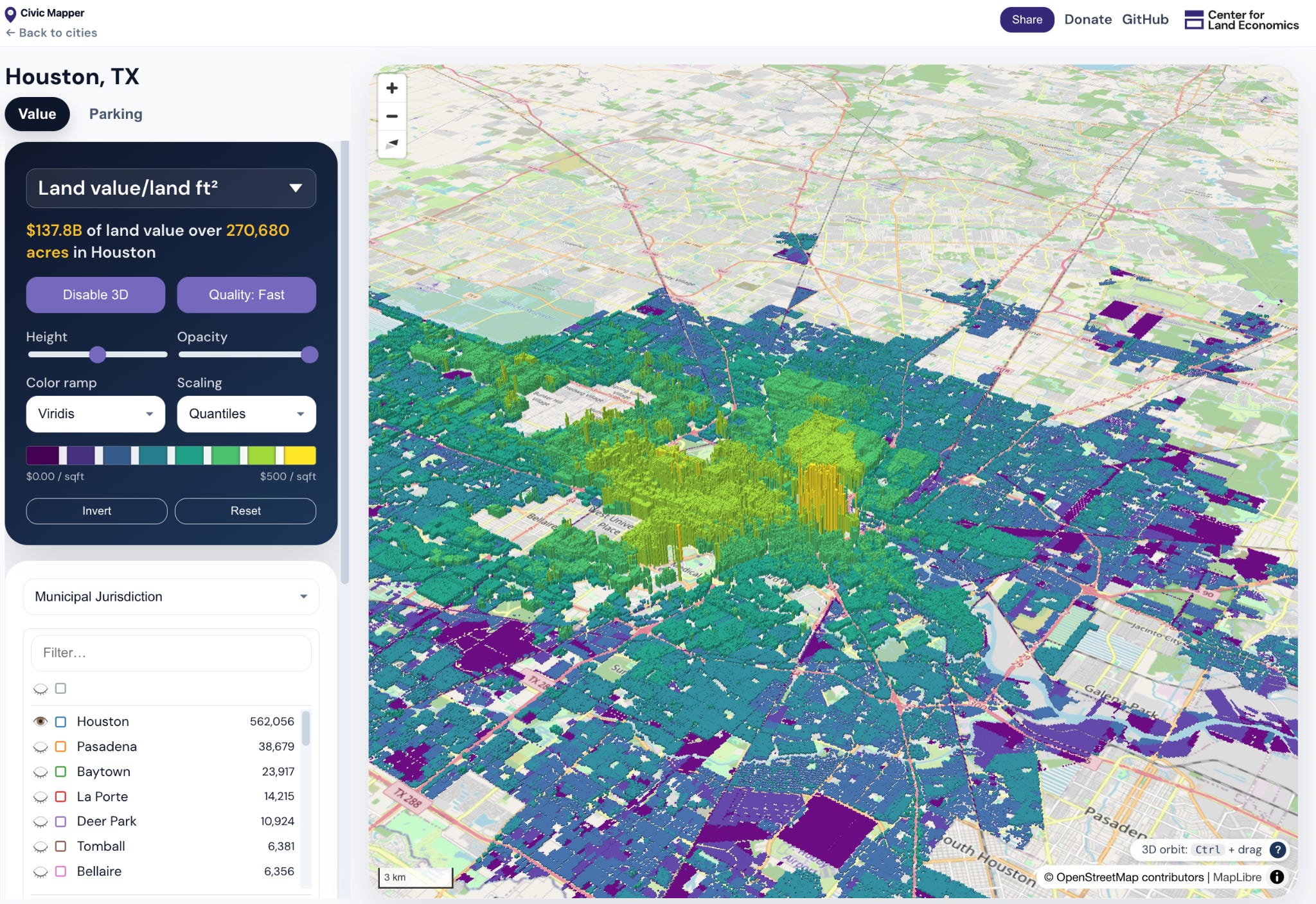
CivicMapper, our website for visualizing land values in cities in 3D, is now fully open source. This means that not only can anyone view the source code, they also have the full legal right to copy it, deploy their own city data, and publish it on their own website. We hope that this will allow others to build on top of this software and continue to improve it, as well as make it easier for volunteers to contribute new cities to our backend.
More LVT momentum
Lars Doucet was announced as a Roots for Progress Institute Fellow for the Blog Building intensive.
I sat down with Kate Gasparro of Building Better Cities to talk about land value tax, “the holy grail of urbanism”.
Burhan Azeem, a Cambridge MA vice mayor responsible for a large upzoning and current candidate for state senate, has endorsed land value taxes with a great video introducing the concept.
StrongTowns Founder Charles Marohn has a really strong piece “Slouching Toward California“ defending property taxes as states like Florida push to abolish them. He also covers land value tax in the 30th minute of his Q&A podcast this week; notably, pointing to Lars as an example of how to “be normal” while talking about land value tax.
Justine Underhill, a Falls Church VA councilmember and urbanist Youtuber, made a video exploring how downtowns can subsidize sprawl and how a land value tax may be the solution to these problems.
Lars encourages video game developers looking for what’s next to consider joining their local assessor’s office in conversation with Allaire Conte at Realtor.com.
Two Wharton professors argue that Mamdani should focus his efforts on land value taxes.
Michael Riha, a Norfolk resident and retired Air Force Lieutenant Colonel, makes the case that Virginia homeowners should demand a land value tax in the Virginia Pilot.
Michael McKee, a native to the DMV area, argues in Greater Greater Washington that land value tax could help fund bus rapid transit lines in Montgomery County.
Do you follow us on socials? I recently started an X account, which is a good time to check in and plug all CLE socials.
Have I missed any updates? Or, do you see opportunity for LVT in your area? Reach out: greg@landeconomics.org.
Greg Miller is the Executive Director of the Center for Land Economics.
One piece of national legislation that would be useful is amendment of the Home Mortgage Disclosure Act (HMDA) to add land value to the data lenders are required to submit to the Department of Housing & Urban Development. The law has always required reporting of the purchase price paid for a property and the total appraised value. Adding the land value provided in the property appraisal would contribute to a real time national data base of changes in residential land values.