



Local governments are increasingly imposing “impact fees” on new development; these are one-time fees that developers must pay every time they want to build something. Impact fees are meant to offset the costs of new construction (for example, increased traffic), and are supposed to be grounded in real costs directly caused by new construction. Courts therefore require impact fees to have an ‘essential nexus’ to the burden the new development creates and to be roughly proportional to it: in 2024, the Supreme Court extended this standard to fees set by legislatures in Sheetz v. El Dorado County. Unfortunately, in real life, impact fees have regressive effects, suppress construction and raise housing costs. Rightly, those who support lifting restrictions on housing, especially affordable housing, also support lowering, reforming, and even abolishing impact fees.
Impact fees have a close cousin known as a “building tax,” which has similar bad effects, but which receives far less attention in YIMBY circles. Building taxes are taxes imposed by local governments on all construction, not just new projects. Additionally, they are proportional to the building’s market value, and are charged every year, not just a single time up-front. Simply put, the more someone builds, the more they pay, forever. The predictable result is a lot less construction.
This “building tax” has been hiding in plain sight all along–lurking inside every conventional property tax. This is because property taxes are actually two taxes bundled together, not one. The first part is a tax on the value of land (which is good), and the second part is a tax on the value of the building, having all the same negative effects of an impact fee (which is bad).
Pro-housing advocates have begun pushing back against high impact fees, as featured in Strong Towns, Public Comment, and Reason Magazine. Analysis estimating the costs of impact fees has been conducted by RAND, the Terner Center, and the wider academic literature. This has led to litigation and corrective legislation in states like California, Montana, and Florida. The pro-housing movement should direct the same righteous energy at removing the equally damaging building tax.
When a landowner decides to build a housing project, they add value to the taxable property on their land, directly increasing their building tax burden. As long as a building tax is in place, more construction means more taxes. The mechanism for how this leads to fewer homes is exactly the same as the mechanism by which an impact fee harms construction: high fees discourage builders from building improvements because the government-imposed costs make the project financially unviable. A builder considering the viability of a new apartment complex must also account for the fact that every additional unit or square foot they build comes with a perpetual added building tax liability.
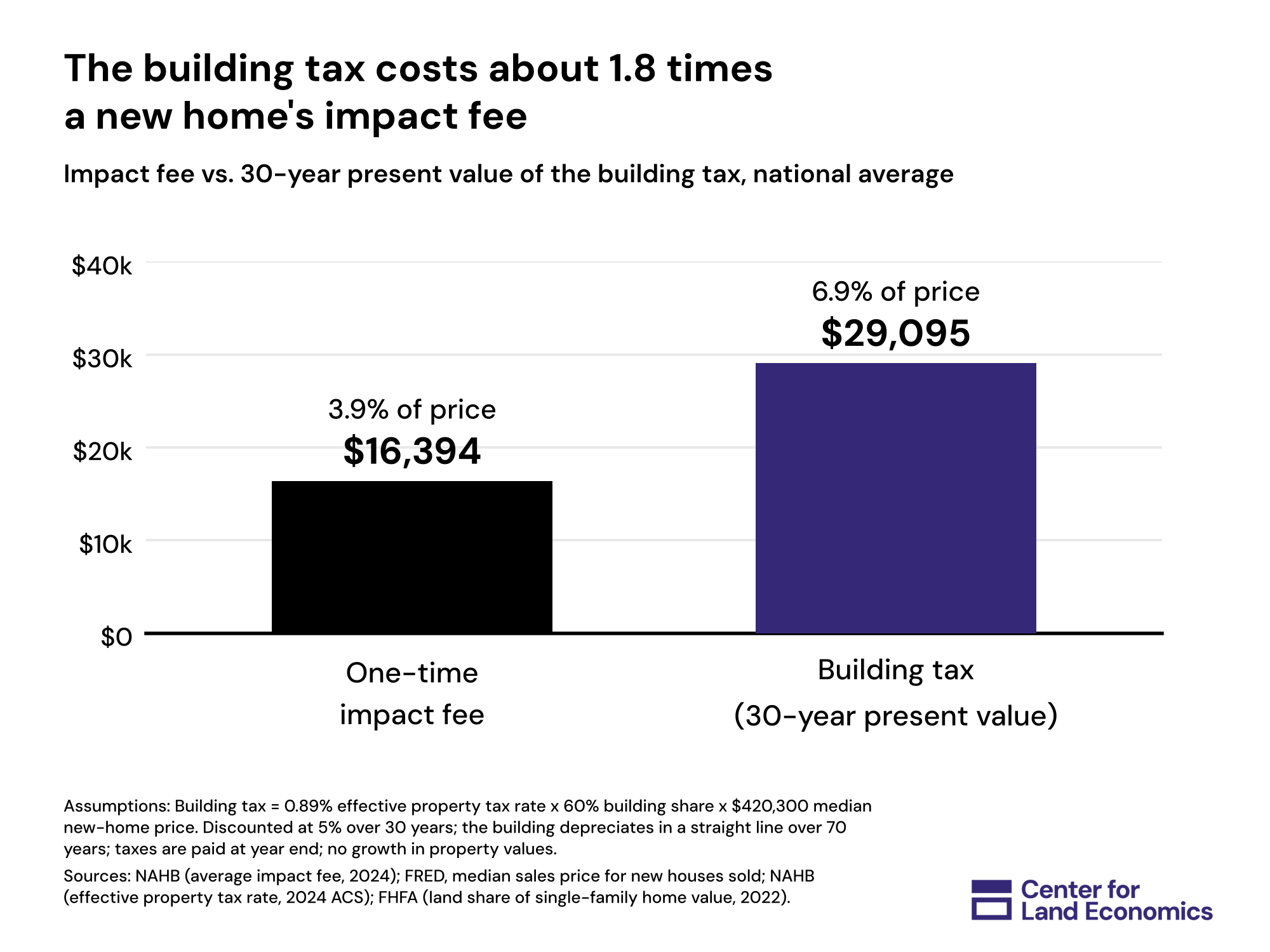
The average U.S. impact fee charged was roughly 4% of the median home price1. By comparison, a building tax is 1.6 to 2 times as large: levied at the national effective property tax rate of 0.89%, it’s about 7 to 8 percent of a new home’s price2. The effective rate is often higher for apartments, which are not classified as homesteads. Whether the tax is due during construction or only once a building is placed in service, it raises the cost of construction, reduces what buyers are willing to pay, and cuts the builder’s expected profit, just as an impact fee does.
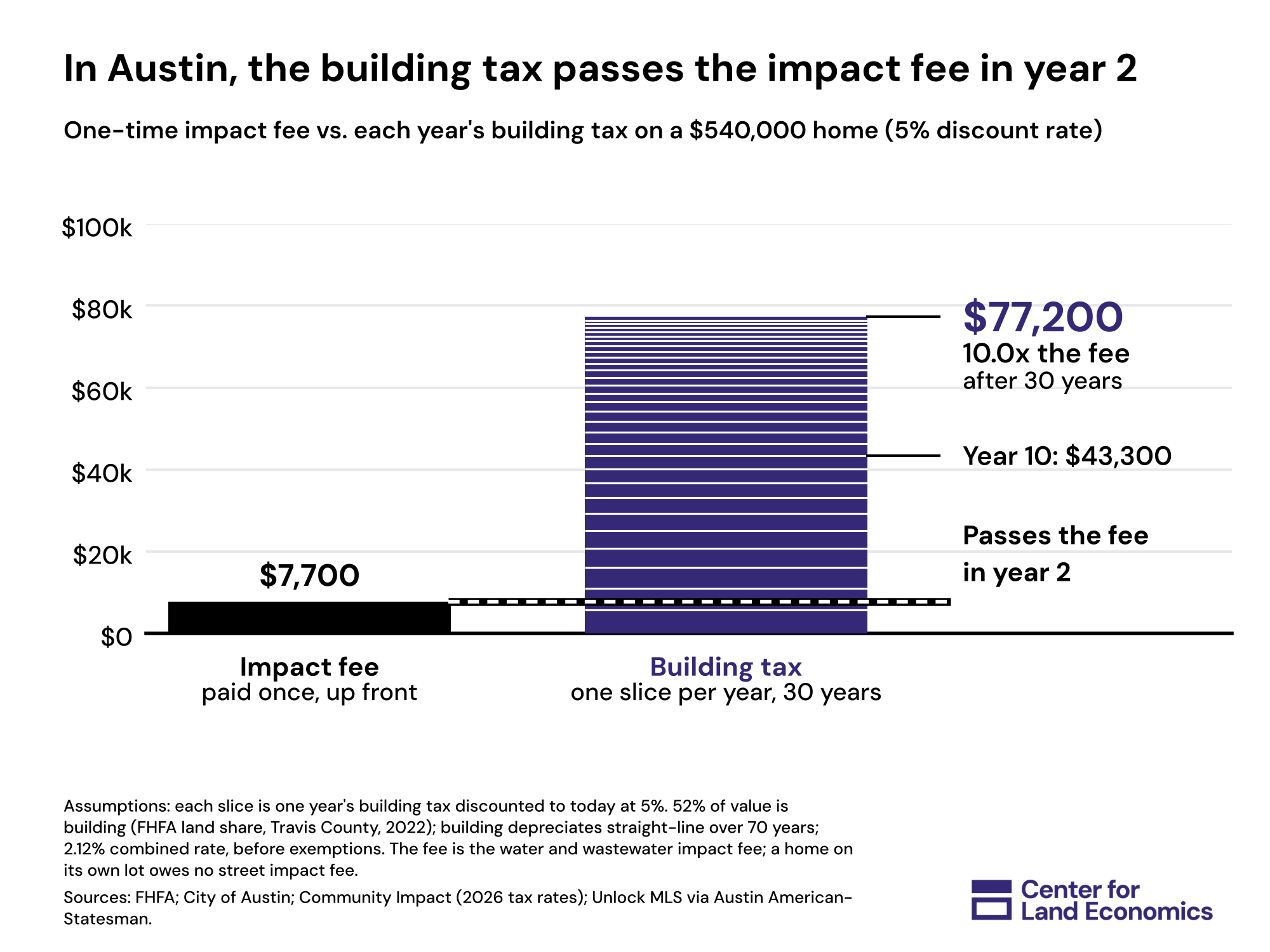
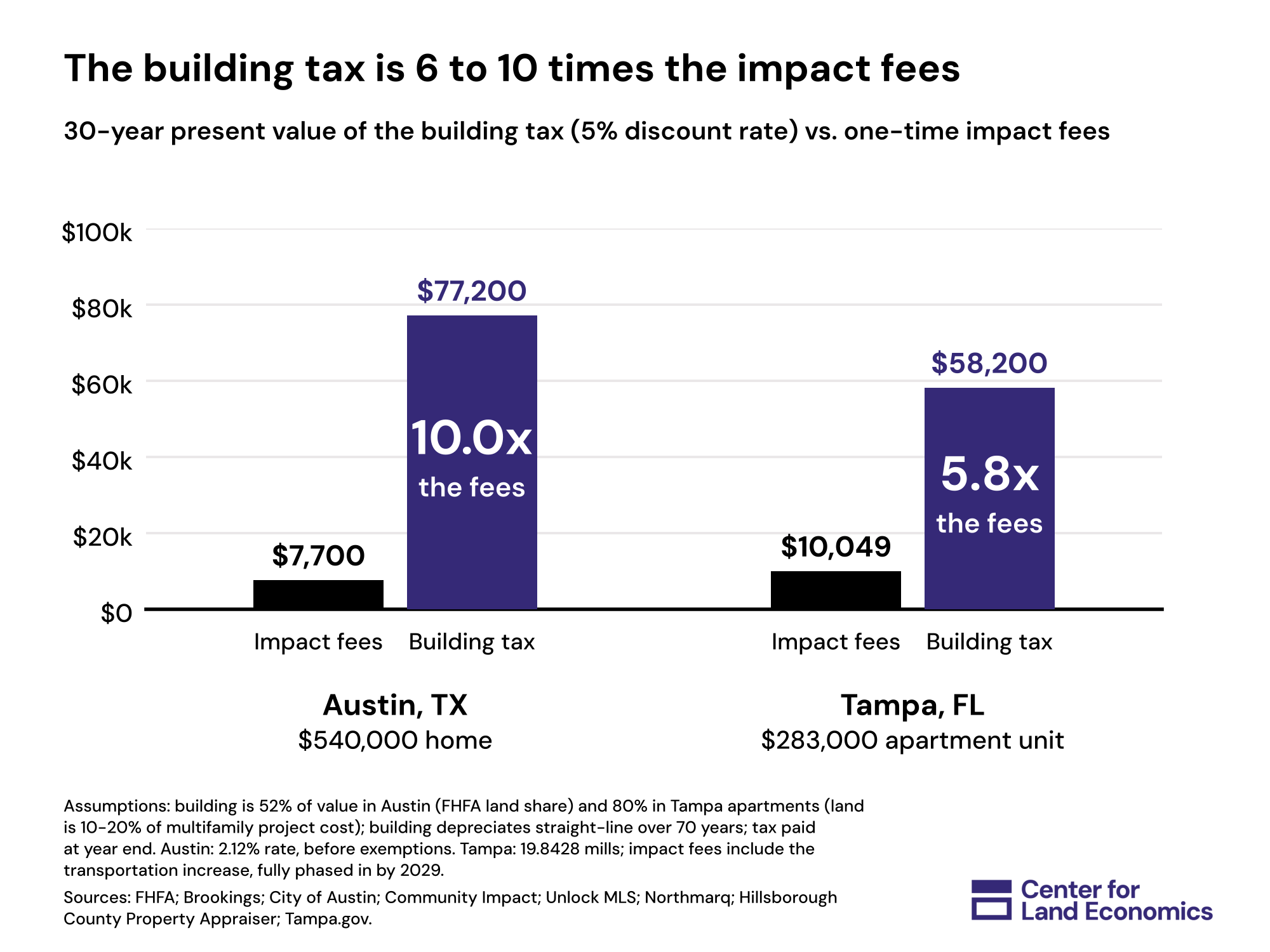
For an illustration, we can look to Austin, where water and wastewater impact fees add $7,700 to the cost of a home built on a lot platted since October 20233. Austin’s property taxes are about $2.1211 per $100 of assessed value.4 With a February 2026 median sale price of $540,000 for Austin homes, this creates a yearly property tax of about $11,454 before any exemptions. Given official land value figures, about $5,956 of that bill is for the building tax.5 At a 5% discount rate, the first year’s building tax is worth $5,672 today and the second year’s is worth $5,325. By the end of year two, building taxes on the property have a net present value of about $11,000, already surpassing the impact fee of $7,700. Over 30 years, the net present value of building taxes on a single home grows to $77,200, 10 times the impact fee.6
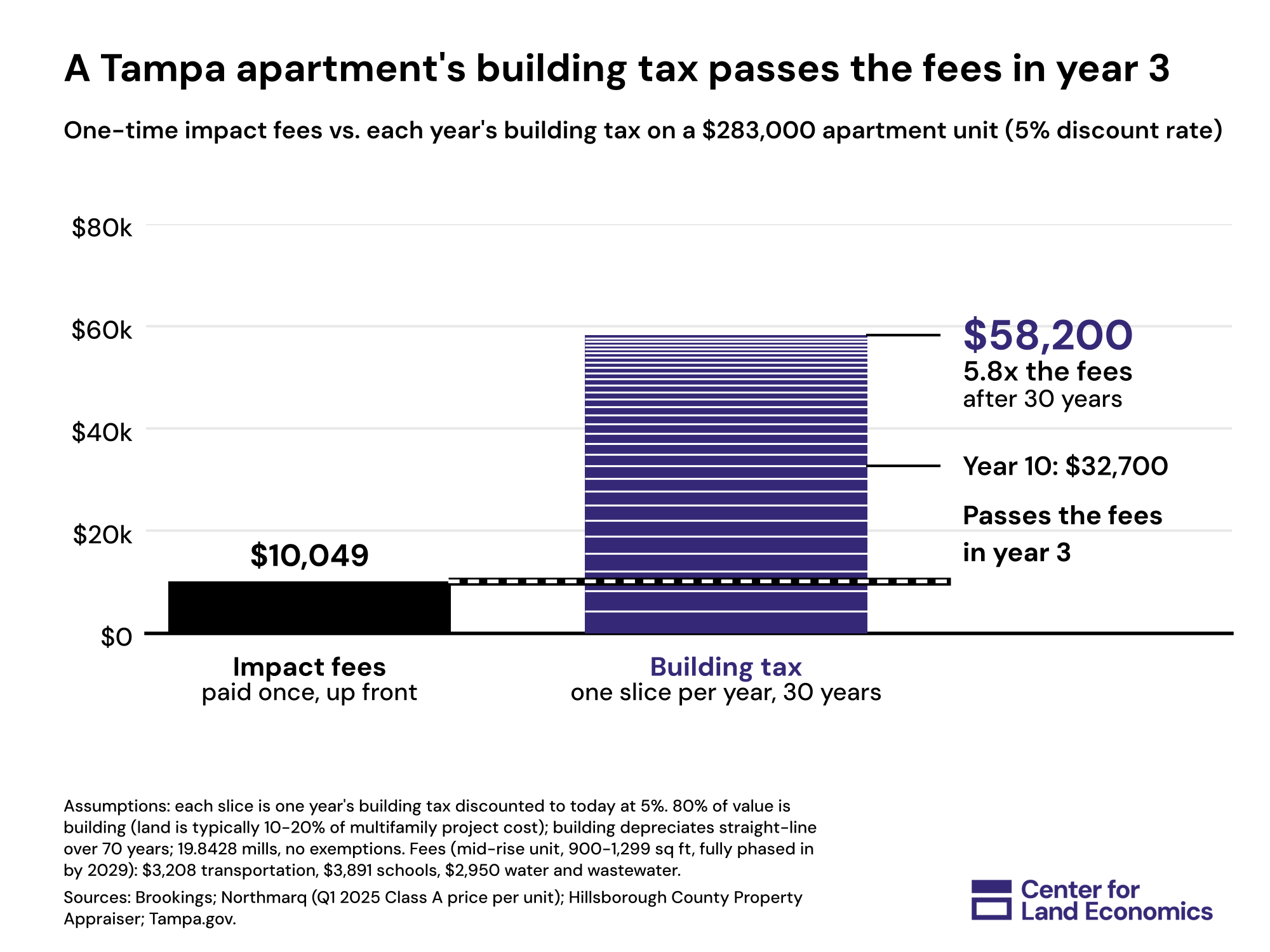
Tampa tells the same story, even when we look at apartment complexes. The total impact fee for a new apartment there will soon be about $10,000 per unit7. Property taxes inside the City of Tampa are about $19.8428 per $1,000 of assessed value. With Class A apartments trading at about $283,000 per unit, this creates a yearly property tax of about $5,616 per unit. Official land values imply about $4,492 of that bill is building taxes. By the end of year three, building taxes have a net present value of about $12,100, higher than the impact fees8. Over 30 years, the net present value of building taxes on a single unit grows to $58,200, roughly 5.8 times total impact fees9.
Lubbock, Texas shows where the cost of growth goes when a city drops impact fees and changes nothing else. In August 2025, the city council voted to set its roadway impact fee to zero. The program had charged developers 25 percent of the cost of new thoroughfares and had collected about $14 million since 2021. The city engineer had said those fees reduce the burden on the general fund, and one councilmember called the repeal an indirect tax increase. The roads still have to be built. One developer who argued for repeal proposed funding them with city road bonds instead, and Lubbock voters had already approved more than $300 million of them. Bonds are repaid through the property tax, which falls on the value of every building, new ones included, every year. The cost of growth doesn’t disappear when the one-time fee does. It moves to the tax that recurs.
At the same time, we are in no way opposed to property taxes in general–just the building taxes bundled into them. Should the ongoing tax revolt against property taxes succeed, abolishing not just the building component of the tax but also the land value component, two bad things would happen. First, land speculation and idle land hoarding of the most valuable lots in town would be supercharged. Second, local governments would be left with no alternative but to turn to even more regressive and damaging taxes such as income taxes and sales taxes, not to mention tolls and fees on anything that moves:
So You Want to Abolish Property Taxes

A lot of people in the Republican party have been talking about abolishing property taxes lately. This is a bad idea with unintended consequences, and they shouldn’t do it.
Those who wish to “abolish” property taxes would be wise to redirect their energy to the one portion of the tax that is actually bad: building taxes, and leave the land component, which can be taxed in a way that increases building and growth, alone. Short of that, a reasonable compromise is simply to introduce a 10-year abatement on the improvement value of new construction, which is easier to implement and yields much of the same effects, while holding overall property tax revenue neutral.
Impact fees and building taxes are two versions of the same bad policy: both charge people for adding homes, resulting in fewer homes getting built. Pro-housing advocates are right to oppose impact fees, and the same logic should make them oppose building taxes with equal or even greater force, given they recur every year instead of hitting just once.
Impact fees are bad; pro-housing advocates should get comfortable saying the same thing about building taxes.
The average U.S. impact fee was about $16,400 which is about 4% of the median home price which FRED places at $420,300 in 2024.
This assumes a discount rate of 5 percent over the next 30 years, along with a 70 year lifetime, straight-line depreciation, and a building that accounts for about 60 percent of a home's value, based on land's 40 percent share of single-family home value nationally in 2022.
Austin Water charges its impact fee per service unit, set by meter size. We assume a 5/8-inch meter for one service unit.
This includes city, county, school district, community college, and hospital districts.
Land was about 48 percent of a typical single-family home’s value in Travis County in 2022, so we assume buildings make up 52 percent of its value.
These figures assume a 70-year lifespan and straight-line depreciation.
Fully phased-in fees (July 2029) for a mid-rise unit of 900 to 1,299 square feet: $3,208 transportation (average of Tampa’s six fee districts), $3,891 schools, and $2,950 water and wastewater (today’s fee, one connection per unit), for a total of $10,049.
We assume 80% of the property’s value is the building, since land is typically 10% to 20% of multifamily project costs. We also assume the unit is assessed at its sale price, receives no exemptions, and is taxed at 19.84 mills for all 30 years.
We assume the building depreciates in a straight line over a 70-year effective lifetime, so the building tax falls by about $64 each year. Taxes are paid at year end and discounted at a 5% nominal rate, with no growth in property values.
One of the silliest things about impact fees is that they are also very short sighted. Like, yeah, the impact fees might help cover the construction of new supporting infrastructure in the immediate future, but the cost to maintain and eventually rebuild that infrastructure doesn't go away. It's a recurring cost. At least property taxes do cover that aspect, too.
That being said, as you point out, impact fees and improvement taxes are based on a somewhat false picture of costs. The assumption is always that more people mean more problems, and thus new people must cover the new costs. And the attitude is that density only makes this worse.
According to studies of city financial data, however, the exact opposite is true. Higher density is correlated with lower costs per capita for both infrastructure and operations for pretty much all categories of standard municipal spending. Schools, transportation, fire service all get cheaper, both in terms of infrastructure built (schoolhouses, fire stations, roads) and staffing (staff don't have to drive as far to do their jobs, among other impacts). The same is true for police infrastructure as well, although it was found that police operations costs are pretty much the same per capita no matter the density, and even very very slightly more expensive (the assumed logic is that higher density leads to more public interactions and thus potential for police-required conflict handling, which offsets other operational efficiencies). The full study can be found here: https://www.mdpi.com/2413-8851/5/3/69
The other half of it is the assumption that by preventing more folks from moving into your town, you stop them from adding to problems like traffic. This is false, though, since those folks don't disappear, they just move farther away. And because they are now farther away than they would prefer, that means they are having to drive even more, increasing traffic more than if you just let them live in your town in the first place. And that's not even getting into the potential for folks being able to shift to walking or biking or taking transit. That's still assuming that everyone is driving. Reducing vehicle miles traveled goes a long way all by itself. But instead we're doing the opposite, and VMT per capita only gets higher and higher every year. No wonder traffic is so bad!
Focusing on the dual nature of property taxes - land v building - is great. People need to understand that, and that a change could incentivize building. But equating the building part of a property tax with an impact fee ignores important differences. My experience is that properly calculated impact fees facilitate building because they ensure that it is matched by adequate public facilities. There is no such direct connection to the building part of the property tax. You can, of course, argue for a different way of funding new facilities that doesn’t add directly (though just once) to builders’ costs. But what would that be? Incurring debt as in the example you give? Which is then mostly paid by the regressive building tax? Communities that charge impact fees are not ignorant of the fact that they raise the cost of development. But what’s a better alternative? An LVT that covers the regular, predictable operating costs of local government would be beneficial. But would using it to cover the irregular costs of facilities that serve particular developments make any sense?