

I interrupt our usual flow of essays for one important announcement:
The Center for Land Economics team has grown to three!
Jeff Fong has joined as our Head of Policy and Partnerships.
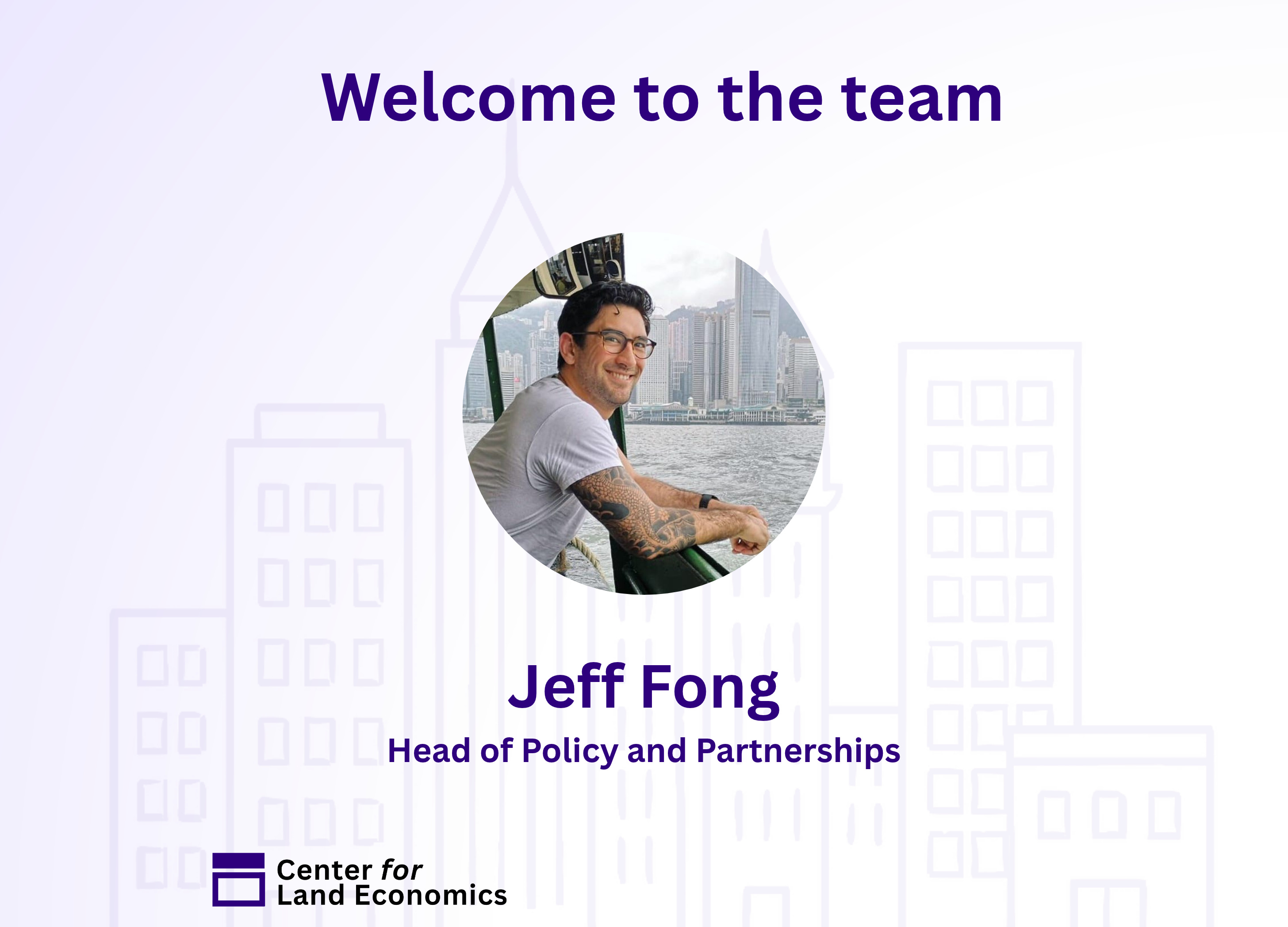
Jeff is a longtime housing advocate, writer, and technologist who has spent years at the intersection of land use and product development. He was an early employee at Lyft, and later led several product teams at Postmates. Since 2020, he’s served as National Board Chair of YIMBY Action, helping grow one of the country’s most influential housing reform organizations. He’s also been thinking about the advocacy model for land value return for years. You can see some of that in his writing at Urban Proxima. He has also previously written for us right here at Progress and Poverty Substack.
How YIMBYism Can Pave The Way For Georgism

As this Substack has previously explored, the YIMBY and Georgist movements are natural complements for each other. Most Yimbys love Georgism and most Georgists are on the train to Yimbytown. However, Yimbyism has gained political traction while Georgism is still relatively niche. Reappropriating land rents remains anathema to most home owning Americans.…
He recently wrote a whole series on public-owned assets, mainly land.

In other words, Jeff is a superstar and the perfect person for this role. Lars and I are very excited to have him join the team.
For the past year, CLE has had far more meaningful work to perform than hands to do it. We’ve been providing technical assistance on property taxes in 10+ states, publishing here every week, maintaining open-source tools for understanding land values and modeling tax shifts, and doing longer-term research, including an upcoming piece on how to test land values.
We’ve shown we can go 0→1. Now we want to go 1→100.
That’s where Jeff comes in. Beyond adding capacity, he’ll build out our Land Action Fellowship (name still TBD). He’ll also help turn CLE’s ideas into programs and tools we can hand to advocates across the country.
Jeff's role exists because one generous individual donor decided to bet on us. That's a big deal for an organization our size, and it shows how much a single person can move things. We're grateful, but we're not done. Our work has grown faster than our budget, and we're still building the runway to match it. If you want to help us keep going, you can support CLE here.
If you’re working on LVT in your area, please add to Jeff’s workload by reaching out at jeff@landeconomics.org. We mean it.
Welcome aboard, Jeff!
I didn't get to read Jeff's Part 2 since it looks like he hasn't written it yet. But the solution to the problem of the Federal government no longer supporting the states and cities like it used to boils down to 2 things that are not the problem, and 1 that is the solution to the problem which is not mentioned in Jeff's summary list of raising taxes, cutting spending elsewhere, or whatever it is that states and cities can do for themselves (whatever could that be...? I'm guessing it's LVT, given the blog reference from the P&P Institute). These are:
1. Curing the animus of the Trump administration to blue states and cities through new elections. This matters a great deal because Trump seeks vengeance a great deal, more than any other president, ever.
2. Using the courts to force the administration to fulfill previous administrations' obligations. This is not trivial. Here in NY, courts have forced Trump to resume funding for the Gateway tunnel project- the largest transit project in the country, to temporarily replace, then augment, the 100+ year old NJ-NYC tunnels for Amtrak and NJ transit to Penn Station (which Trump has taken over, though for that he seems to want to have private real estate interest pay for it out of neighborhood development as part of a deal that so far is not transparent).
Before going onto the federal solution, it's worth noting relatedly, and as comedian Bill Mawr said "Money is not real."
3. OK, the solution is Henry George's Other Great Idea: Sovereign Money. Debt-free sovereign money was introduced in America during George's lifetime to fight the Civil War by president Lincoln and Congress. United States Notes, aka Greenbacks because the new bills had a green back were, and could be again, issued directly by the U.S. Treasury. There was no central bank in 1862-1863 and the NYC banks back then wanted 24-36% interest. U.S. Notes are our longest-lasting currency, reissued up until 1971, one year before Nixon took the U.S. off the international gold standard, helping to fuel inflation (the oil crisis had something to do with that too, though more cynical economists blame the need to pay for the Vietnam war in depreciated currency too). They were officially in circulation until 1996, but are still technically valid currency, though it would be dumb to spend them like that since they sell for 3X face value on eBay (I have two $5 U.S. Notes myself); you'd be getting $5 worth of goods for money costing ~$15!
Critically, U.S. Notes are specifically excluded from the debt ceiling in the U.S. Treasury quarterly debt report (I have a snippet of a recent report showing that, but I can't attach that here). They are not debt. They can be used to PAY off the debt, however, retiring all or part of it in ~10 years, with refinancing along the way. Since they are acceptable for taxes - electronically now, not just in paper bills like in Lincoln's day - they are guaranteed 1:1 legitimacy with Federal Reserve Notes issued by the Central Bank in exchange for Treasuries which are now paying high interest.
The Constitution even permits Congress to "coin Money" in Art. 1, Section 8, Clause 5. And the Supreme Court has allowed for government issued money in the case of Julliard v. Greenman in 1884, still valid:
"Juilliard v. Greenman (1884) — The Legal Tender Case
The U.S. Supreme Court held that Congress has constitutional authority to make U.S. treasury notes legal tender for private debts in peacetime as well as wartime, upholding the Legal Tender Acts of 1862 and 1863"
Henry George said of all the 9 types of money in his time, Greenbacks were the most favored by the People. They could be again.