

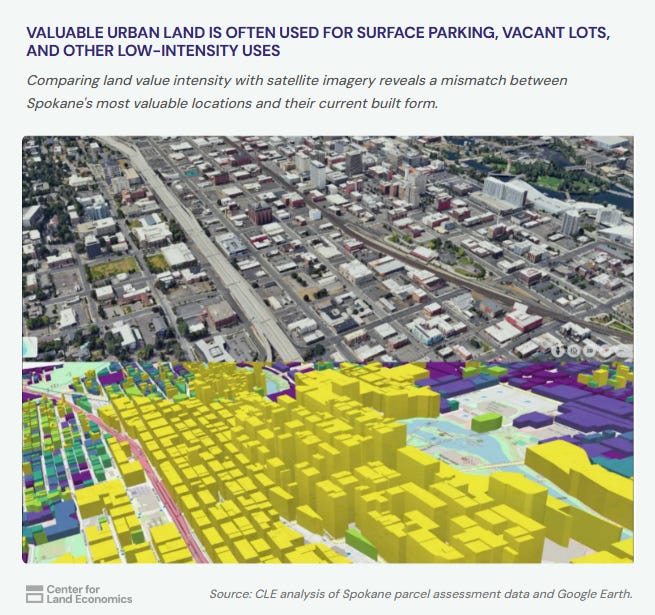
There are two things we like to point out here at the Center for Land Economics: the most valuable land is concentrated in city centers, and these are precisely the areas where land is being held out of use, as surface parking lots and the like.
A common reply to this is: “if people hold valuable land out of use, there must be a good reason for doing so.” One such example is a LessWrong.com post by Matthew Barnett, entitled “Some Arguments against a Land Value Tax”. He first argues that in most cases, land speculation doesn’t make rational sense:
In reality, the opportunity cost of holding idle land is not insignificant. When a landowner holds onto undeveloped land, they forgo the potential income they could have earned by selling it and investing the money into other productive assets, such as stocks, bonds, or real estate developments elsewhere. Economic theory suggests that rational landowners would compare the expected appreciation of their land to the returns they could earn from reinvesting their capital, and in most cases, holding idle land for an extended period of time would likely not be the most profitable option.
However, granting that land speculation does still happen, he argues that it’s fine:
Even in cases where land is held idle by developers or investors, it is unclear that speculation is inherently harmful or inefficient in an economic sense. Land speculation often involves anticipating future trends in development, infrastructure, or zoning, and holding land can sometimes be a rational way to align its use with long-term economic needs. For example, an investor who buys land near a growing city may be waiting for the right moment to develop it, ensuring that the land’s use aligns with future demand. The act of holding land in such scenarios could be seen as part of a broader rational economic process, rather than as an inefficiency that needs to be corrected.
There’s a couple of questionable assumptions baked into this. The first is that everyone in the economy is behaving rationally, which isn’t always true. The second is that just because some individuals have rational incentives to speculate on land, it must also be good for society. Behavior follows incentives, and holding prime land out of use is only rational under status quo incentives, which we can and should change. But what are those incentives?
Fortunately, there’s a large body of economic research dedicated to this exact phenomenon. I was reminded of this by my friend, Professor Arpit Gupta of NYU Stern (an excellent economist whose substack you should follow):
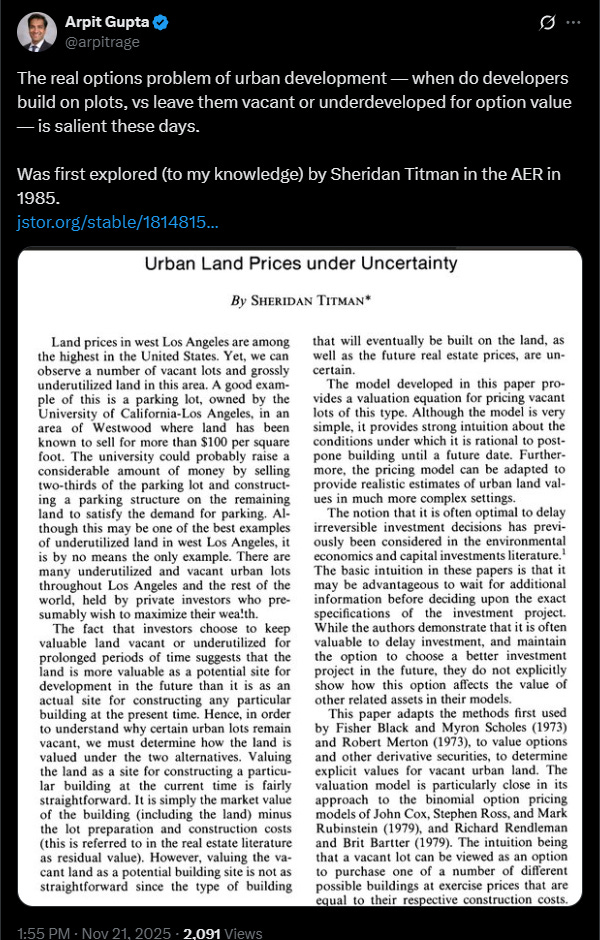
The paper Dr. Gupta is referring to is Urban Land Prices Under Uncertainty by Sheridan Titman, which is the seminal paper describing the “option theory of land value.” Long story short, there’s a perverse incentive to hold land out of use because committing to a particular building today means giving up the opportunity to build a different, better building tomorrow. Additionally, our existing property tax structure further tilts the scales towards waiting over building. If we understand how these two forces interact, we can enact better policies which will reduce the incentive to hoard the best land and increase the incentive to build.
The paper itself is fairly dense and leans on abstract financial jargon, so I’m going to break it down into simple English with lots of pictures.
Option Theory of Land Value
Let’s say I own a vacant lot downtown. If I were to build something on it today, I could make a certain amount of profit. However, I notice that the city is growing. If current trends continue, in five years I could make twice as much profit if I waited, and then built an even bigger building. The bigger building could make more money, but only if future demand is sufficient to lease the extra units at higher rents. I could build a smaller building today and max out my earnings in the present, but when the market improves in a few years I will regret being stuck with this smaller building, because tearing it down isn’t free.
This means my land has not one but two different potential values—its current potential, and its future potential, and I have to pick one. How do I pick?
As it turns out, we can borrow a financial framework from Wall Street called options to understand this better. Now, if you’re like me, whenever people start talking about stocks and bonds and calls and puts and options and shorts and all that other financial jargon I get completely lost. So for my own sake and yours, I’m going to break this down in plain English.
Groundhog Day
Let’s say it’s Groundhog Day, and we’re taking bets on whether Punxsutawney Phil will see his shadow. A friendly bookie offers to sell you one of two contracts: Shadow and No Shadow. If you buy one unit of Shadow, the bookie pays you a dollar if Phil sees his shadow, and nothing if he doesn’t. If you buy one unit of No Shadow, the payouts are reversed—a buck for not seeing the shadow, nothing for seeing it.
You can buy as many units of Shadow and No Shadow as you want, but on Groundhog day, only one type will pay out and all the others will become worthless. How much should you pay for each contract?
Well, that depends entirely on what you think the relative likelihoods are. Historically, Phil sees his shadow most of the time, so you should be willing to pay at least 50 cents for a Shadow contract and less than 50 cents for a No Shadow contract. If you know with perfect certainty that the little dude will see his shadow, you should even be willing to pay up to 99 cents for a Shadow contract, because you’re guaranteed to make money.

.jpg)
When Phil sees his shadow, you may exercise your Shadow contracts and collect a dollar for each one, but your No Shadow contracts immediately expire as worthless.
To Build or Not to Build
A landowner faces a similar situation, but instead of betting on the fate of small furry mammals, they are betting on the future prospects of their city. If the best market conditions are right now, they’d be better of building right away. However, if future possibilities are promising, they might be better off waiting.
Still, vacant land earns you no income, whereas land with a building could be leased out or sold. You thus have two other choices besides holding: build something on the land, or sell it and put the money in treasury bills. Every option you don’t take has an opportunity cost—money you could have made but didn’t.
And of course, waiting isn’t free. Your money is tied up when you could have stuck it in very safe treasury bonds earning decent interest. You have recurring costs, such as mowing weeds, repairing fences, or cleaning up dumped trash. You also have to pay property taxes.
However, parking your money in land is not like sticking money underneath your mattress. Money decays with inflation, while land tends to not only hold its value, but in cities tends to grow. Even if your land isn’t generating income, you still make money when its value increases. Therefore, land is often seen as a safer investment than just hoarding cash in a low-interest savings account.
Also, building increases your holding taxes, and the bigger you build, the more you’ll pay, because property taxes are proportional to property value. If you build nothing, you will pay less, often a lot less. Here’s a real-word example from our report on Cincinnati, Ohio. Despite the affordable housing complex sharing the same zoning and location as the parking lot, it pays over twenty-two times as much in tax for each square foot of land it occupies.
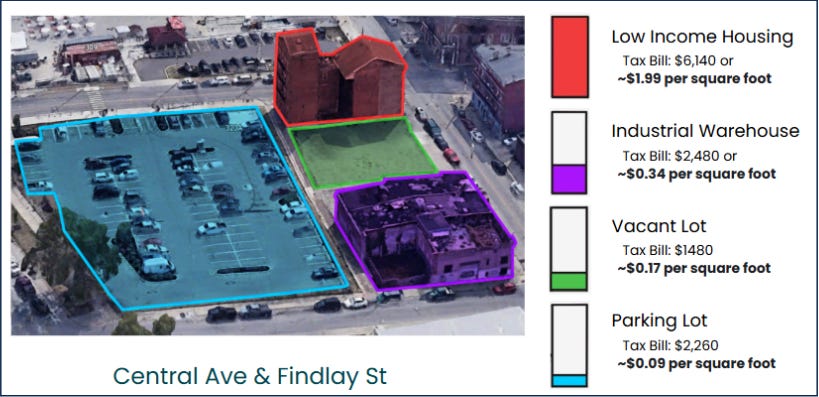
Building means taking a costly risk that might not pan out if the customers or tenants don’t show up for it, and conventional property tax structure makes it cheaper to just hold. Furthermore, holding land can be more attractive than higher yielding treasuries simply because land is scarce; if you have any intention to build in the future, you will worry about having to repurchase the land later at a higher, unknown price.
Finally, land speculation is driven in part by uncertainty. If you already knew for sure what the most profitable choice was, you could decide right now. However, as uncertainty grows, so does the potential value of future uses, and the easier it is to justify waiting one more year just to be sure.
This explains why you might choose to hold a lot vacant, even if you could make more money by developing now, or by selling the land and sticking the money in treasuries. Committing too early could mean foregoing a bunch of future revenue because you didn’t “keep your options open.” If we dig a little deeper, we’ll see how added building costs like development impact fees and property taxes tilt the scales towards “wait,” while land value taxes tilt the scales back towards “build now.”
Option-based Land Value
Given the right data, we can price the “build now” and “wait until later” options in the same way a developer does, and determine which is bigger. According to Titman’s paper, if you take the maximum of the two options, you get the current market value of the land. This is the highest amount of profit you can expect to make whenever you finally pull the trigger, discounted back to today1.
Let’s try this method now, starting by pricing the option of building today.
Value of building now
For the sake of simplicity, let’s assume we’re just trying to decide how big a building we should construct (in areas with restrictive zoning, we won’t have much choice over potential uses, anyways). This is going to depend on two things—how much we think we can sell our building for, and how much it costs to build it.
In this simplified multifamily residential example, each unit rents for about the same rate, so revenue will scale linearly with size.
total_revenue = unit_price * sizeCost, on the other hand, increases as the building gets bigger—the tenth floor is more expensive to build than the first, because of added building complexity, the need for stronger foundations, etc. We’ll grab that information from readily available industry construction cost tables, encoded here as cost_function.
total_cost = cost_function(size)Okay, but this assumes we already know how big a building we want. How do we determine that? Well, if we know the price we’ll get for selling each unit, and how much our costs grow with each additional unit, we just find the point where building the next unit costs more than it earns: the point of zero marginal return. Here’s a simple toy example: if each unit sells for say, $75,000, but the first one costs $60,000, and each subsequent one costs 5% more, than it makes sense to only build five units. Sum up the marginal profit for the first five units, and we have our total profit.
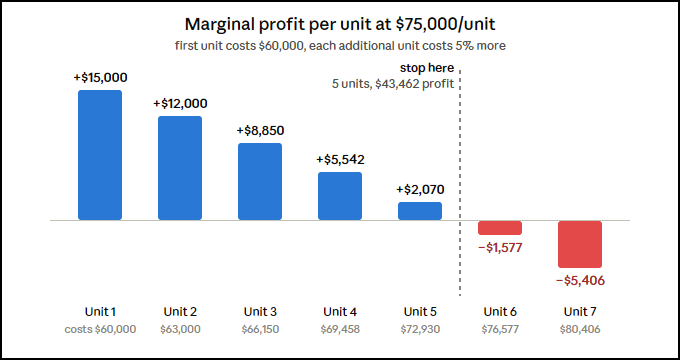
This procedure, which we’ll call calc_profit, simply spits out the expected profit and the maximum number of units we should build, if we give it the price per unit and our cost structure:
profit, num_units = calc_profit(price_per_unit, cost_function)Now we know what we would want to build today, and how much money we’ll have left after we build and sell it.
Value of building later
We’re uncertain how much our units might go for in the future, but we can make an educated guess, and express that as a range. Then we just do the above calculation twice, once for the best case scenario, and once for the worst case.
profit_high, size_high = calc_profit(future_price_high, cost_function)
profit_low, size_low = calc_profit(future_price_low, cost_function)
If we plug in some numbers, we get a result like this:
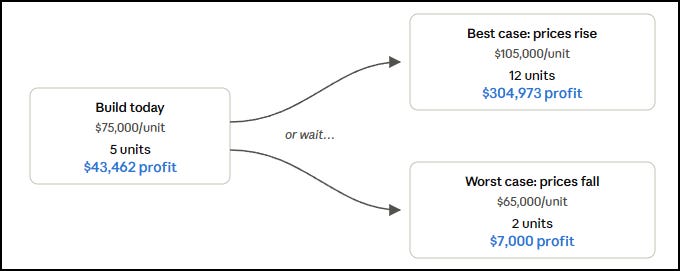
Now we know how much money we might make by building in the future, in the best case and worst case scenario. However, this is future money, and future money isn’t the same as present money. We have to find some way to merge these two scenarios, because only one of them is going to happen. Going back to our Groundhog day metaphor, both the Shadow contract and the No Shadow contract sell for less than one dollar a piece, because one of them won’t happen and will go to zero. A similar thing is going on here—we’re calculating a scenario price that we’ll use to discount each possible future, then combine them into one value that prices in all my future expectations, including costs and uncertainties.
How do we calculate a scenario price?
First, gather these inputs:
p0: The price we get for selling one unit today
ph: The high estimate price for selling one unit in the future
pl: The low estimate price for selling one unit in the future
R: The annual rental yield of one unit
Rf: The risk-free rate of return (treasury bills, essentially)
If we have that, we can do the math like this:
denominator = ph - pl

s_price_high = (p0 - (pl + R) / (1.0 + Rf)) / denominator
s_price_low = ((ph + R) / (1.0 + Rf) - p0) / denominator
There’s a few key differences between these weights and the Groundhog day contracts: first, these aren’t probabilities, they’re more like expressions of how different each scenario is from the present. Second, the two scenario weights won’t perfectly sum to 1.00, the way probability contracts do. Instead, they’ll sum to about 0.954, which is 1.00 divided by 1.0477, the interest rate I’d make in my best risk-free investment alternative, a treasury bill.
If we plug our numbers in, we get both scenario prices: 0.2345 for the best case future, and 0.7200 for the worst case future. Here’s the exact math if you care:
p0 = 75000
ph = 105000
pl = 65000
R  = 3750
Rf = 0.0477

denominator = ph - pl = 40000

s_price_high = (p0 - (pl + R) / (1.0 + Rf)) / denominator
s_price_low  = ((ph + R) / (1.0 + Rf) - p0) / denominator

s_price_high = (75000 - (65000 + 3750) / 1.0477) / 40000
s_price_low  = ((105000 + 3750) / 1.0477 - 75000) / 40000

s_price_high = (75000 - 68750 / 1.0477) / 40000
s_price_low  = (108750 / 1.0477 - 75000) / 40000

s_price_high = (75000 - 65619.93) / 40000
s_price_low  = (103798.80 - 75000) / 40000

s_price_high = 9380.07 / 40000
s_price_low  = 28798.80 / 40000

s_price_high = 0.2345
s_price_low  = 0.7200

//check: 0.2345 + 0.7200 = 0.9545 = 1 / 1.0477
Now that we have the two scenario prices, we can weight the profit from each possible future and combine them. Since each scenario price is pre-weighted against the best risk-free investment, they’re also already discounted to today’s dollars.
profit_wait = (profit_high * s_price_high) + (profit_low * s_price_low)This gives us how much profit will be left over by building and immediately selling something in the future, valued in present terms, accounting for our stated uncertainty.
Deciding whether to build
We now have two profit values: profit_now and profit_wait, which represent the amount of profit we expect to get from building now, or building later.
Notice that even though the option math heavily discounts the best case scenario, the fact that it’s possible still greatly increases the option value of waiting. This shows how growing uncertainty can tilt the scales towards waiting; if I was certain future profit would merely equal present profit, the inherent discounting of future money would push me to build right now.
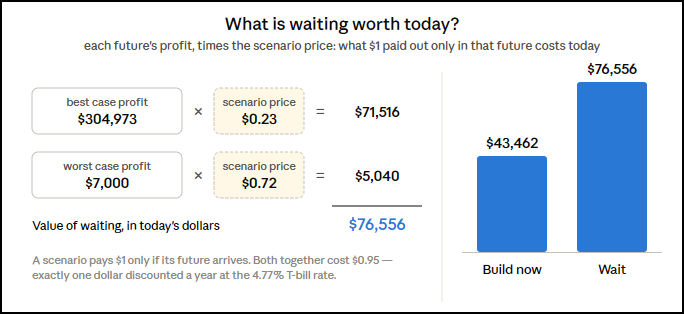
profit_now represents how much profit I have left over if I build the most valuable building under current market conditions and immediately sell it. The profit in this scenario is also the value of the land. To understand why, imagine that instead of me doing this deal, it’s somebody else. They are now paying the same costs of construction and gaining the same revenue from selling the building I’m considering. But on top of that, they have to buy the land from me first, and profit_now represents how much profit someone would get after selling the building today if we assume they already own the land. Therefore, profit_now is the maximum amount they could pay for the land and still break even.
profit_wait represents the exact same thing, with a few exceptions. First, it’s based on assumptions about future market conditions, not current ones. Second, that future value is discounted back to today, because future dollars are worth less than current dollars. Third, it’s accounting for the fact that I’m foregoing the opportunity to just sell my land now and put the money in treasury bills, which are guaranteed a certain rate of return. Fourth, it changes based on my uncertainty about the future.
Nevertheless, if profit_wait is greater than profit_now, it makes sense to wait. If profit_now is greater, it makes sense to build. The greater of these two is the price I’m willing to sell the land for today, because that’s how much value I would get by either doing something with it myself, now or in the future, adjusted for time, uncertainty, and my best risk-free alternative.
Cool, So What?
There are several interesting things that fall out of this model.
First, it tells us why people hold land out of use—because it’s individually rational!
Second, it lets us predict what would happen if the holding cost structure was changed, changing the profit of each scenario. Conventional property tax structure, which increases in proportion to how much you build, and decreases in proportion to how much you don’t build, makes it cheaper to wait and more expensive to build now. If instead we make it more expensive to hold land, and at the same time that holding cost doesn’t change at all in response to what you build, the equilibrium point shifts and more landowners would build rather than hold, or else sell to someone who will.
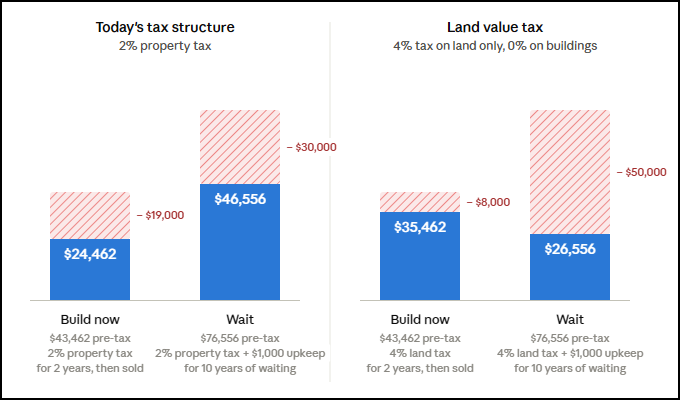
Third, it lets us better understand the larger equilibrium. Right now, valuable downtown lots held out of use are an example of a prisoner’s dilemma, a scenario in which individually rational choices can create worse outcomes for everyone involved. Every person who builds now helps to create a more vibrant city, attract new people and businesses, and thereby makes conditions more favorable for others to also build now rather than wait. The same happens in reverse—every person who waits helps contribute to the hollowing out of downtowns, slowing the city’s growth and making it more rational for others to hold out and wait too. Removing taxes on buildings and shifting them to land changes this dynamic.
Some critics may concede that land value tax encourages more development now, but at the same time increases the cost of more optimal development in the future because now the developer must pay teardown costs before they can redevelop. I’m happy to acknowledge this point, but on net I think this is the wrong problem to worry about; our society is so biased against building in general that we shouldn’t let the perfect be the enemy of the good.
We should also acknowledge that plenty of landowners are not rational and never perform the above calculus at all. Some people buy more parcels than they have the capacity to develop, some people buy land just to keep it out of competitors’ hands, and some people buy and hold land just because they think, “hey, at least it won’t go down in value.”
In short, whether or not people hold valuable land out of use because it is individually rational, doing so wastes a precious and scarce resource that everybody needs, drives up the cost of housing, and is bad for society overall.
Land value tax would fix this.
A dollar in your pocket today is more valuable to you than a dollar you get ten years from now. This is for a lot of reasons—if you have that dollar right now you can invest it and get a return over time, but there’s more practical concerns, such as the fact that you might not live to see ten years from now. For every business decision, there is a “discount rate” which represents how much the person in question values a dollar today versus a dollar in the future. For instance, if my “annual discount rate” is 5%, then 100 dollars today is worth as much to me as 105 dollars next year, 159 dollars ten years from now, and 265 dollars twenty years from now.
This is a case in which using a simplified model is actually introducing more complexity than the real world, but that's only true if you choose a specific real world example: i.e. the most important thing in deciding whether to build is like deciding whether to buy: location, location, location.
I live in Midtown NYC, which has a historically low 1.5% vacancy rate, but even that low figure is deceptively high because it includes a lot of empty ultra-luxury units (these days, all new NYC construction is considered luxury unless it's specifically built to be affordable: i.e. at Average Median Income of 160% or less). The YIMBY "formula" therefore is just "Build more, everywhere and to the greatest extent possible." And rezoning goes on all the time too, as well as buying air rights, converting existing office to housing...anything to get more floors and units. There's no question it will sell - if condos/co-ops - or rent if rentals, especially if built for moderate income people. If truly affordable, e.g. 80% AMI or less, you'll need a lottery to screen people OUT, not a broker to get people IN. If it's rent-stabilized, it's "Katie, bar the door."
Yet, even in Manhattan, we still have parking lots, not as many but still too many to be chance. Why? Because it's typical to have a parking lot paying 1/10th the property tax as a building right next door, and if a new skyscraper goes up the ratio may be even more extreme. There's an actual real world example highlighted when it was still a parking lot by two members of my local Common Ground chapter: Lindy Davies (deceased) and Mike Curtis, in this short video: https://vimeo.com/67776419?share=copy&fl=sv&fe=ci. A new luxury high rise was finally built on this 28th Street & Park Avenue(!) corner lot: the Prism at Park Avenue South Apartments. I don't know what they pay in taxes, but it's surely more than the 11-story building that used to adjoin the parking lot before adjoining the Prism.
This parking lot was notable to Lindy and Mike because it had been there for decades. In the same video they pointed out how 1-story McDonald's and similar stores were placeholders, basically paying minimal taxes for minimal land use, while profiting well for their low overhead business, until finally making a killing by selling out. This kind of low profit hold-and-sell-later-to-make-a-killing goes on all the time in NYC. Zoning and NIMBYism (some of which may be legitimate like saving our neighborhood 2-story 2-block Kip's Bay theater,have valid arguments about keeping neighborhood amenities, so there is complication that way).
But in a growing, dense city, you don't need a lot of fancy formulas, and I don't believe developers use them anyway. Given the long development timelines, interest rates and whether a developer will get permission, including rezoning, matter much more. If you build it, they will come.
Excellent piece. One other feature worth noting about the "value" of keeping a plot vacant in valuable location is that you can take out a loan against it's value and have that loan just collect interest and pay down your loan with it and any extra...you have some tax-free money. Josh Vincent and I found quite a few of these in NYC when we were doing a bunch of studies a number of years ago. Some of them with Lindy.