


This Election Day, Florida voters will consider Amendment 3, which will increase tax breaks to property owners and at the same time limit how local governments can spend property tax revenue. While the goal is to provide tax relief for Floridians, it will also make it difficult for municipalities to maintain balanced budgets. Meanwhile, the chief benefits of the measure would mainly go to the oldest and wealthiest Floridians.
Amendment 3, which requires 60% of the vote to pass, reforms property taxes in three ways:
First, the amendment would raise the homestead exemption (the portion of a primary residence’s value that isn’t taxed) from $51,411 to $150,000 in 2027 and $250,000 in 2028, all to be indexed for inflation. This change would apply to non-school property taxes only, and takes effect for current residents first; people who move to Florida after Dec. 31, 2026, would have to wait five years to receive the increase.
Second, the amendment would lower the assessment cap, the limit on how much a property’s taxable value can rise each year, from 10% to 5%, for non-homestead property (rentals, businesses, and anything else that isn’t a primary home).
Finally, to quote the amendment directly since the interpretation is a bit confusing:
This amendment requires counties and municipalities to use property taxes solely for public safety, education and schools, infrastructure, natural resources, bond debt service, retirement benefits for employees, and operations and administration1.
Much of the support for the proposition is based on a view of municipal finance which sees local deficits as a choice created by frivolous spending, which can be fixed simply by trimming budgets “efficiently” with no adverse trade-offs. Florida’s Governor, Ron Desantis, said at a roundtable in support of the amendment: “The State of Florida has reduced its budget FOUR YEARS in a row. Local governments can surely do the same.” Unfortunately, municipal governments may not have an easy way make cuts. In 176 Florida cities, spending on police, fire, and EMS already exceeds all property tax revenue collected, according to the Florida League of Cities, and the state’s own economists project that Amendment 3 would reduce local government property tax collections by $11.8 billion annually.
The solution Tallahassee politicians have in mind is simple: “efficiency.” However, efficiency alone will have trouble closing a $11.8 billion annual budget hole. While speaking at the Governor’s roundtable, Rosie Cordero-Stutz, the County Sheriff of Miami-Dade, noted that her office “reduced annual technology costs by $12 million without reducing services through closer oversight and a careful review of spending.” While it’s great that Sheriff Cordero-Stutz saved her constituents 0.08% of the county’s total budget, the county will need to cut much deeper should amendment 3 pass.
The State’s own Revenue Estimating Conference Report predicts that by 2031, Miami-Dade county would lose $919 million per year by 2031. When considering special districts and Miami-Dade’s 34 cities, the whole county will lose $1.39 billion. Even if one assumes there was over a billion dollars of easy-to-find waste to cut, this would still take time to uncover through a lengthy and arduous auditing process. Meanwhile, the losses will begin accruing immediately–statewide, $4.9 billion would be lost by early 2028 alone. Worst of all, this would all unfold in an environment where local budgets are already strained. Steve Vancore from the No on 3 campaign described the amendment as follows: “This is telling government ‘You need to lose 10 pounds and we’re going to cut your leg off.’”
When localities realize that they cannot trim their way out of the budget crisis that Amendment 3 will likely create, they will be left with exactly one option: raise taxes, and there will be no good choices left. They could raise taxes on goods, such as gas taxes and sales taxes, or raise non-homestead property taxes, which would simply shift the tax burden onto businesses and multifamily properties. These tax hikes would all raise the cost of living, and they wouldn’t be modest increases.
Any new tax sufficient to fill the gap created by Amendment 3 will need to be large. We at the Center for Land Economics built a model based on PUMS data in order to estimate how much state sales tax, corporate income tax, or county sales tax, would be required for states to raise the amount of revenue that amendment 3 loses (personal income tax isn’t even on the table, as it’s barred by the state constitution). By 2036, sales tax would have to be raised by 1.74, up to 7.74%, the highest in the country. The state corporate income tax would have to more than triple at 19.3%, which would also be the highest in the nation. Counties would have to raise their local sales taxes by 2.3% on average.
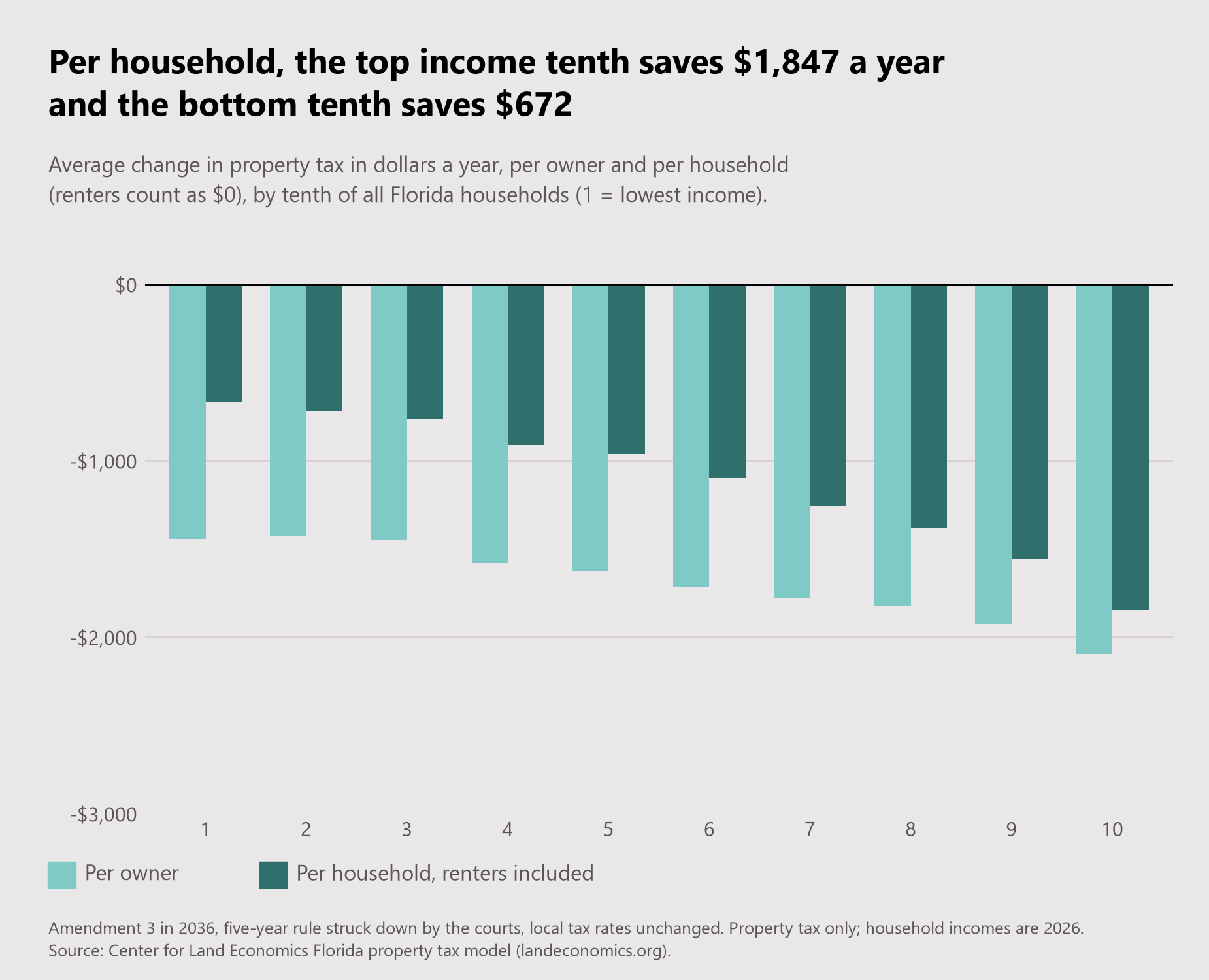
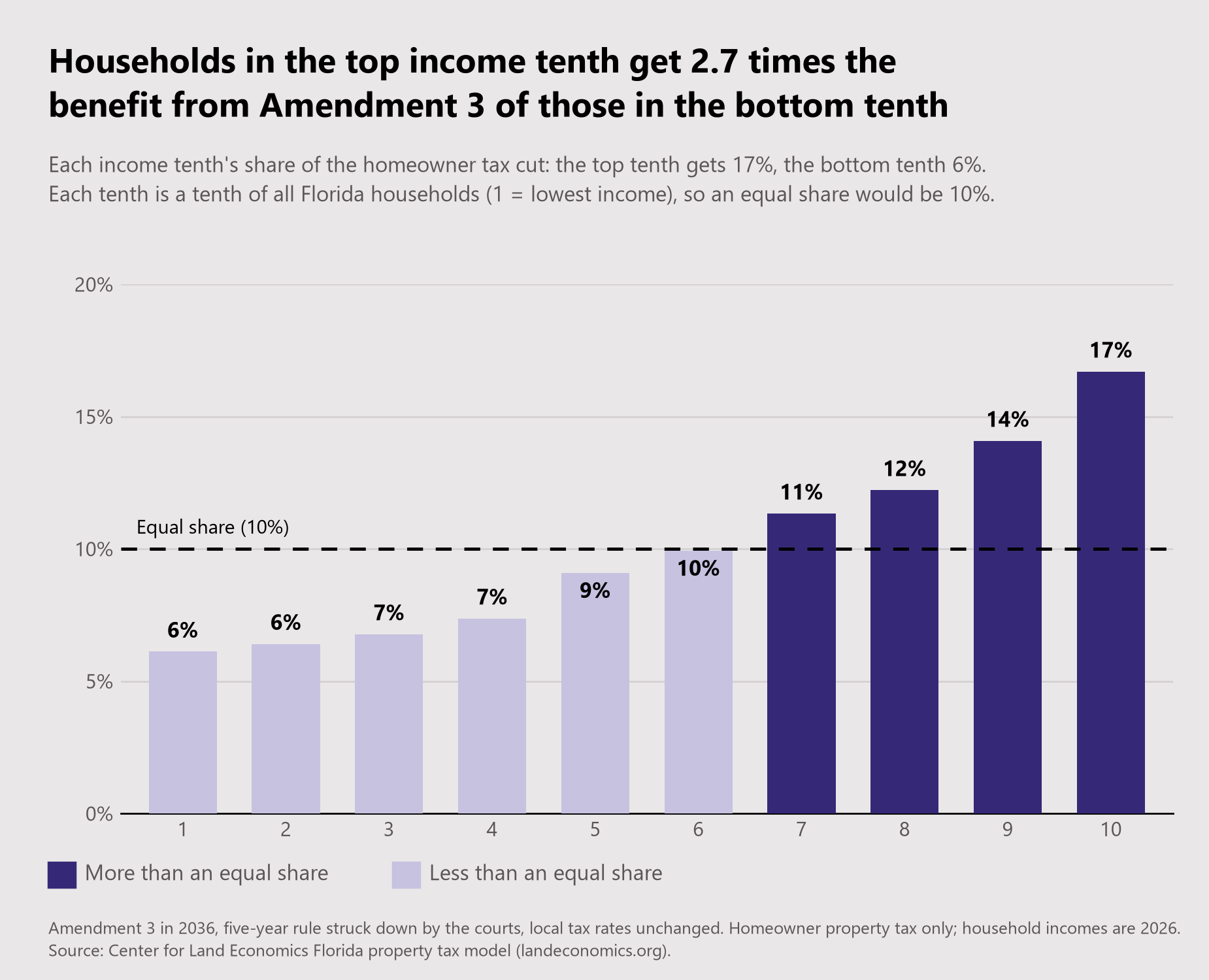
Amendment 3 hurts local governments, but who does it help? According to the numbers, the wealthy. While all homeowners would pay less in property taxes before adjusting for additional taxes that plug the gap, the rich would save the most. For every $10,000 saved via this amendment, the poorest decile of households would only save $672 in 2027, while the wealthiest decile of households save $1,847. However, those savings wouldn’t be free: whatever replaces the revenue would be regressive, so the amendment amounts to a transfer of wealth from the poor to the rich.
Also, we recently covered studies about how low property taxes discourage home sales, both by raising selling prices and reducing the cost of holding onto housing. This means that the disproportionately older cohort who already owns property will continue holding even if they would otherwise want to sell, while younger Floridians get locked out. A study by researchers at NYU, CUNY, and the NBER found that doubling the amount of property tax led to an increase in homeownership among those aged 25-34 by 4.3 percentage points. By contrast, lowering property taxes would lead to less homeownership amongst younger Floridians. This is why—as we have also previously covered—many young conservatives have come to the defense of property taxes.
As Saagar Enjeti, a populist right-wing pundit said about cuts to property taxes:
“This is a massive giveaway to the old and it’s an inversion of how politics should exist…They would have no incentive to sell, which actually locks them even more so into housing stocks”
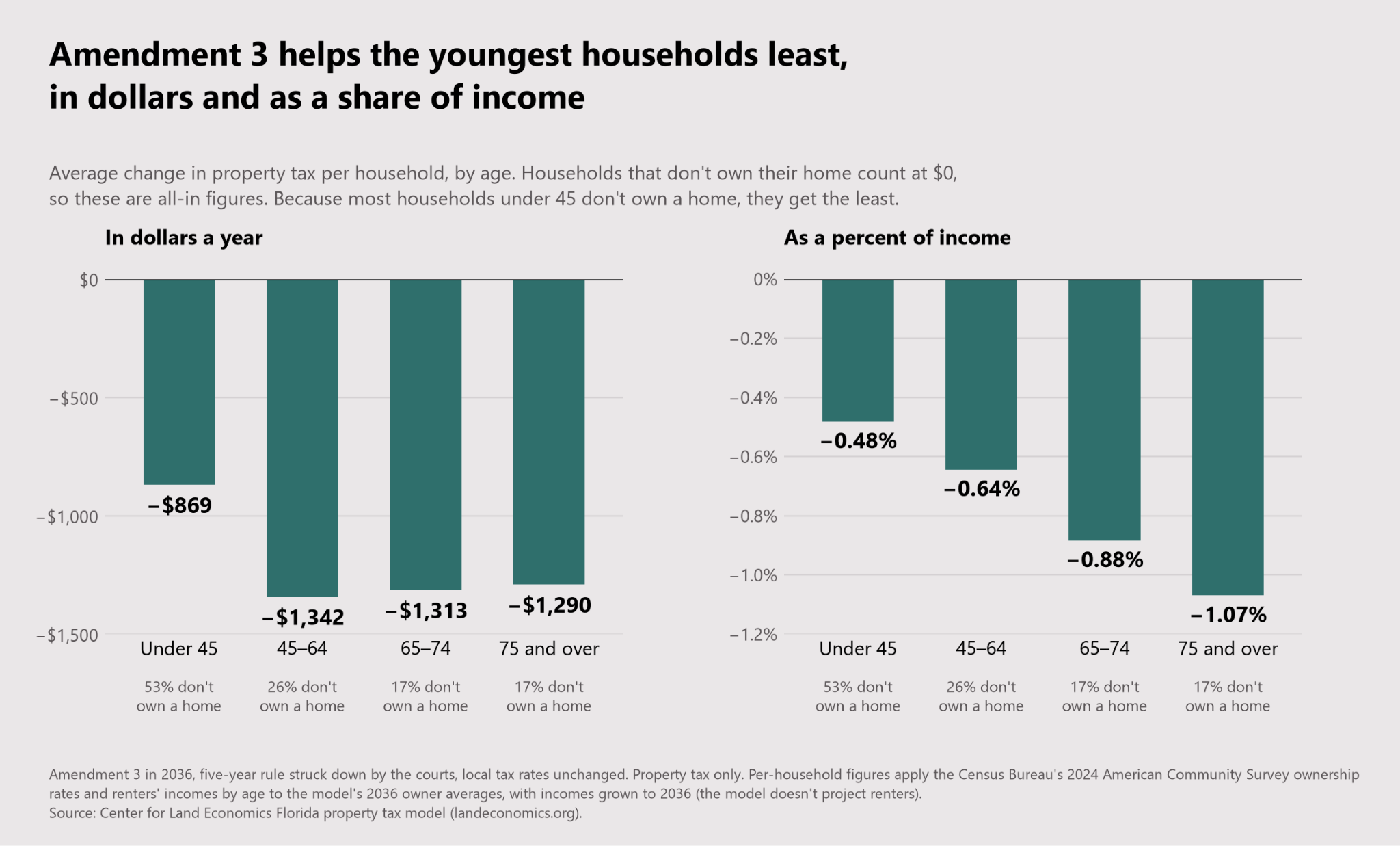
Our model supports the finding that this policy’s savings go disproportionately towards the elderly. The average household over 45 saves about 1.5 times as much money due to amendment 3 when compared with those under 45. Measured against income, Amendment 3’s property tax cut grows with age: in 2036 it is about 0.48% of income for owners under 45 and 1.07% for owners 75 and over. This means as a share of income, the elderly get nearly double the benefits that result due to Amendment 3.
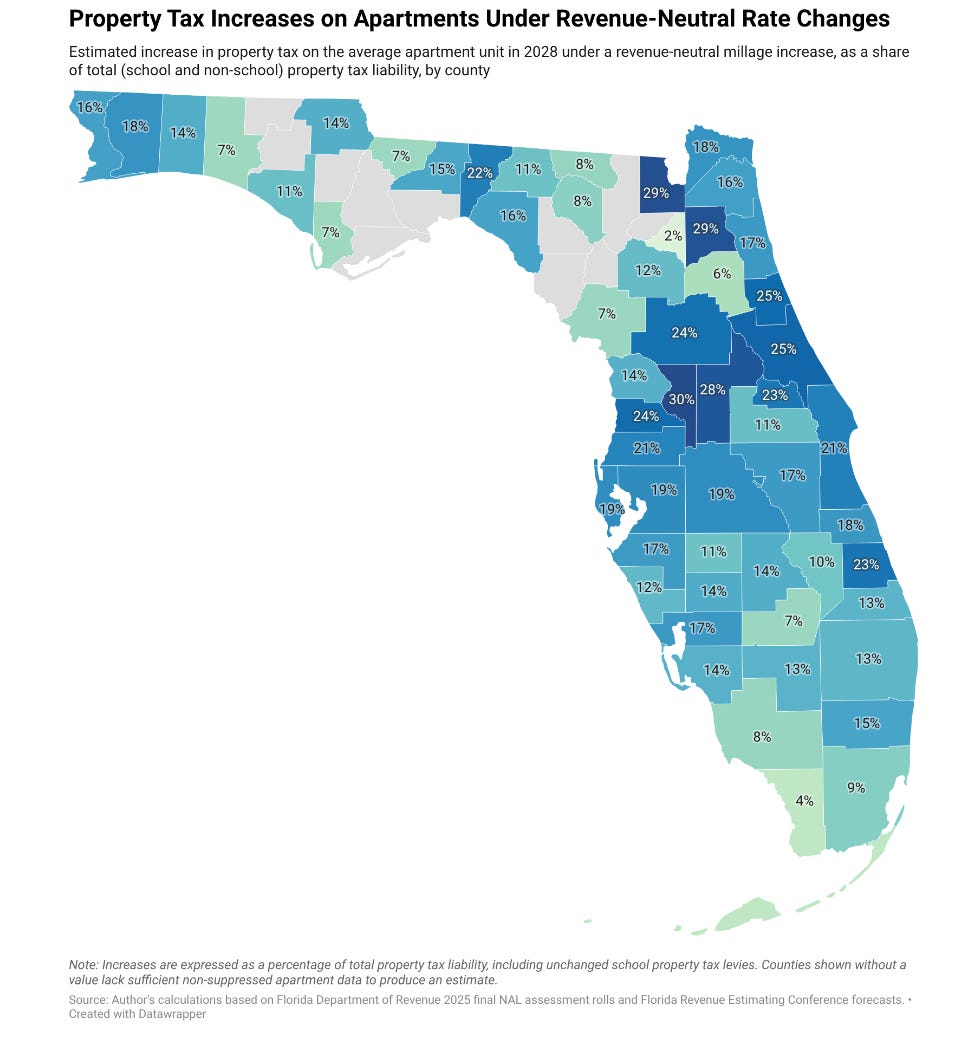
However, this analysis only accounts for the distribution of Amendment 3’s tax cuts, not the distribution of the costs necessary to fill the budget gap it creates. When governments try to fill in these savings with tax increases, younger generations of Floridians will get hurt even more. Sales taxes primarily affect poorer and younger Floridians, who spend more money on consumption, and raising non-homestead property taxes will cause rents to increase, disproportionately affecting the younger renting population. An independent analysis from Jared Walczak shows the estimated impact on shifting the tax burden to apartments, with increased rates in some counties increasing by as much as 30%:
Amendment 3 hands localities a painful deficit in exchange for giveaways which primarily go to the oldest and wealthiest landholders. The existing system, while far from perfect, at least works towards balancing local budgets and sustaining social services for everyone.
Daniel Stein is a Research Intern at Center for Land Economics and an undergraduate Economics major at Stanford University. Lars Doucet is the president of research & development at Center for Land Economics.
It is unclear how strongly this actual restricts local spending, and to what degree “operations and administration” serves as a loophole.
"An independent analysis from Jared Walczak shows the estimated impact on shifting the tax burden to apartments, with increased rates in some counties increasing by as much as 30%"
A pure land value tax should be able to be passed through to renters. Can you explain how the property tax increase *is* passed through?
The answer is large cuts. Your definition of "waste" is insufficiently expansive.