


Through December 1st, the first $25,000 of all collected donations will be matched.
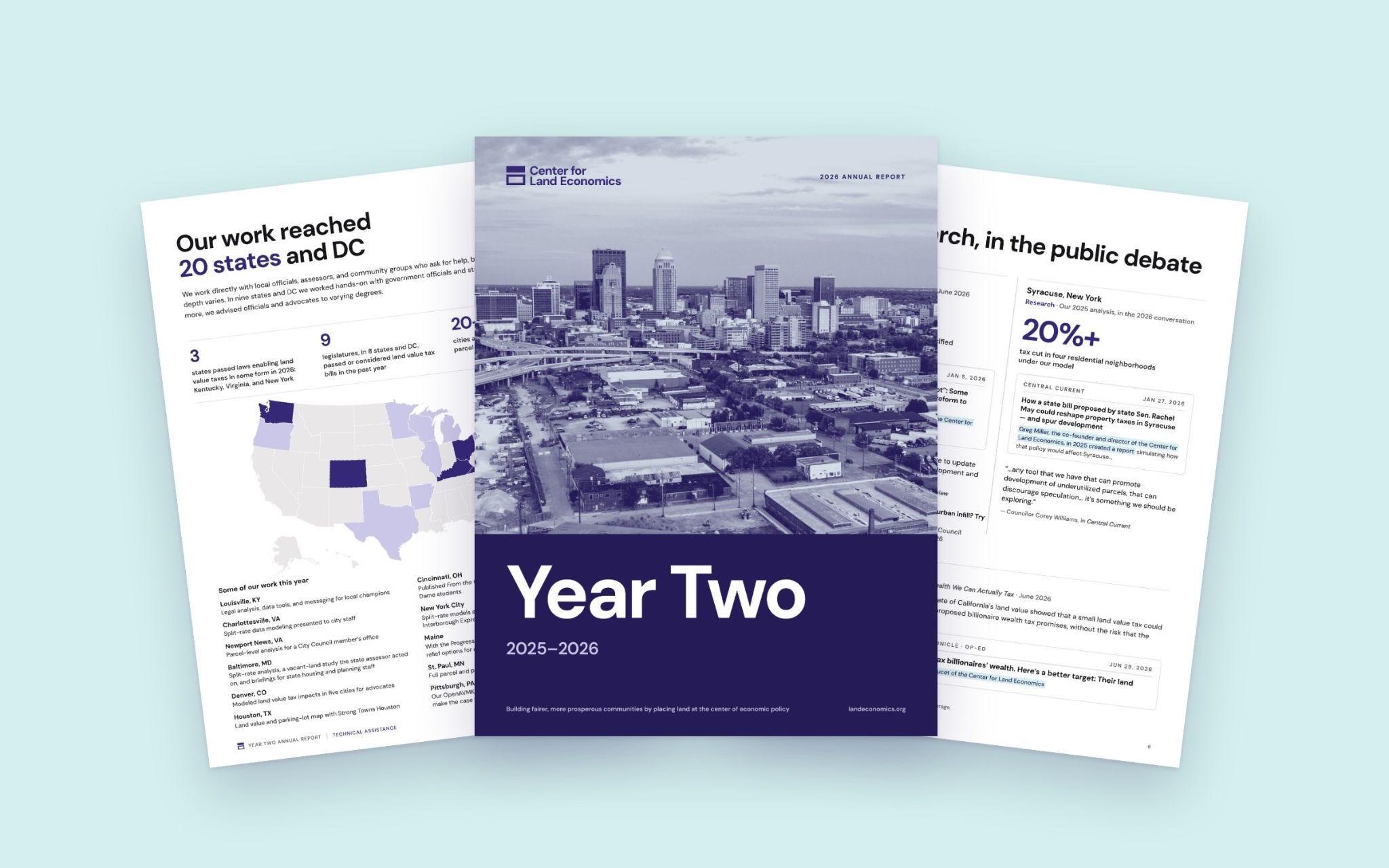
As of this week, the Center for Land Economics is two years old!
Over the last two years, we have kept one mission in mind: returning the value of land to the public. In practice, this means making land value tax reforms popular and practical.
Our focus is counter-factual impact: things that wouldn’t have happened without us. This means we are not content with pumping out a few whitepapers a year and watching quietly from the sidelines. Instead, we’re working with changemakers across the country, where our research is directly pushing the conversation forward.
Our first year report covered our foundational achievements which set the stage for this year’s. It’s hard to overstate what our tiny team has managed to accomplish in just two short years, especially on such a small budget. For the full picture, please read our Year Two Annual Report, released today. The report is short and includes our financials.
We are fundraising
Of course, we’re fundraising, and we’d love your help. We’ll just say it upfront: we need more money to fund the scale of our impact and scope of our mission.
The first and easiest way to support us is to donate through clicking this button:
You can donate via card, bank transfer, Apple Pay, Google Pay, PayPal and Venmo, and there’s a recurring donation option. Your gift will be matched. Generous supporters have offered to match every gift, dollar for dollar, up to a total of $25,000, through December 1st, 2026.
The second way you can help is to tell all your friends. Please share our donation link and Year Two Annual Report with anyone who might be interested.
How we got here
People often ask how we created CLE. Starting a nonprofit is pretty easy: we threw a logo together and filed some legal paperwork, and all of a sudden we existed. The much harder task was getting the world to actually take us seriously.
We announced CLE on this Substack in February 2025, and committed to a weekly posting schedule, before we had any accomplishments to write about. At that stage, CLE still was just two people—Greg and Lars—on a mission, with barely any gas in the tank: we had a small initial grant from Astral Codex Ten, but spent it quickly.
Frankly, for most of the last two years we’ve been working hard just to stay alive. For many months we worked without pay, and for nearly all of last year, Greg picked up a whole second day job, all while putting in 40+ hour weeks for CLE. In June, we finally took the big leap; Greg quit his day job (effectively cutting his own take-home pay) to dedicate himself to the CLE full time. Then in September, we brought on Jeff Fong as our Head of Policy and Partnerships, growing the CLE to three full-time staff.
We know that we can only complete our mission by growing our talent and resources. More hands and more support will deliver more tangible results, more quickly than anyone expected.
We have been able to get as far as we are today thanks to the support of our generous donors. We hope you’ll consider joining us as we continue on this journey.
What we did this year
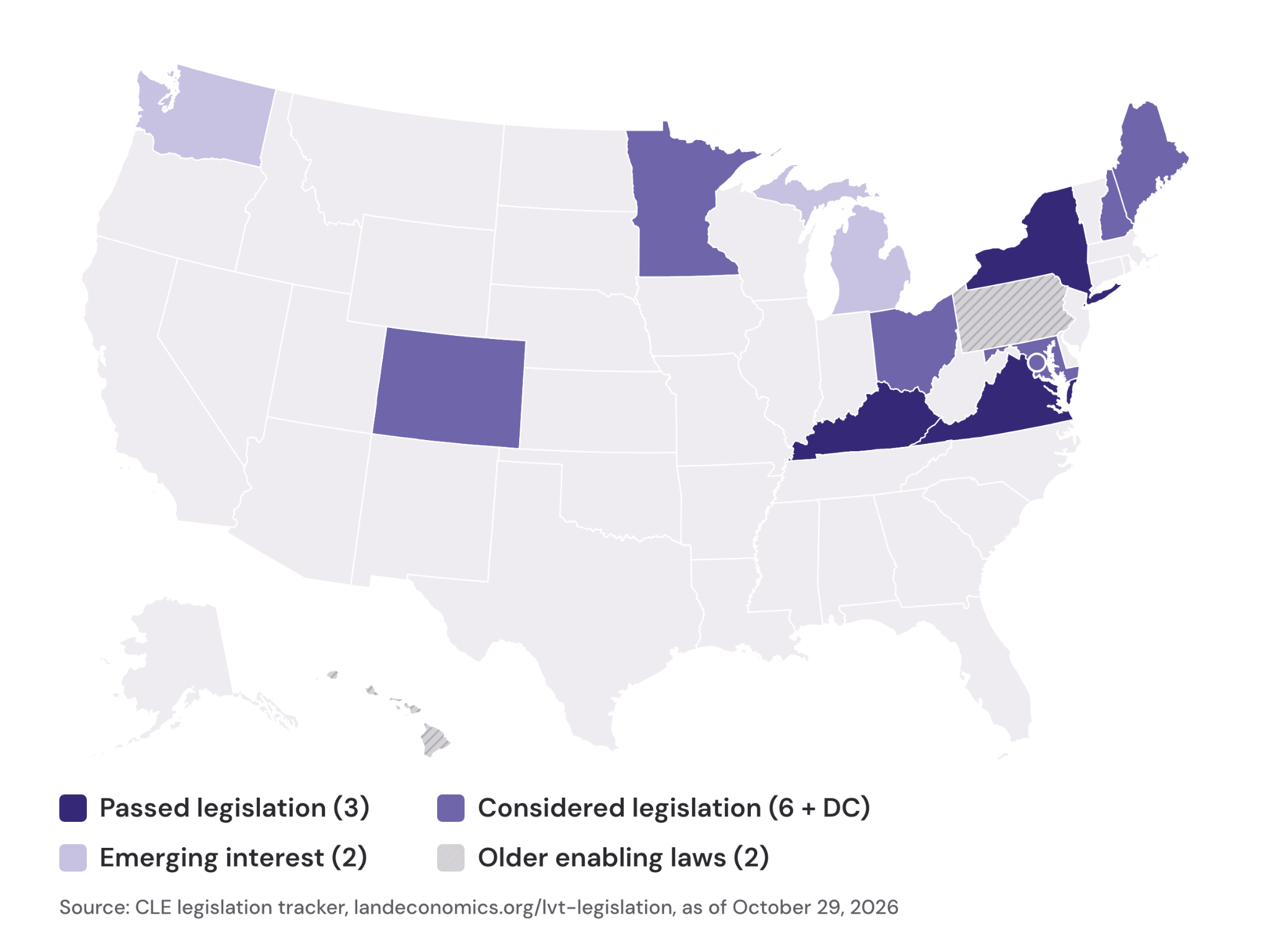
Three states passed laws enabling land value taxes in some form: Kentucky, Virginia and New York. In each of them we’re now helping cities work out how to put them into practice. Five more states and DC considered similar bills. This is the most legislative momentum the movement has seen in decades, and you can follow it all on our legislation tracker.
Kentucky’s interest started with a reader of this blog. Jackson Arnold, a Louisville resident, found CLE through this Substack and our LVT Landscape Live webinar. He led most of the ground work, and we supported him with data tools, messaging support, and legal analysis. Meanwhile, he engaged with local officials to produce actual legislation. HB 607 became law in April, which enables Louisville to implement a land value tax shift.
“CLE helped me craft the talking points and data that spoke directly to policymakers, and prepared me for every objection. Their groundwork paved the way for our lightning-fast win.” - Jackson Arnold, Louisville
Most of our work now comes from similar inbound sources. Someone reaches out, and we help them directly with knowledge, research, tools, and expertise. We worked alongside and built relationships with government officials and staff in nine states and DC, and more than 20 cities and counties received parcel-level land value tax shift models from us.
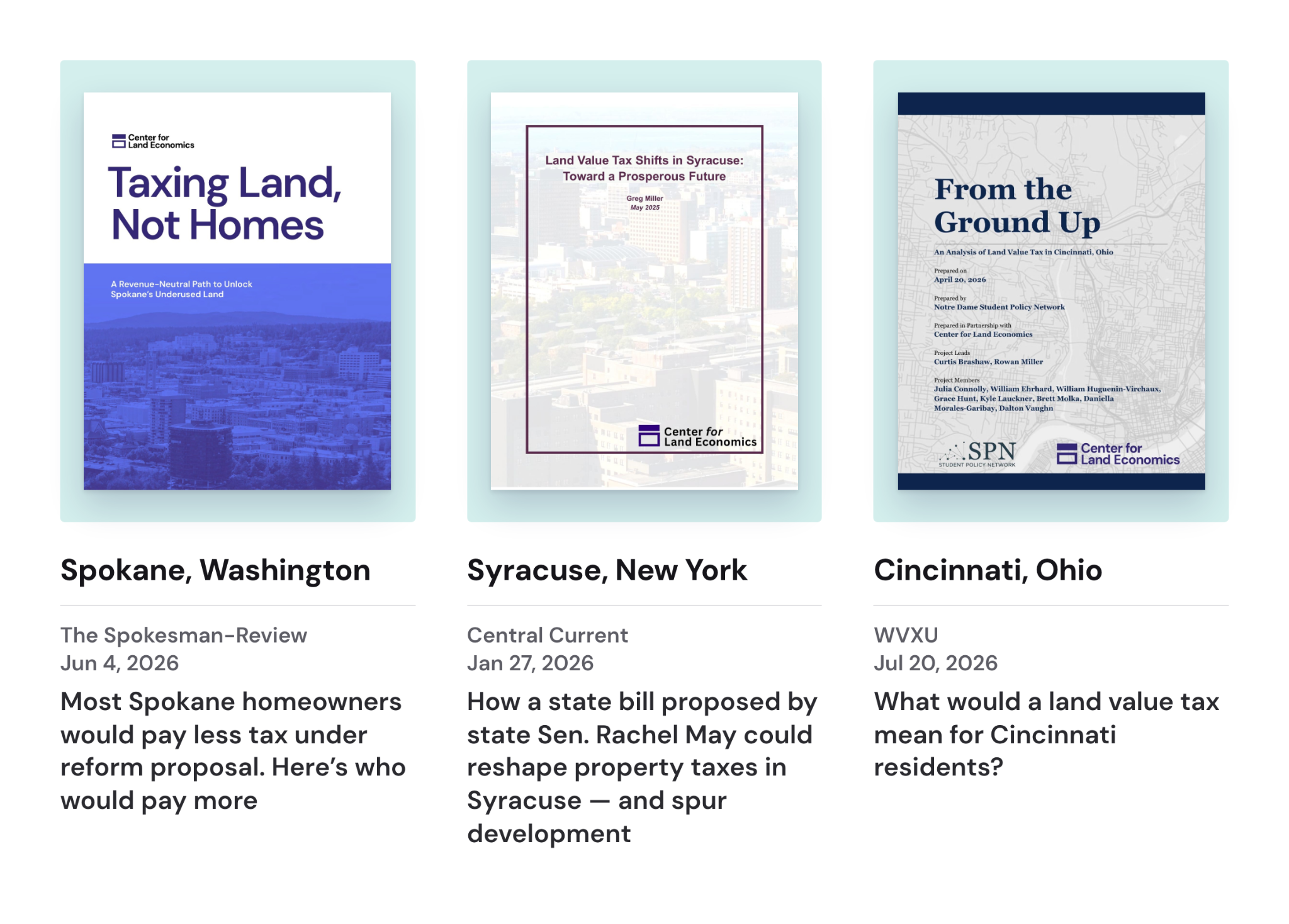
Elected officials are now taking up revenue-neutral land value tax shifts. We have been working with elected officials across the country; here are just a few examples of some who went on the record when we released a report:
“[A land value tax] is another tool we have to update our tax code in order to incentivize development and disincentivize prospecting…”
— Washington State Rep. Natasha Hill, in the Spokesman-Review, on our Spokane analysis
“…any tool that we have that can promote development of underutilized parcels, that can discourage speculation… [land value tax is] something we should be exploring.”
— Syracuse Councilor Corey Williams, in Central Current, on our Syracuse report
“If you tax improvements less, you get more improvements, which is good.”
— Ohio State Sen. Bill Blessing, in WVXU’s coverage of our Cincinnati report, written with Notre Dame students
A few more highlights of our work this year:
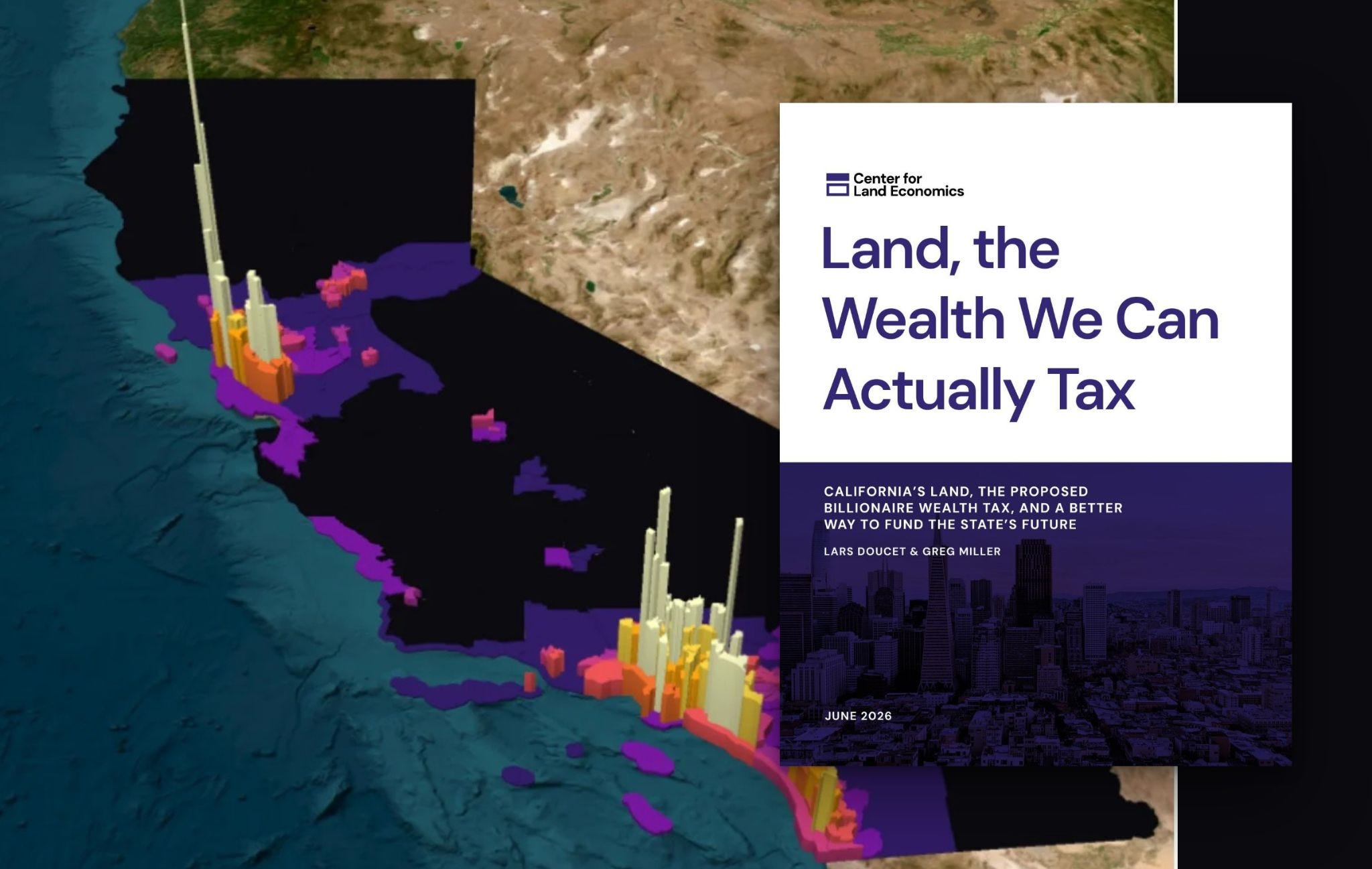
California. We estimated the total aggregate land value of all parcels in the state and found that a small land value tax could easily match the amount of revenue proposed by the billionaire wealth tax, without any risk of capital flight. Read the report, plus our two San Francisco Chronicle op-eds: on the billionaire tax and on Prop 13.
Baltimore. Our 2025 study found the city’s vacant land was badly undervalued. The state assessor has since revalued 11,539 vacant properties. That added $159 million in land value to the rolls from the third of the city reassessed so far, with about $480 million projected over the full cycle.
Testimony. Across the country, we are also called upon for our expert testimony. Lars testified before the DC Council on its land value assessment bill, and I testified before Maryland’s task force on county and municipal revenue.
There is so much more work we do behind the scenes. We are in conversations everywhere trying to make land value tax popular and practical. From group chats and conference lobbies to legislative hearings, we’re there, spreading the message, listening to skeptics, answering questions, and responding to objections. This quiet, patient, and often behind-the-scenes work is what lays the foundation for real material outcomes.
Our tools
We don’t just sling words; we also do the work. We’re building free and open-source tools that are increasingly being used by officials and advocates across the country.
OpenAVMKit, our mass appraisal software, is now used by the Lee County, Florida Property Appraiser to build some of its models. In October, Lars and John Kossa, Lee County Property Appraiser’s data scientist, presented at IAAO, the annual assessor’s conference.
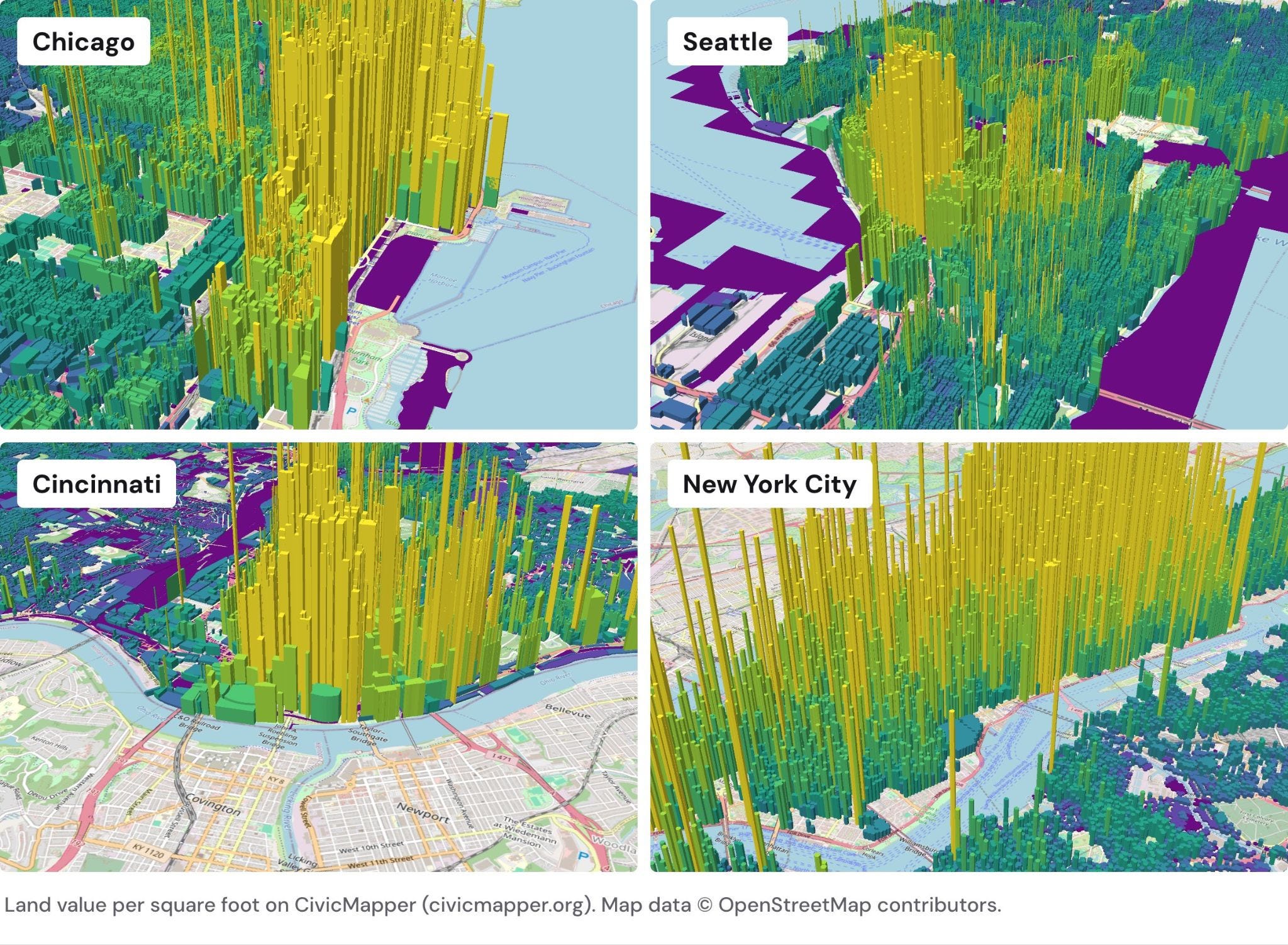
CivicMapper, our free and open source 3D land value map visualizer, went from 3 cities to over 40 since we first launched it here last December. Several cities were added by outside contributors.
LVTShift, our free and open source tax shift policy modeler, has now modeled 20+ cities and counties; we’ve also added instructions for how you can vibe-code your own. Local officials are now using this tool to better understand their own cities and the impact of different LVT Shift scenarios.
Writing
This Substack has been and remains core to our work, an essential channel keeping up momentum on LVT. This year, it grew from 5,500 readers to more than 7,250. Some of our most popular posts from the last twelve months include:
And in September, Lars returned to Astral Codex Ten (where a lot of the momentum for LVT and the seeds of CLE were first planted): with his long awaited follow-up article, Does Georgism Work? Five Years Later.
Consider sharing our Substack:
Beyond the blog, we helped spread ideas concerning land policy to many different venues. We had 30+ press stories, podcasts, and op-eds, and gave 15+ talks at events and conferences, from Strong Towns National Gathering to Progress Conference. Each of these was an opportunity for us to platform land value tax shifts.
Give the Gift of Georgism
While our Year Two Report covers everything we’ve achieved in even greater detail, it also tells the story of how capital efficient we’ve been in our second year of operation and makes the case for how much more we could be doing with increased funding.
From November 2025 through October 2026, we spent a total of $196.8K; three-quarters of our spending goes to salaries. All the results we’ve gained so far were paid for with this budget, and that’s with Greg intentionally foregoing a CLE salary for six whole months. While we’re proud of what we’ve done and how little we did it with, such a budget could not be sustainable in the long term.
Over the same stretch, we raised $409.8K, nearly a third of it in September. After this year’s expenses, a little over $210K is left.
Our costs have changed. At the start of 2026, we were paying one full-time salary; we are now paying three. Beyond salaries, our budget must also pay for travel to the cities and states where the work is happening, the programs we run, and the administrative costs of keeping it all alive.
Our goal is to raise $500K for 2027 by December 31. This covers the salary of the three of us through next year and into 2028 with a few months of runway, so we can spend 2027 focused on the work.
Of this $500k goal, we already have $250K committed. So we are halfway there.
Right now, the first $25,000 donated through December 1st will be matched by generous supporters, so every dollar you give before then counts twice.
If we go past $500K, every additional dollar goes to growing our impact through growing the team; there is no shortage of important work in this space.
Demand for our work now outpaces what three people alone can do; we are therefore pursuing a model where a small core team empowers and multiplies the efforts of every local champion who reaches out to us. More support will let us:
Say yes to more champions. Every month we hear from elected officials, assessors, and advocates who want help understanding their city’s land and are interested in land value taxes.
Develop more tools. Our tools are informing the conversation in localities across the country, we have a lot more to do on this front.
Do the research. There are a large list of foundational research questions we are interested in pursuing. For instance, we are preparing a large report on land valuation and preparing more research down the line.
There is no shortage of work to be done to bring good Georgist principles to life. At minimum, we want to keep doing the great work we are already doing; at maximum, we want to double down, expand, and transform this burgeoning movement into a true revolution.
You–yes you–can make that possible, and every little bit helps. Until December 1st, every dollar you donate directly is matched, up to $25,000. A $5 gift becomes $10, a $50 gift becomes $100, a $1000 becomes $2000, and so on:
Donate now and double your gift
Frequently Asked Questions
Is my donation tax-deductible?
Yes. The Center for Land Economics is a 501(c)(3) public charity, EIN 39-3672325. Donations are tax-deductible to the extent the law allows, and gifts made by December 31 count toward your 2026 taxes. New federal legislation means that even if you don’t itemize, you can still deduct up to $1,000 in cash gifts to charity ($2,000 for married couples filing jointly).
I can only give a little. Is that still worth it?
Yes; small dollar donors matter more than you think. To stay a public charity, we have to show the IRS that we’re supported by a broad base of the public, not just a few large donors. Every gift counts toward that test, even $5. Small-dollar donors are a big part of how we meet the public charity test.
I have a corporate matching program. Will it work?
Yes, any corporate matching program should work. Look us up in your company’s giving tool (Benevity, YourCause, Bright Funds or whatever it uses) under “Center for Land Economics, Inc.” or EIN 39-3672325. If we’re not listed, tell us which tool your company uses and we’ll get ourselves added. Read more on our donation page.
I’m giving through a donor-advised fund. What should I do?
We’re already set up on multiple DAFs. Search for “Center for Land Economics, Inc.” on your fund’s website; giving there costs us less in fees than the donate button. If you’re donating through a DAF, we encourage you to also reach out to Greg so that he can confirm receipt, but please also reach out in the case that your fund can’t find us listed. Shoot an email to greg@landeconomics.org and we’ll work it out with you.
I want to give stock. What should I do?
Giving appreciated shares directly is usually a better option than selling them and donating the cash. Email greg@landeconomics.org and we’ll send instructions.
I’m considering a large donation. What should I do?
If you’re considering a large gift and want to talk it through, email Greg at greg@landeconomics.org. If you want to know exactly what your money will pay for, just ask and we’ll be happy to tell you in great detail.
I’m not donating, but I support land value taxes. What can I do?
Get involved! If you’re a local changemaker, reach out to Jeff Fong, our Head of Policy and Partnerships, at jeff@landeconomics.org, so we can grow the map of land value tax legislation.
I want to get involved in your open source work. What can I do?
Reach out to Lars Doucet at lars@landeconomics.org, or join the OpenAVMKit discord, there’s an invite link at www.openavmkit.com.