


Welcome back to the 11th edition of Landscape. First things first, it is Thanksgiving week, so:
Happy Thanksgiving!
There’s a lot to be thankful for in momentum on land value taxes this year. In this Landscape, I look at election results and how land value tax legislation is gaining momentum across the country and beyond. Most state sessions have been out, but a lot of groundwork is being laid for the year to come.
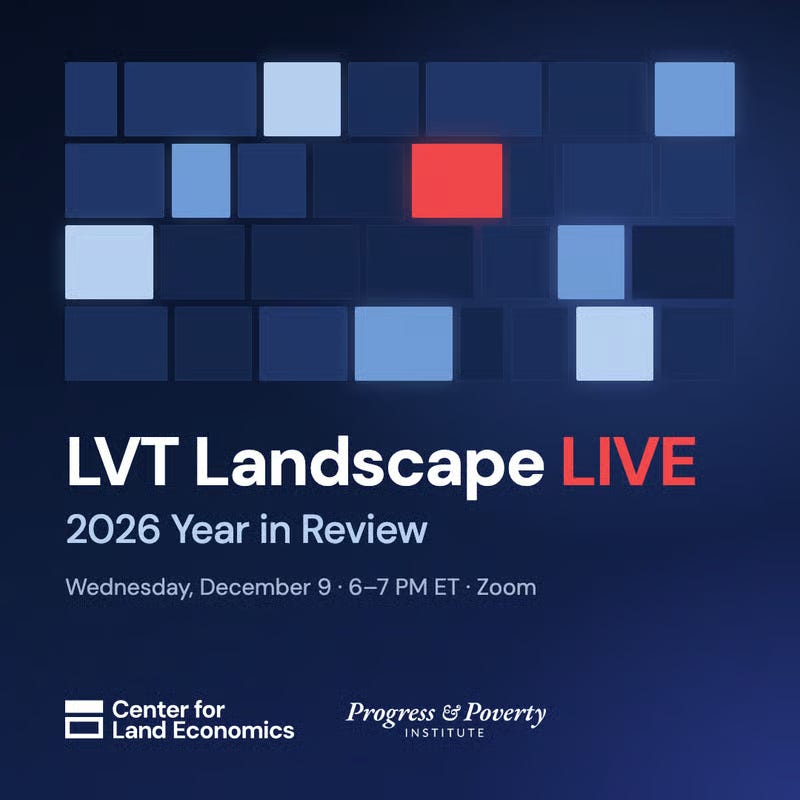
Join us December 9 for LVT Landscape Live: A year-end roundup
It has been quite a year for land value taxes. Kentucky and Virginia passed new enabling legislation, and New York extended its authority to fund transit through land value tax. Our legislation tracker now covers 13 states and DC, spanning new laws, recent bills, emerging efforts, and older enabling authority.
On Wednesday, December 9, 2026, at 6:30 PM ET, the Center for Land Economics and the Progress and Poverty Institute are hosting the third edition of LVT Landscape Live. Join us for a webinar reviewing where land value tax stands right now across the country and how we hope to continue the momentum in the 2027 legislative cycle. You can expect:
An insider look into all states considering LVT, where I try to give you all the download on all states considering LVT, including: a look back at every state LVT bill from 2026 and which bills passed, which didn’t, and where the holdups are on state bills and on local implementation.
A discussion of the roadblocks we keep encountering, from state constitutions and land assessment to messaging and organized opposition, and how to get past them in 2027.
A short international update, including the UK’s new Prime Minister, Andy Burnham, who has supported LVT, and New Zealand’s Opportunity Party, which campaigned on LVT and won entry to Parliament in November.
Live Q&A.
Can’t make it live? Register anyway, and we’ll send you the recording.
Now, on to updates from across the country.
LVT in Minnesota
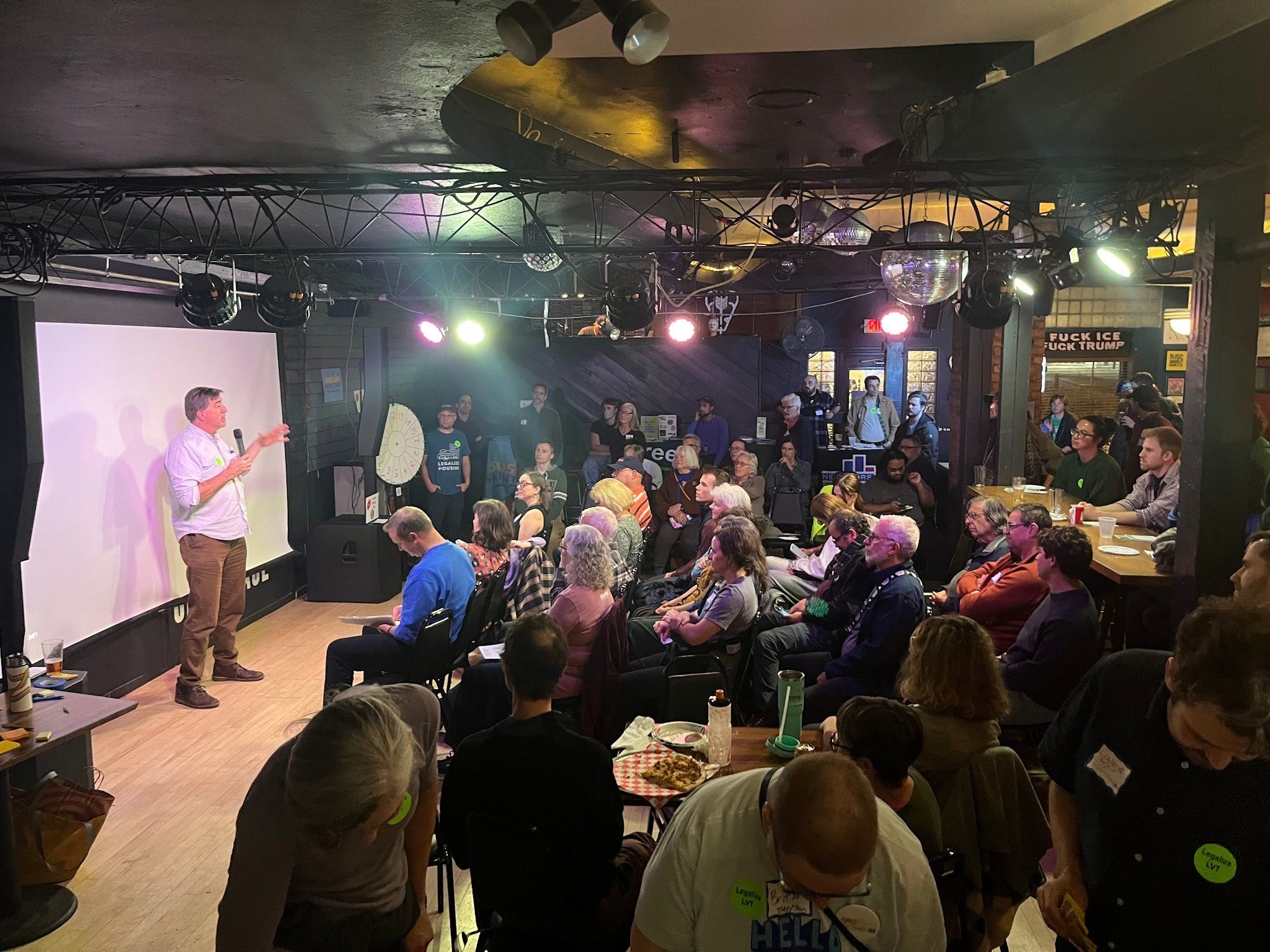
In Minnesota, Representative Steve Elkins promised to reintroduce land value tax legislation on the first day of the January 2027 legislative session. Local advocates recently gathered at an LVT event in St. Paul organized by Sustain Saint Paul, Neighbors for More Neighbors, the Sierra Club North Star Chapter, Our Streets, and the Bicycle Alliance of Minnesota, where Elkins spoke about the growing support for the policy.
The idea already has support across Minneapolis. In the 2025 mayoral race, Mayor Jacob Frey and runner-up Omar Fateh both supported piloting a land value tax for Minneapolis. Fateh, though he lost the race for mayor, is still a state senator and is the lead author of SF 1422, which would let cities create land-value taxation districts. Elkins is the lead author of its House companion, HF 161.
Elkins told the crowd, “More and more people are getting it,” and added, “Keep your fingers crossed, but I think this could be our year.”
Streets.mn, an urbanist blog in Minnesota, also recently released an explainer on how a land value tax would work in St. Paul’s Midway, showing how a shift could change the incentives around vacant and underused land.
Washington, DC lays the groundwork for LVT
Our nation’s capital has been considering ways to raise revenue and stabilize its finances. Among those proposals is legislation introduced by Councilmember Brianne Nadeau that would set land valuation standards. B26-0777 would require land to be valued as if vacant and available for its highest and best use, and require separate testing of the land component of assessments.
The proposal has attracted support from influential local policy voices. Greater Greater Washington, a respected regional advocacy organization and urbanist publication, testified in favor of exploring a land value tax shift. Nick Johnson of the Institute on Taxation and Economic Policy (ITEP), a progressive tax policy think tank, also told the Council that LVT could advance economic development goals and that better land assessments would help determine its distributional effects.
Lars testified on October 16 in support of reforms allowing quarterly property tax payments and setting better standards for assessing land separately from buildings. He also encouraged the Council to adopt standards that rely less on vacant-land sales and make use of methods like teardown sales, land residuals, and income approaches.
This legislation could set an important precedent for assessment reform across the country. Land valuation is central to mass appraisal, yet there are no set standards and routine checks of land valuations themselves. Instead, in cases where states do mandate checks and valuation standards, they only apply to total property values. With the refinements CLE has suggested, DC could require clearer valuation standards, public reporting, and tests of accuracy and fairness for the land component itself. Those reforms would help improve assessment equity whether or not DC ultimately adopts LVT, and could provide a model for other states.
Momentum across Virginia
As many readers of this blog know, Virginia recently authorized four more cities to adopt split-rate taxation: Charlottesville, Falls Church, Fredericksburg, and Newport News. They joined Fairfax, Poquoson, Richmond, and Roanoke, bringing the total to eight cities with authority under the Virginia Code.
Now, Alexandria’s draft 2027 state agenda seeks the ability to tax land value locally. Alexandria is outside the eight cities covered by current law, so it would need the General Assembly to grant authority first. This shows the increased appetite for authority to implement land value taxes as other cities gain the ability themselves.
Meanwhile, Roanoke elected Danny Clawson to City Council. Clawson centered homelessness in their campaign, and plans to push for a land value tax to better use vacant lots and increase housing supply.
Roanoke Mayor Joe Cobb also recently told WDBJ that the Council has discussed LVT. Roanoke already has the authority to tax land, so it can pursue a split-rate shift locally.
For the broader Virginia case, Michael D. Riha argues in The Virginian-Pilot that local tax systems need structural reform, including a shift toward land value taxation.
Returning to Michigan
Former Detroit Mayor Mike Duggan famously pushed for an LVT in Michigan. His efforts stalled at the State House, where it fell one vote short of the support needed. We expect Michigan to revisit the idea in the next year or two.
Detroit’s former budget director and deputy CFO, Steve Watson, recently appeared on Daily Detroit to discuss how to make the city more affordable. Land value tax makes up a core part of his property tax reform roadmap. He argues that shifting taxes from buildings to land could lower the burden on homeowners while asking more of speculators, scrapyards, and surface parking lots.
Speaking of land value tax in Detroit, as Watson put it on the podcast, “it’s still a really good idea.”
New Jersey looks to land value return for transit
New Jersey Assemblywoman Katie Brennan, a first-term legislator and urban planner with a background in housing policy, has released an excellent video explaining land value capture: when new transit makes nearby land more valuable, some of that value can help pay for the transit itself.
Her bill, A5386, co-sponsored by Assemblyman Clinton Calabrese, would direct the New Jersey Economic Development Authority to study supplemental transit financing mechanisms, including value capture, ground leases, and other tools. It would also require recommendations and guidance for municipalities. Between her video and her introduction of the bill, she has made quite the splash, including attracting Politico attention.
The idea of land value return to fund transit follows in the footsteps of New York’s Section 119-r, which we covered in Landscape 9. Reed Schwartz and Alex Armlovich’s Niskanen Center piece explains how that authority could help fund New York City’s Interborough Express by returning part of the land value created by new transit to the public.
For more on that idea, Reed also appeared on MTS to discuss funding transit with land value capture, including lessons from Japan and Hong Kong and the fiscal challenges facing American transit.
Baltimore: a high property tax
Baltimore continues to explore shifting property taxes toward land and away from buildings. Its base city real-property tax rate is 2.2%, before homeowner credits and other adjustments, a particularly high rate that makes the tax on new construction and renovation consequential. We have been active in the Baltimore conversations, and work on state enabling legislation continues alongside a much-awaited Maryland Department of Planning summer study report on land value tax. One main hurdle is that the State Department of Assessments and Taxation has put a large fiscal note on any enabling legislation.
The Maryland Center on Economic Policy also includes split-rate taxation among its recommended local revenue reforms, calling for broader county authority.
Building Tales has a great new explainer, “Could a Land Value Tax Transform Baltimore?”, on how a shift could discourage blight and land hoarding while rewarding productive investment.
2026 ballot measures show a mixed bag for property tax revolts
Alongside the main election battles was a fight over a revolt against property taxes. Counter to the mainstream narrative, the results were actually mixed, with several states rejecting anti-property tax measures. Here are selected statewide measures from November 3.
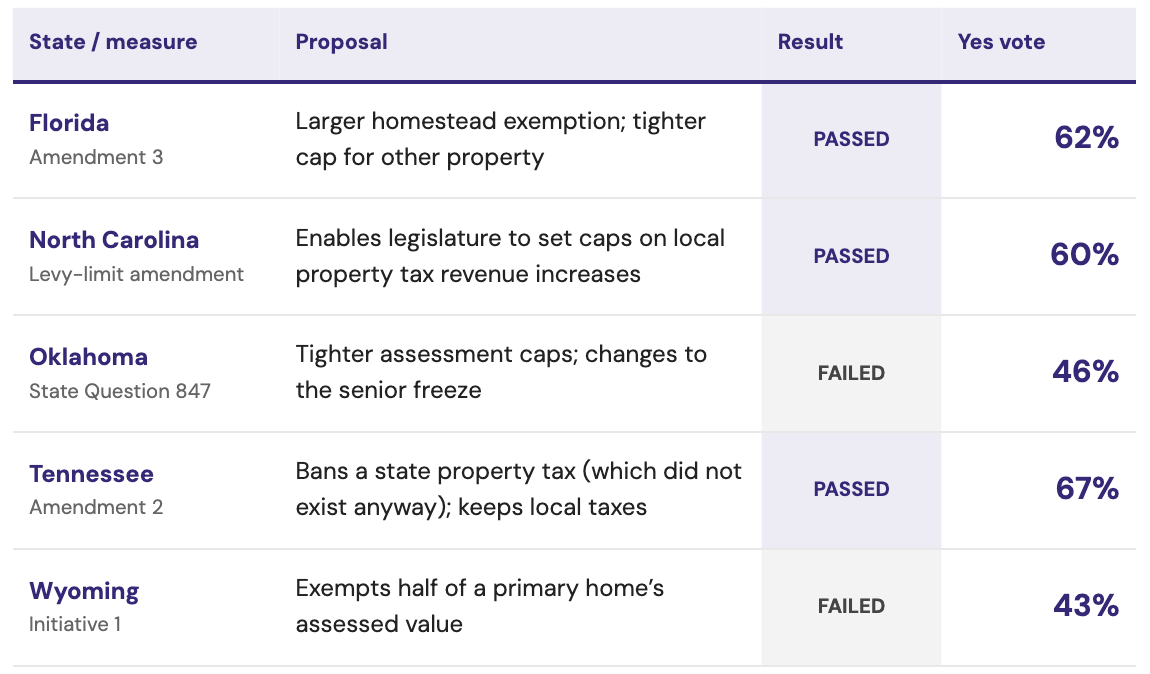
The measure that got the most attention was Florida Amendment 3, which greatly increases the homestead exemption and lowers the assessment-growth cap for non-homestead property. We previously wrote about how it would leave local governments facing major service cuts while distributing benefits regressively. The amendment cleared its required 60% threshold.
Florida is a unique political hotbed for homeowner-focused tax populism (or, perhaps, slopulism). It has a particularly large older population and a long-established politics of protecting homeowners from property taxes. We should be careful about treating its result as a national verdict. Oklahoma and Wyoming, two strongly Republican states, rejected major property tax restrictions. Those results suggest that voters can recognize the importance of property taxes to their communities and local economies.
Importantly, Ohio also had a push for property tax abolition, but despite the strong efforts behind it, the organizers did not even get enough signatures to get the proposition on the ballot.
Lars in the Texas Tribune
Texas is one of the Republican states that has been flirting with property tax relief, up to and including eliminating property taxes. Even with the blue wave, governor-elect Gina Hinojosa, a Democrat, also ran on proposals that include significant property tax relief programs. The Texas Tribune reports that lawmakers are considering renter relief, limits on tax bills, as well as other changes, despite tax experts’ warnings that broad tax cuts will undermine reliable local revenue and shift the burden onto other taxpayers.
Lars was interviewed by the Texas Tribune for this piece and made the case for allowing localities to experiment with LVT. He explained that a shift could lower taxes for typical homeowners and renters while increasing the burden on land-intensive properties. He also emphasized the development incentive: owners of vacant land and parking lots would have more reason to build or sell.
“You really do push the tax burden onto vacant, undeveloped lots, particularly in these city centers,” Lars told the Tribune.
ITEP takes a closer look at LVT
The Institute on Taxation and Economic Policy (ITEP) released “The Promise and Pitfalls of Land Value Taxes: How Smart Policy Design Can Advance Progressive Goals” on November 24. ITEP is a well-respected tax policy research organization whose work is widely used in progressive state policy debates, so its decision to write a report on land value tax is a sign of how far the conversation has moved.
Rita Jefferson, a senior analyst at ITEP, recognizes the potential for land value tax to encourage denser development while discouraging speculation and returning publicly created land value to communities. ITEP emphasizes land value tax as an urban development policy and focuses the report on land value tax shifts within conventional property tax systems, rather than treating it as an additional progressive revenue source.
While the report is more ambivalent about whether a land value tax passed in isolation is progressive (I would maintain it is), it is still useful for showing that even within how we collect taxes currently, we can achieve progressive results. The report cites CLE’s legislation tracker as well as some of our research.
LVT was all over YIMBYtown
Land value tax was all over YIMBYtown in Raleigh. Jeff Fong has a good write-up of the conference, as does Steve Hoskins of the Progress and Poverty Institute.

At the same time, YIMBY Action recently released an LVT policy primer, another sign of how naturally land value tax and urbanism fit together. Lars and I also appeared on Infill with Laura Foote, YIMBY Action’s executive director, to discuss why the policy is gaining momentum and what it could mean for housing.
More LVT momentum
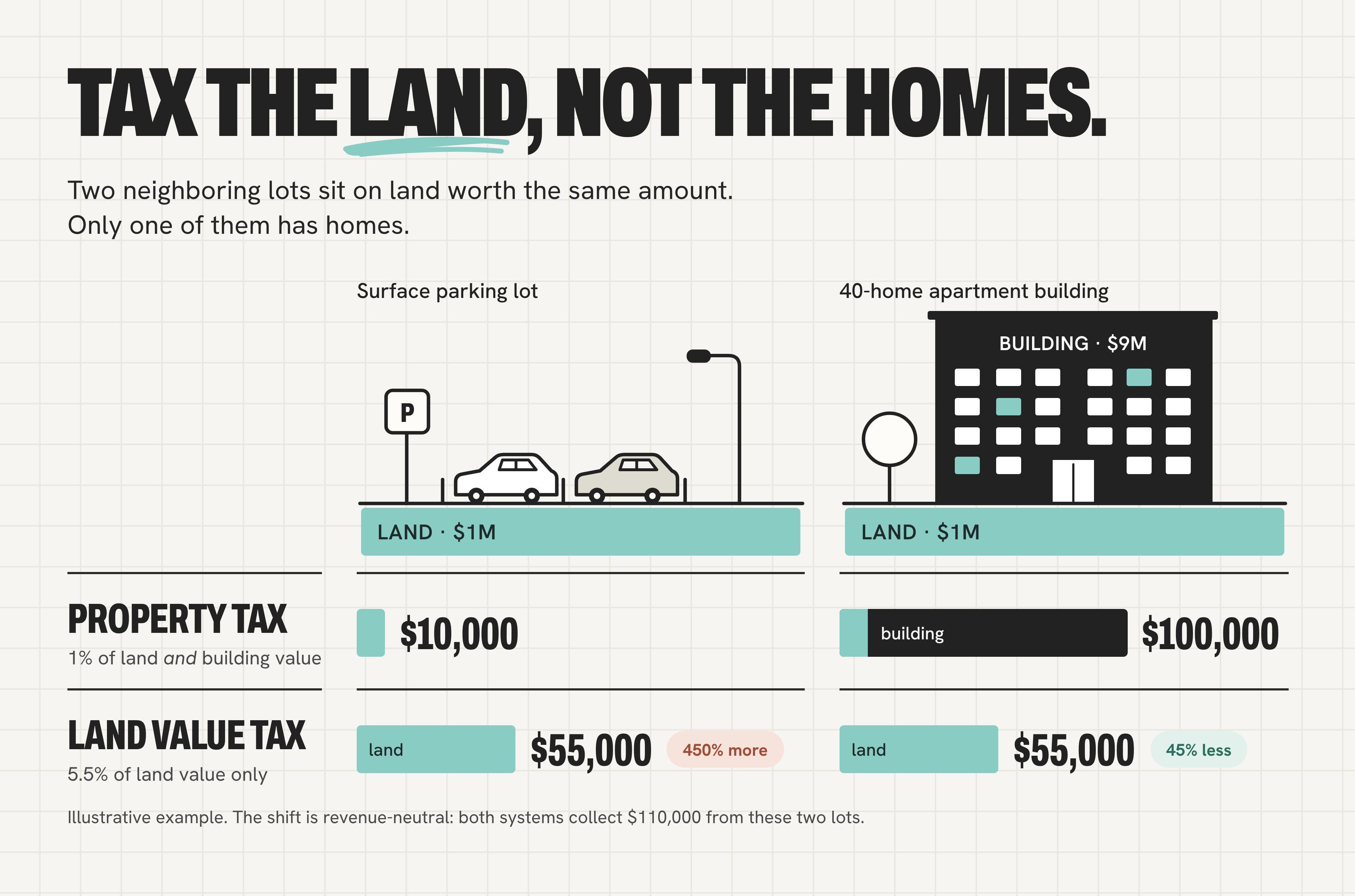
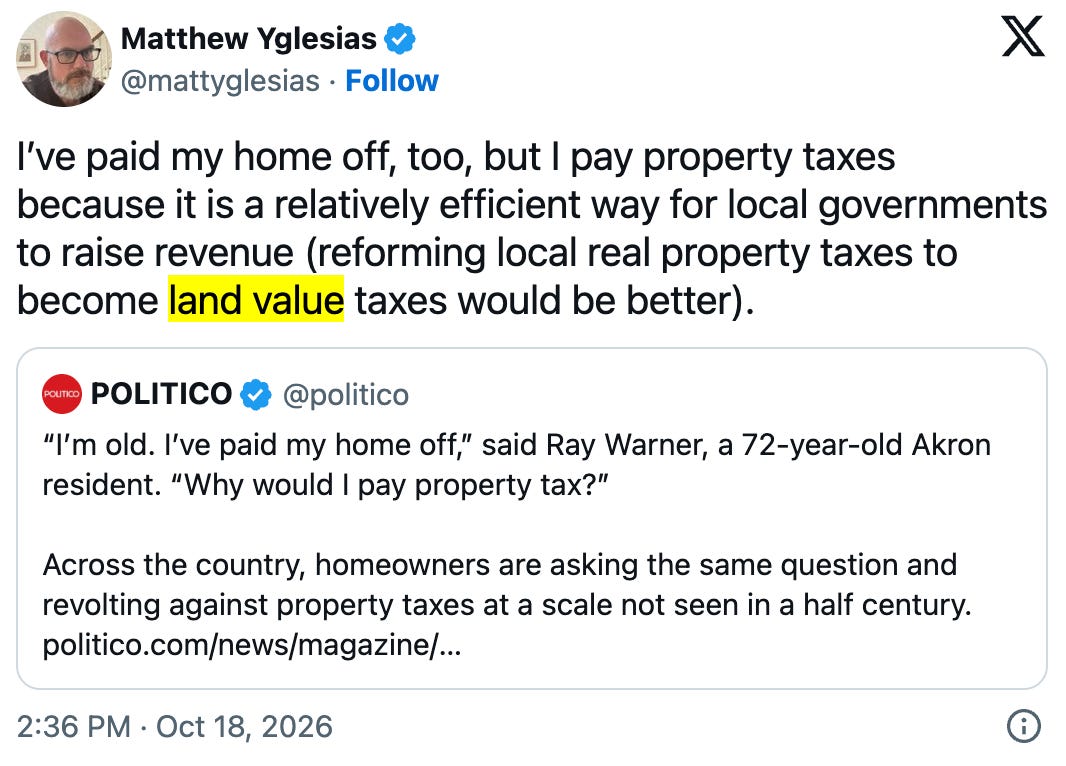
We are seeing LVT become a more regular part of the conversation in policy circles, with more policy writers comfortable discussing it publicly. Matt Yglesias defended property taxes and argued that shifting them toward land would be better still.
Brandon McGinley argues in the Pittsburgh Post-Gazette that restoring LVT could address Pittsburgh’s vacant land and fiscal problems. Pennsylvania already has longstanding enabling authority.
In Providence, Lucas Thompson makes the case for a revenue-neutral shift in “One Solution to PVD’s Housing Crisis? Tax Land More and Buildings Less”. His piece shows examples of how the current property tax system rewards vacant lots and surface parking lots while taxing housing and businesses that the city needs more.
A local Colorado newspaper re-ran a piece by Chuck Marohn, Strong Towns’ founder, from 2019. We figure we should bring it back too, because he makes the case that taxes shape the beauty of our neighborhoods and the way they get built.
A new paper by Paul Forrester at Wharton discusses the environmental case for LVT. Forrester argues that land value and severance taxes can enable green growth, which he defines as “growth that does not require additional resource exploitation.”
Louisville continues to move toward split-rate taxation. WDRB reports on advocates making the case that the policy can address neglected storefronts.
And some international momentum
In Kelowna, British Columbia, Davis Kyle was elected to City Council, placing second among eight elected councillors. Andrew Rose sat down with Kyle to discuss how Georgists can win local elections and summarized some key lessons: build a comprehensive platform, meet voters where they are, and repeat new and unfamiliar ideas.
New Zealand’s Opportunity Party won entry to Parliament in November after campaigning on its three-part Tax Reset, including a land value tax, a Citizen’s Income, and retirement-system reform. Steve Hoskins explains the result and what comes next. Its eventual leverage will depend on final results and coalition negotiations.
The UK’s National Institute of Economic and Social Research discussed LVT as an alternative to a wealth tax for raising revenue efficiently. We also recently covered Prime Minister Andy Burnham’s support for LVT. Arpit Gupta has joined the discussion of how land value taxation could help address Europe’s debt challenges.
Two years of CLE
If you have not seen yet, we released our Year Two Annual Report. Three states passed LVT legislation this year, more than 20 cities and counties received parcel-level LVT shift models from us, and our tools and research are helping turn local interest into workable policy. We’ve also welcomed Jeff Fong as Head of Policy and Partnerships.
Most of our work now comes from inbound requests from advocates and public officials.
If you want to help us keep doing our work that makes LVT reform possible, please consider donating to support CLE’s next year.
Do you follow us on socials?
Jeff: LinkedIn
Have I missed any updates? Or do you see an opportunity for LVT in your area? Reach out: greg@landeconomics.org.
Greg Miller is the Executive Director of the Center for Land Economics. Daniel Stein is a Research Intern for CLE and undergraduate student at Stanford.